At fifteen, Robert Davies went to work aboard an Imperial Oil tanker instead of spending his summer on a baseball diamond. He returned to the ships through every summer of high school. The small blue book that recorded those years survived. It tells us what he did. His family tells us what came after.
Adult historical editionFamily-held evidenceUpdated 29 August 2026
Part I
The Book
A small government booklet survives. Its five rows tell us where Bob worked; its mistakes and faint marks tell us where the questions begin.
The surviving evidence
One line per summer
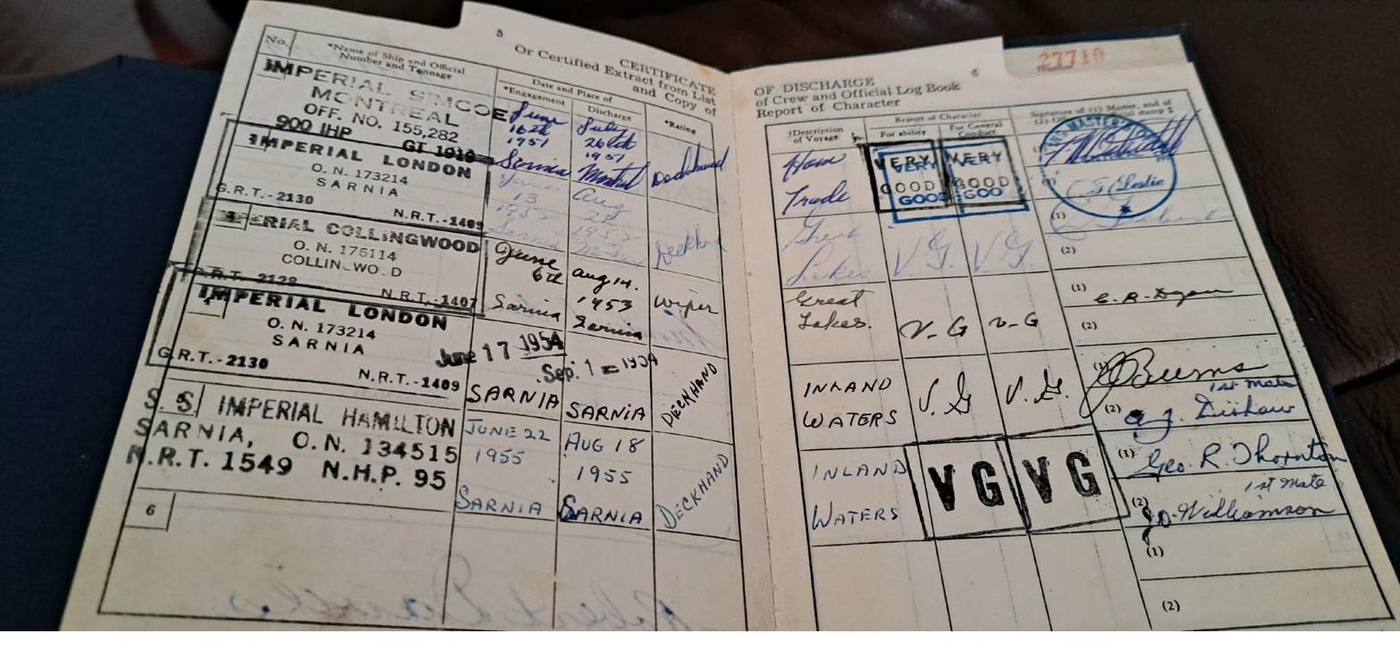
A seaman's discharge book is a plain object. It records a ship, a job, the place a sailor joined, the place he left, and the officer's judgment of his work and conduct. Book 27710 does something more unusual: it preserves nearly the whole of Robert Davies's high-school summers in five narrow rows.
The family knew the book had belonged to Bob. What unlocked it was a note from his eldest daughter, Brenda: these were the ships her father worked on during high school; he did not like spending his summers at sea because he wanted to play baseball; and his father had arranged the work.
That turns a list of ship names into a story. A teenager wanted one life for his summers and was sent into another.
Edward + Eileen Robert’s parents Joan · Ted · Robert · Reg · Diane
→
Robert + Donna married 1957 Brenda · Cheryl · Judy · Sandra → 12 grandchildren
Year
Ship and rating
Engagement
Age
1951
SS Imperial Simcoe Deckhand · Home Trade
16 Jun, Sarnia → 26 Jul, Montreal
15
1952
Imperial London Deckhand · Great Lakes
13 Jun, Sarnia → 22 Aug, Montreal
16
1953
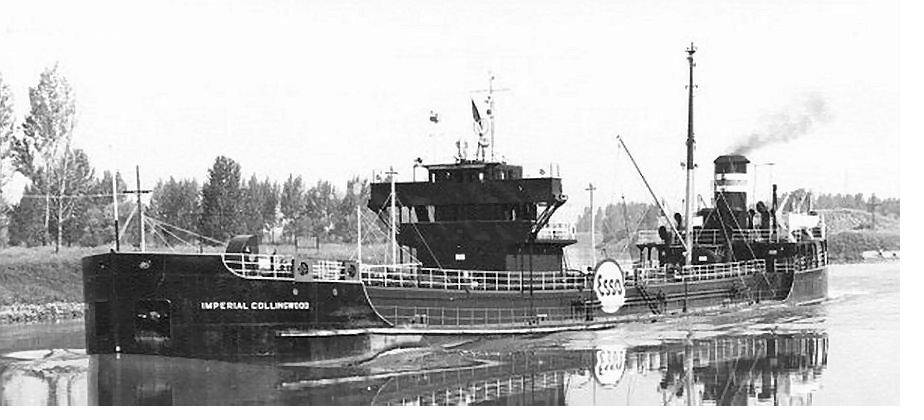
Imperial Collingwood Wiper · Great Lakes
6 Jun → 14 Aug, Sarnia
17
1954
Imperial London Deckhand · Inland Waters
17 Jun → 1 Sep, Sarnia
18
1955
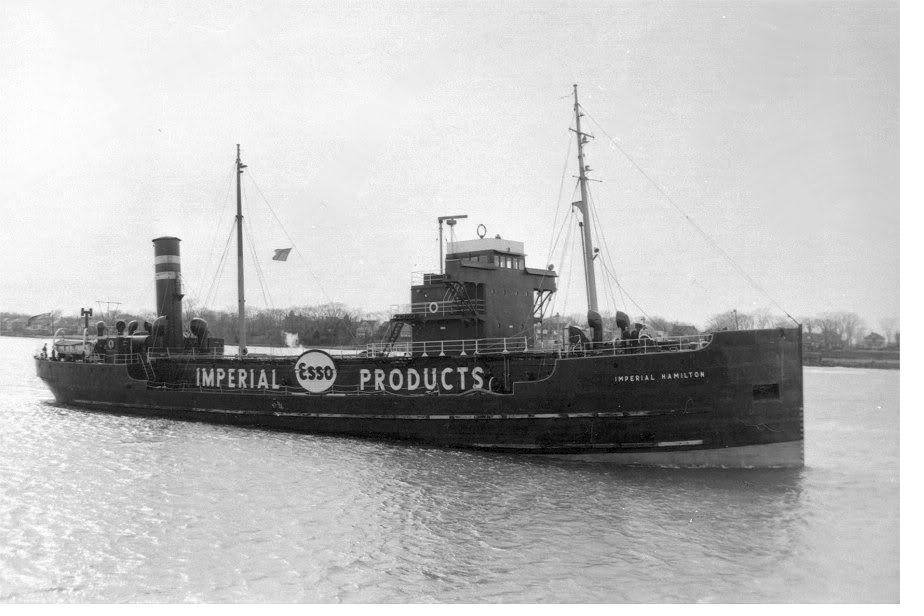
SS Imperial Hamilton Deckhand · Inland Waters
22 Jun → 18 Aug, Sarnia
19
The almost-lost summer1952 is written in pencil. The line has faded so badly that it was once suspected of being ink bleeding through from the facing page. It reads in the correct direction, sits exactly where a 1952 engagement belongs, and is matched by the character report opposite. Examination of the original book confirmed the year. Five summers stands.
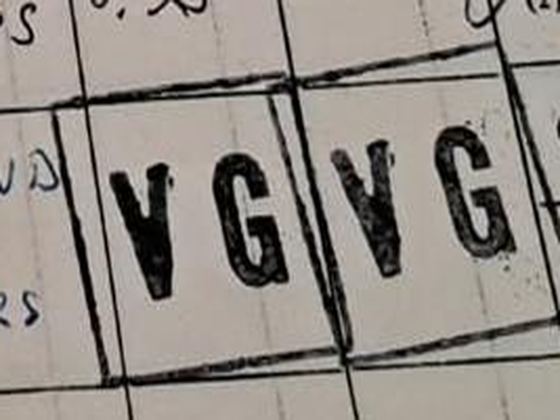
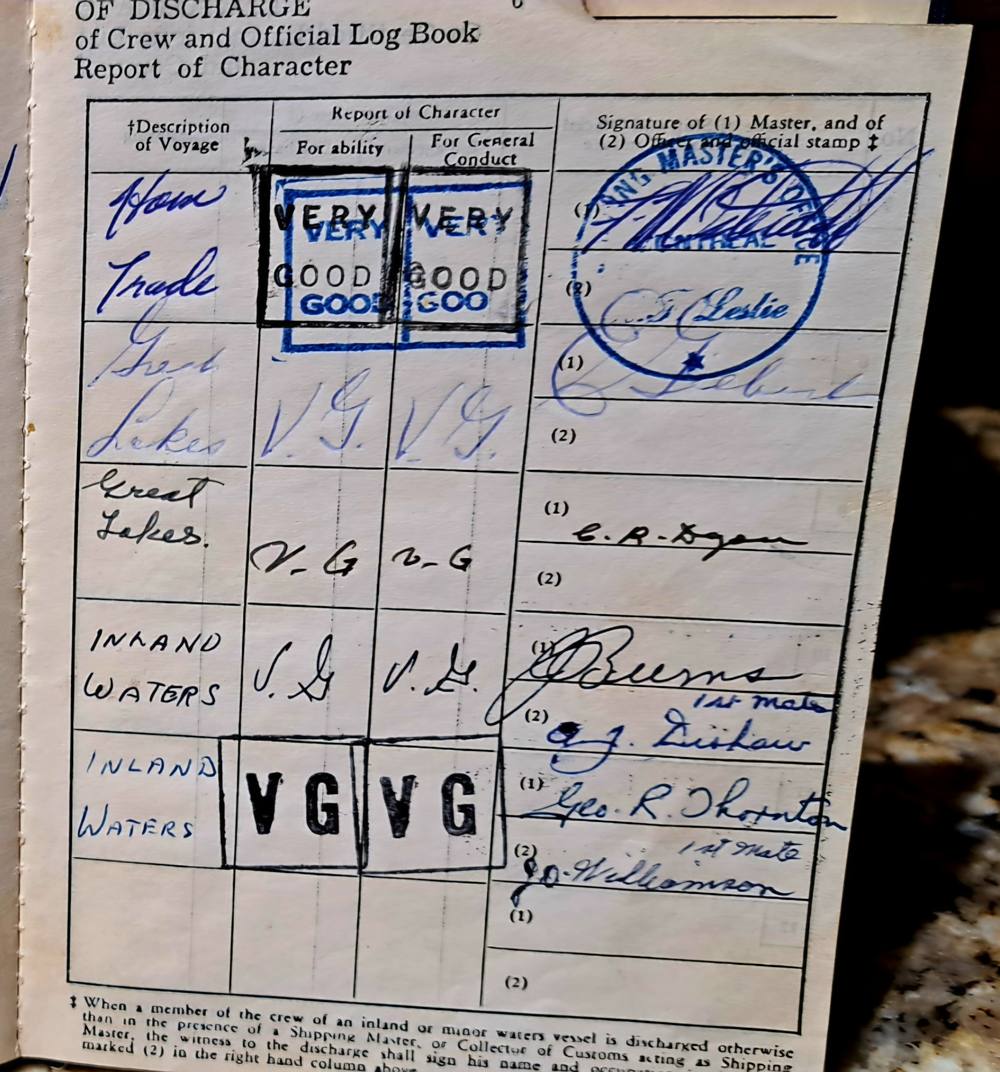
No. 27710, stamped in red.Ability: VERY GOOD. Conduct: VERY GOOD.Five matching character reports on the facing page.
Every summer ends the same way. The officer signing him off judged his ability very good and his general conduct very good. Some wrote the words; others used a stamp. Whatever Bob felt about the job, the surviving record is consistent about how he did it.
The boy described by the government
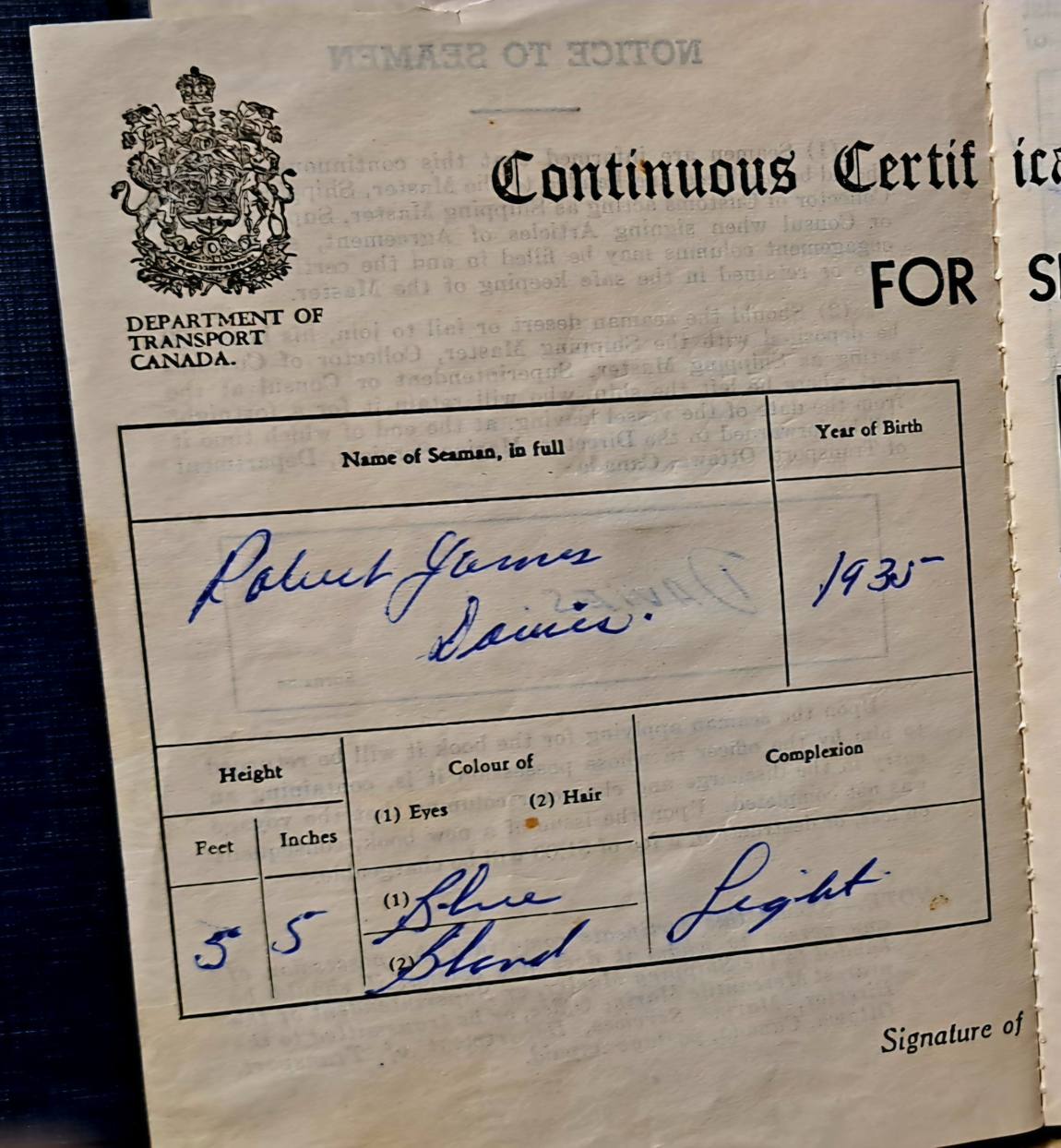
When the front of the booklet was finally examined in full, it supplied the only known written physical description of Robert as a teenager: Robert James Davies, born in Montreal, five feet five inches tall, blue eyes, blond hair, light complexion, no distinguishing marks, and no officer's certificate.
Department of Transport personal particulars. The booklet records his year of birth as 1935.
The wrong year
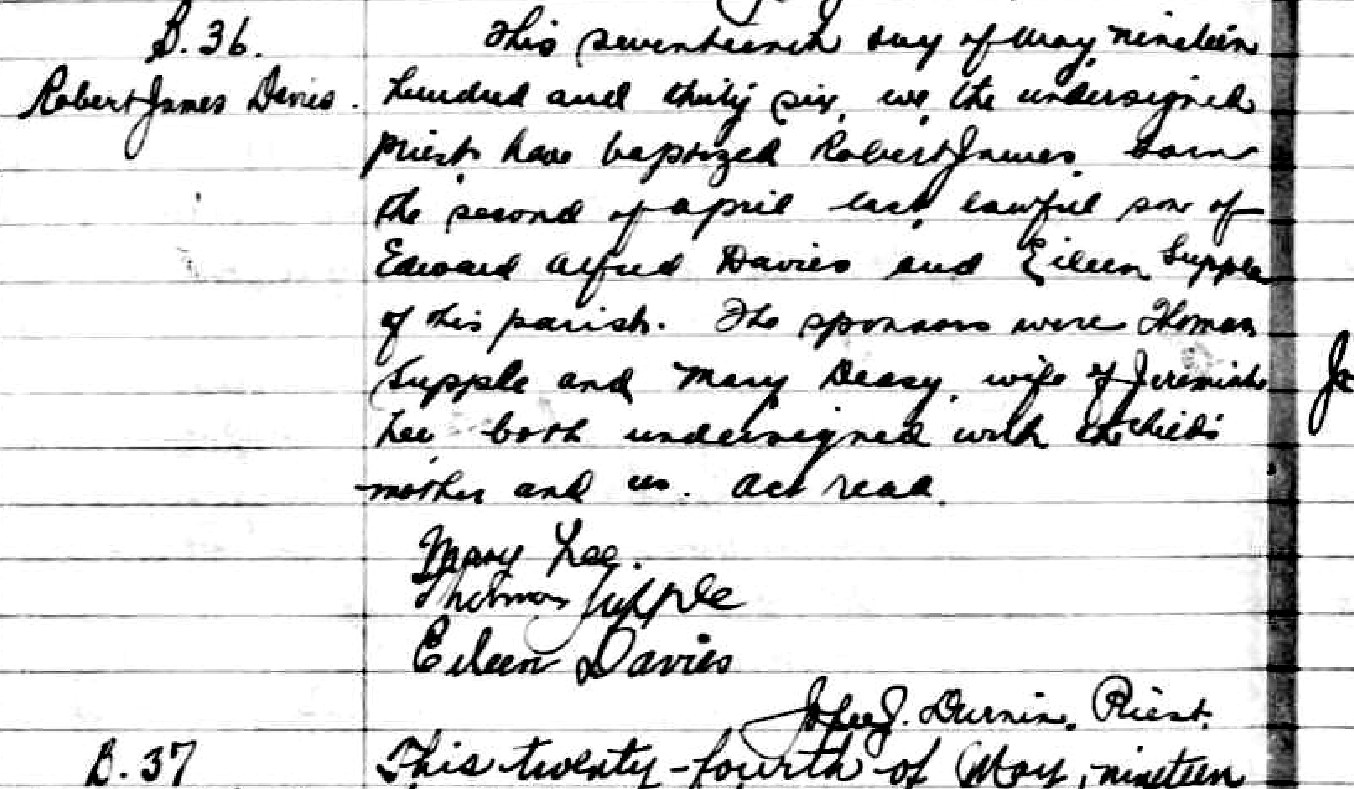
The book says 1935. A contemporary church register made six weeks after Robert’s birth directly records him as born on 2 April 1936 and baptized on 17 May at Saint Aloysius parish in Montréal. The entry names Edward Alfred Davies and Eileen Supple as his parents, and Eileen Davies signed the page.
Entry B.36, Saint Aloysius parish, Montréal, 17 May 1936.Eileen Davies's signature beneath the baptism entry.
The register is close to the event, names both parents, and carries his mother's signature. It establishes that Robert was fifteen years and two months old when he joined the Imperial Simcoe in June 1951. The discharge book makes him exactly one year older.
That discrepancy is important, but it does not explain itself. Brenda later stated during a recorded family conversation that her father had lied about his age and “was only 15.” Her statement agrees with the arithmetic. What has not yet been established is the mechanism: no primary source has yet been found showing a sixteen-year minimum for this particular berth, who entered “1935,” or whether the wrong year was deliberate rather than clerical.
What the evidence allows us to sayThe contemporary baptismal register directly attests 2 April 1936. The discharge book nevertheless records 1935, and why that conflicting year was entered remains open. The one-year difference would have made a fifteen-year-old appear sixteen; that makes the entry worth investigating, but it does not prove why it was written.
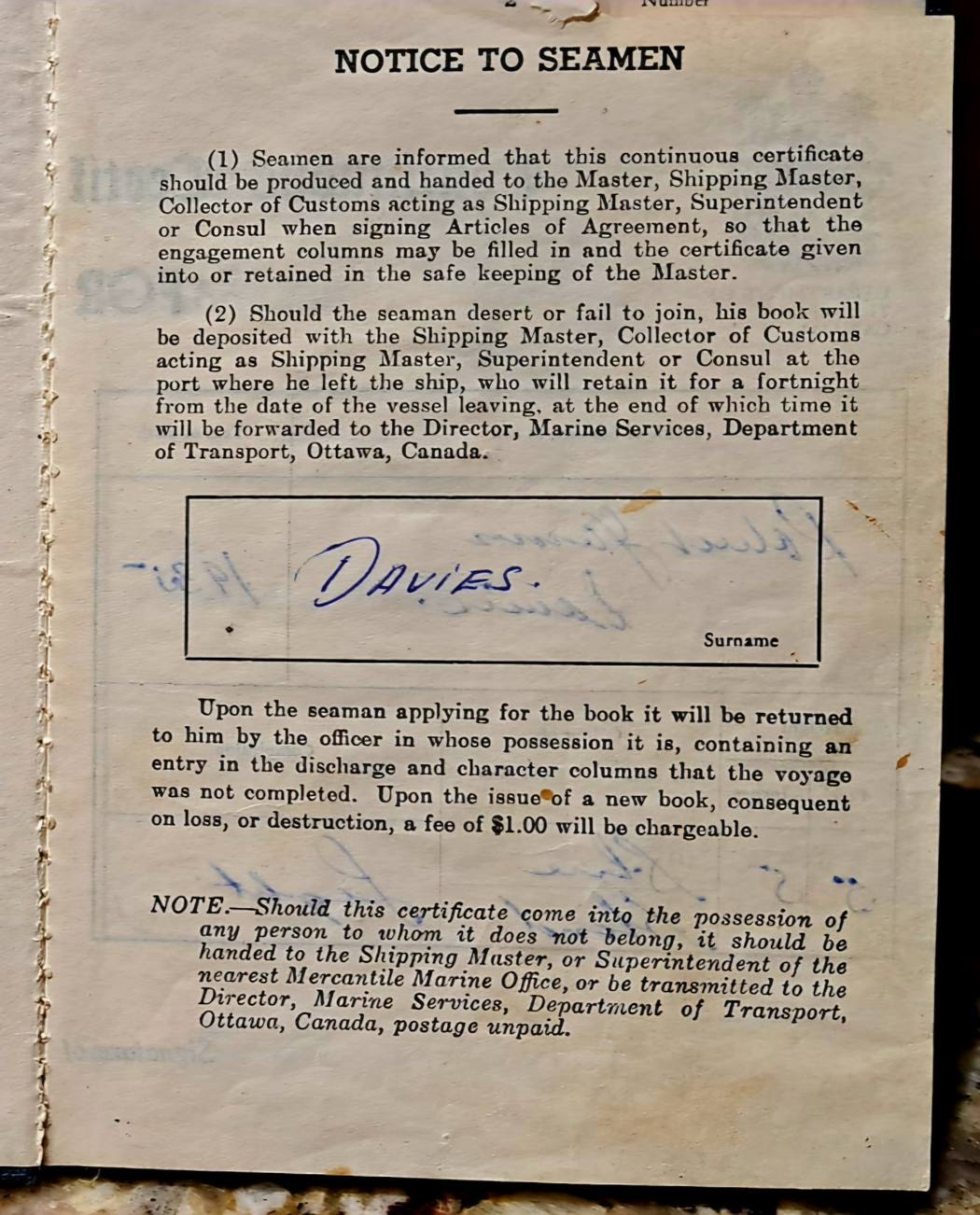
Montreal, Que., and Robert Davies's own signature. Two other identifiers on the page — S.C. No. 4443 and U.T. M/499-179 — remain to be decoded.
Part II
Five Summers
From fifteen to nineteen, Bob returned to Imperial Oil tankers through every high-school summer. Read the years as a sequence of growing up, not simply a list of voyages.
Ages fifteen to nineteen
Five summers
The simplest way to understand the book is by age. At fifteen he joined his first tanker. At sixteen he did it again. At seventeen he worked in the engine room. At eighteen he returned to a ship he already knew. At nineteen, just after finishing high school, he signed on for the last time.
Imperial Simcoe · first ship, 1951.Imperial London · 1952 and 1954.Imperial Collingwood · engine-room summer, 1953.Imperial Hamilton · last ship, 1955.
15
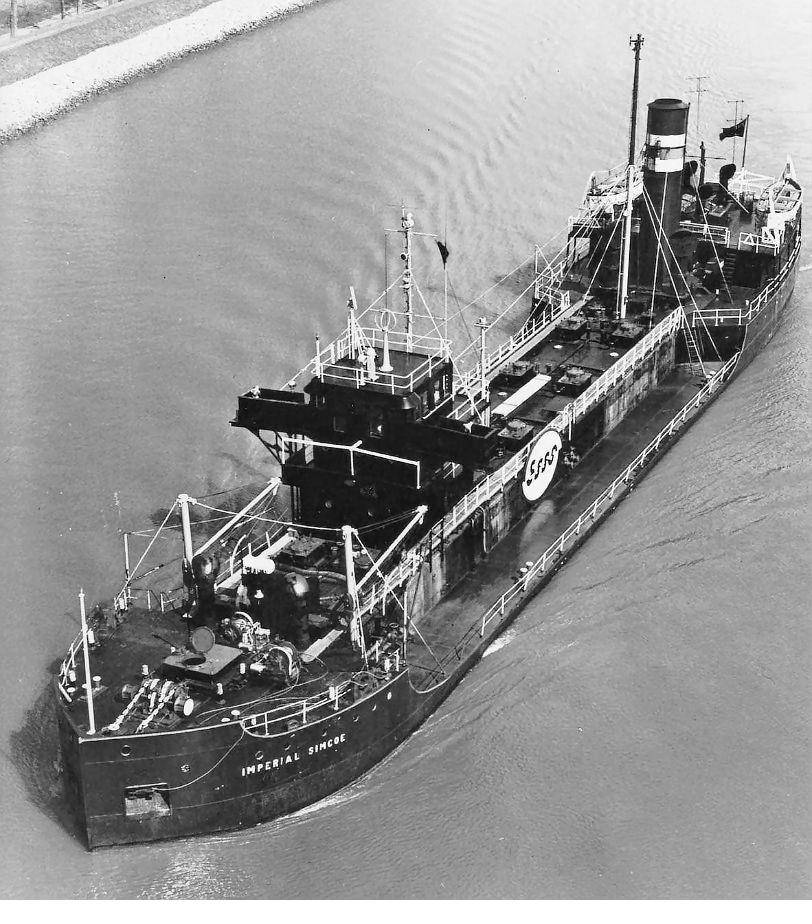
1951 · SS Imperial Simcoe. Ten weeks after his birthday, Bob signed on at Sarnia as a deckhand. He left the ship at Montreal on 26 July.
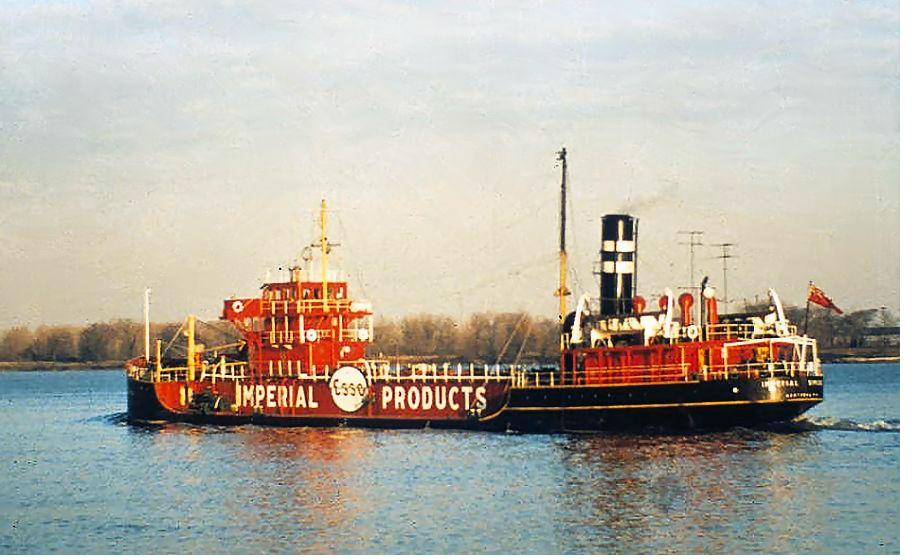
The Simcoe had been built in 1930 as Simcolite. By Bob's first summer she was already twenty-one years old. She was one of Imperial Oil's canal-sized tankers, built for a Great Lakes and St. Lawrence system whose locks limited the dimensions of the ships that could pass.
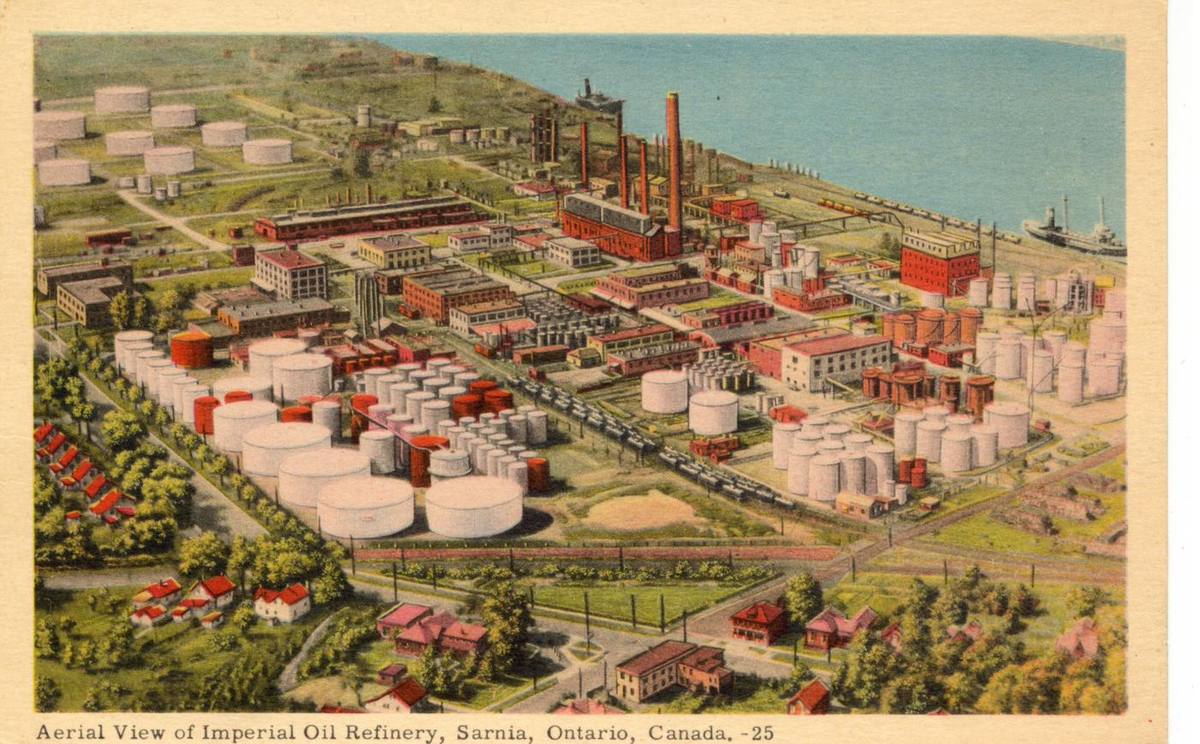
The Imperial Simcoe alongside — a working scene close to Bob's era.Imperial Oil refinery, Sarnia, c. 1950. The city and the job were inseparable from the river.
Sarnia was growing quickly: its population rose from 34,697 in the 1951 census to 43,447 in 1956. Imperial Oil had been refining there since the nineteenth century, while the wartime and postwar petrochemical build-out was transforming the city's economy and skyline.
Even the length of Bob's working day belonged to a recent struggle. Great Lakes seamen had struck in 1946; the settlement included an eight-hour day. The teenager who came aboard five years later entered a workplace whose hours had just been reshaped by collective bargaining.
16
1952 · Imperial London. The pencil summer. He joined at Sarnia on 13 June and left at Montreal on 22 August.
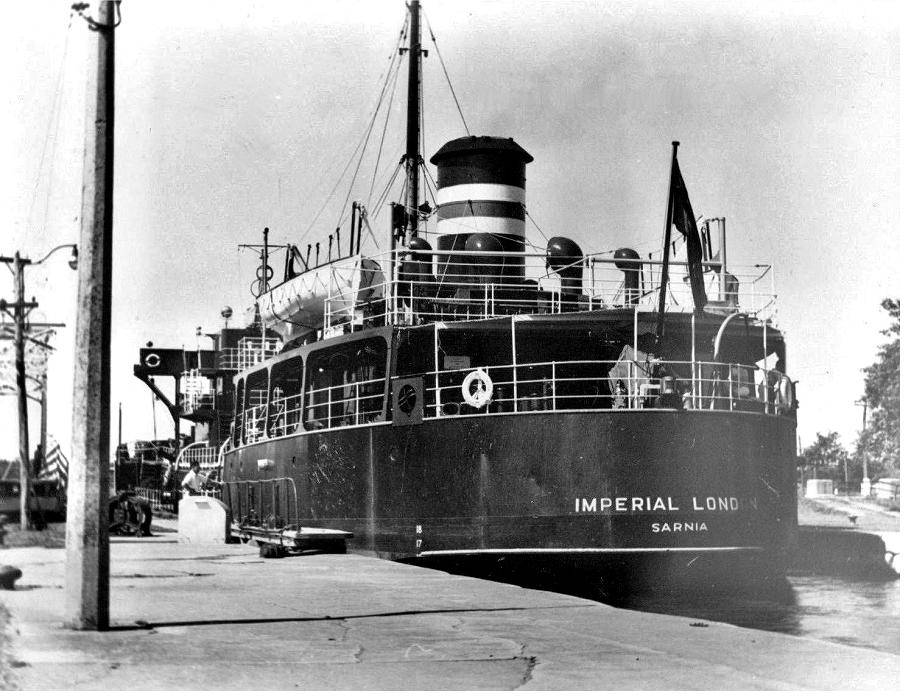
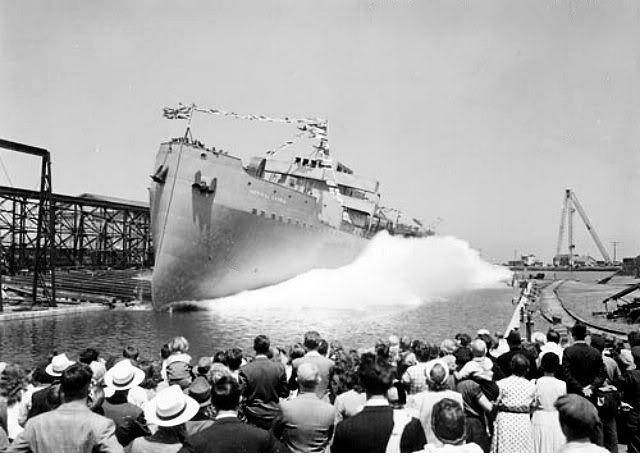
The London was almost new. Launched at Collingwood in 1948, she was only four years old when Bob first worked aboard her. He would return to the same ship two summers later.
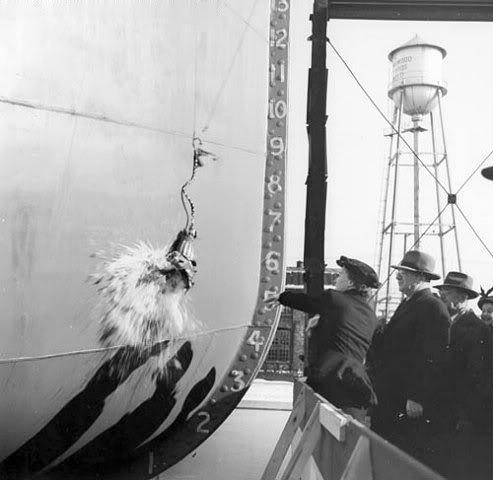
Launch of the Imperial London, Collingwood, 1948.The christening at the bow.
17
1953 · Imperial Collingwood. His only engine-room engagement: wiper, the entry-level rating responsible for cleaning and assisting around machinery spaces.
This summer sits inside an unusually dense run of public events. They give us a precise picture of the world around Bob without pretending to tell us what he thought about it.
21 May 1953
A violent tornado struck Sarnia and Lambton County, killing seven people, injuring more than a hundred, and damaging large parts of the city.
2 June
The coronation of Queen Elizabeth II was marked across Canada.
6 June
Bob signed aboard the Imperial Collingwood at Sarnia, sixteen days after the tornado.
27 July
The Korean Armistice Agreement was signed while Bob was still under engagement aboard the ship. There is no evidence showing when or how he learned the news.
14 August
He was discharged at Sarnia: ability very good, conduct very good.
18
1954 · Imperial London. Back on the same tanker, this time for his longest engagement: 17 June to 1 September.
Construction of the modern St. Lawrence Seaway began in 1954. Bob was still working aboard ships designed around the older canal system while the replacement was being built around them.
Pipework, hatches, winches and catwalks on a tanker deck — the physical world of a deckhand's summer.
19
1955 · SS Imperial Hamilton. The oldest of his ships, built in 1916 as Sarnolite. That name now matters: contemporary records identify Captain Edward Davies as Sarnolite’s master in 1945. Bob’s final tanker was therefore the same hull his father had commanded a decade earlier. He signed off at Sarnia on 18 August.
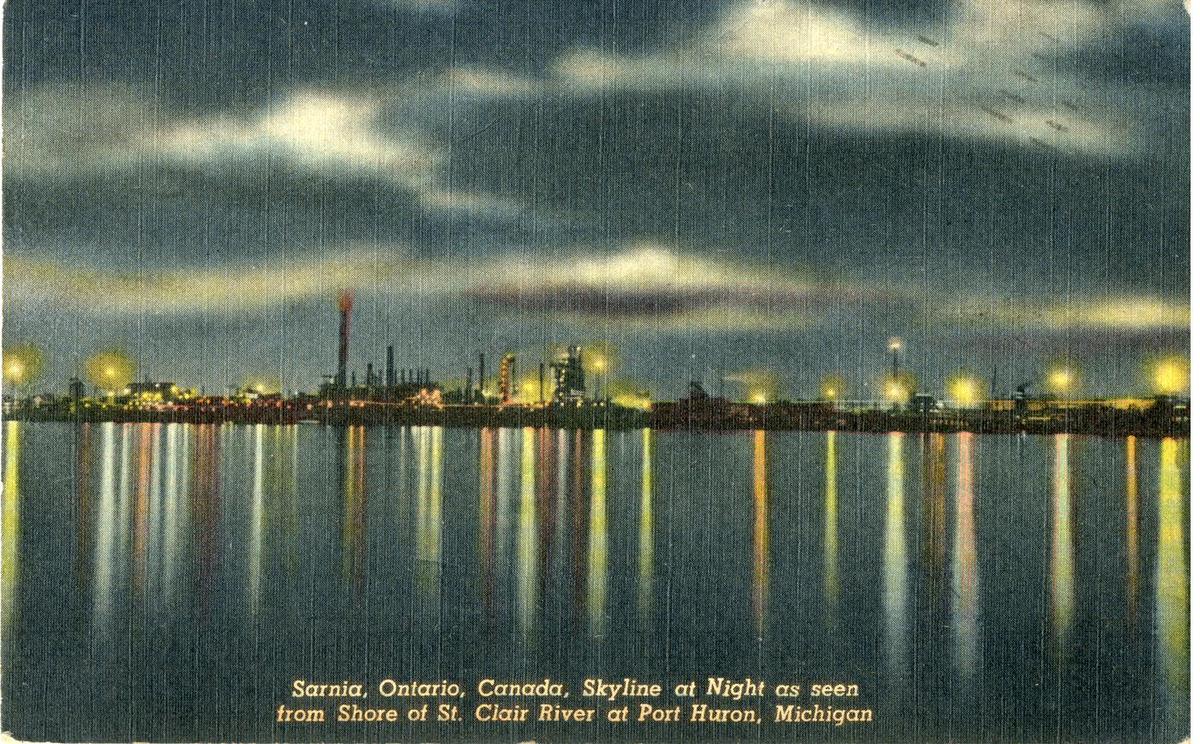
Sarnia from Port Huron, postmarked 1955 — Bob's final summer on the ships.
As far as the family knows, that was the end of his seafaring. The discharge book closes at nineteen.
Part III
The Life Outside the Book
Ships left the clearest paper trail, but they were never the whole teenager. School, family, baseball, work ashore and the life he chose belong beside the ledger.
September to June
The other nine months
The book can make the ships look like Bob's whole adolescence. They were not. They occupied the summers between school years — and the school record gives us a much livelier teenager.
The next sections deliberately widen the frame: first the schoolboy, then the father who arranged the work, the sport Bob preferred, and finally the adult life the seaman’s book never recorded.
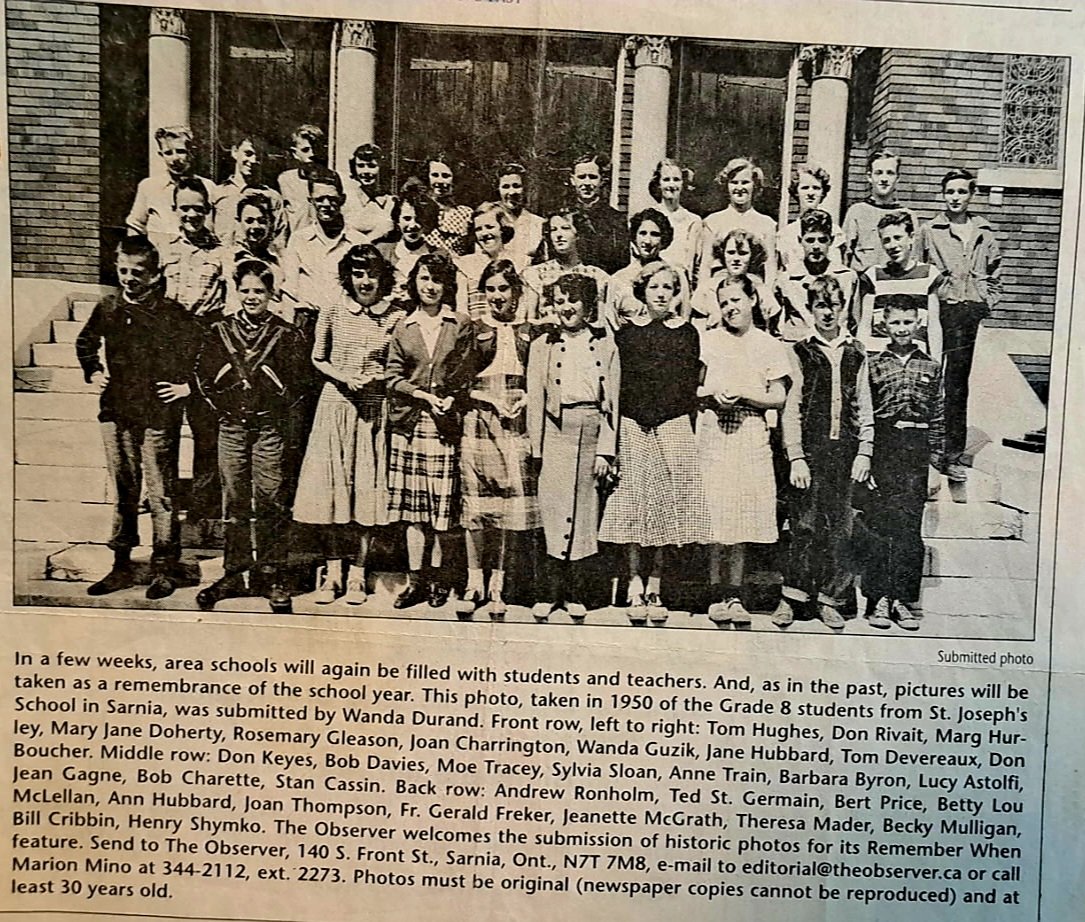
In 1950, before the first ship, Bob was in Grade 8 at St. Joseph's School in Sarnia. A class photograph later printed in the Sarnia Observer names him among thirty-two students. His brother Ted recognized him when shown the picture in 2026, although the specific face he pointed to was not recorded and therefore remains unmarked here.
Grade 8, St. Joseph's School, Sarnia, 1950. Bob is named in the printed list.
From 1950 to 1955 he attended St. Patrick's High School. Put the two records together and the pattern is exact: five high-school years, five summer engagements. The first voyage followed Grade 9. The last began after graduation.
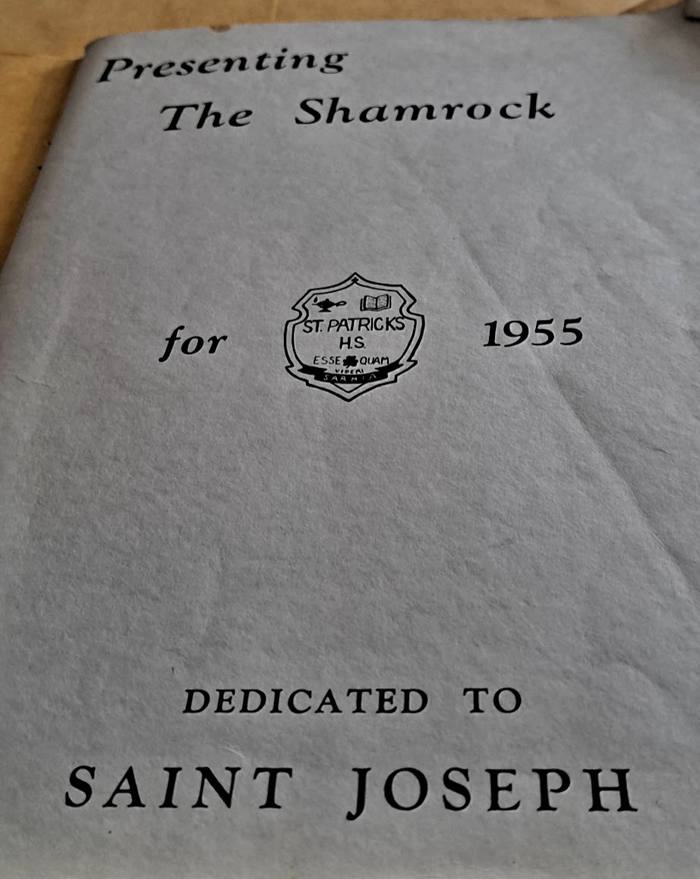
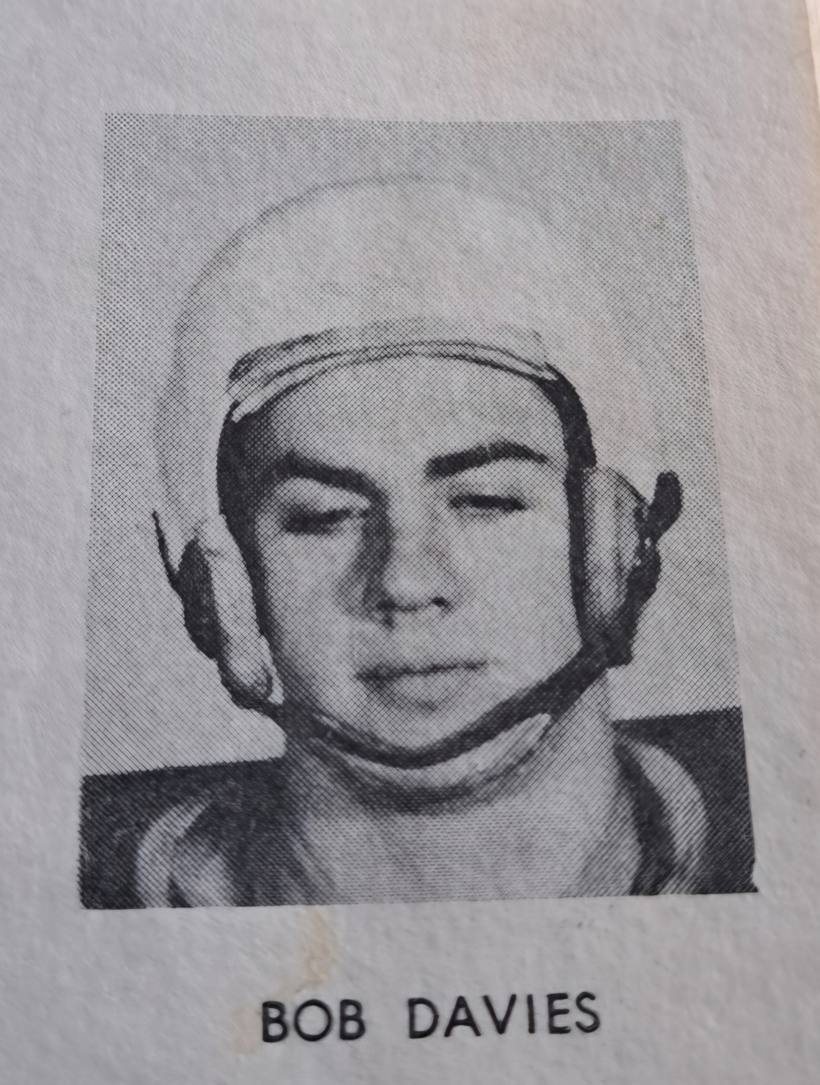
The Shamrock, 1955 — his graduating-year yearbook.Bob Davies, Fighting Irish football.
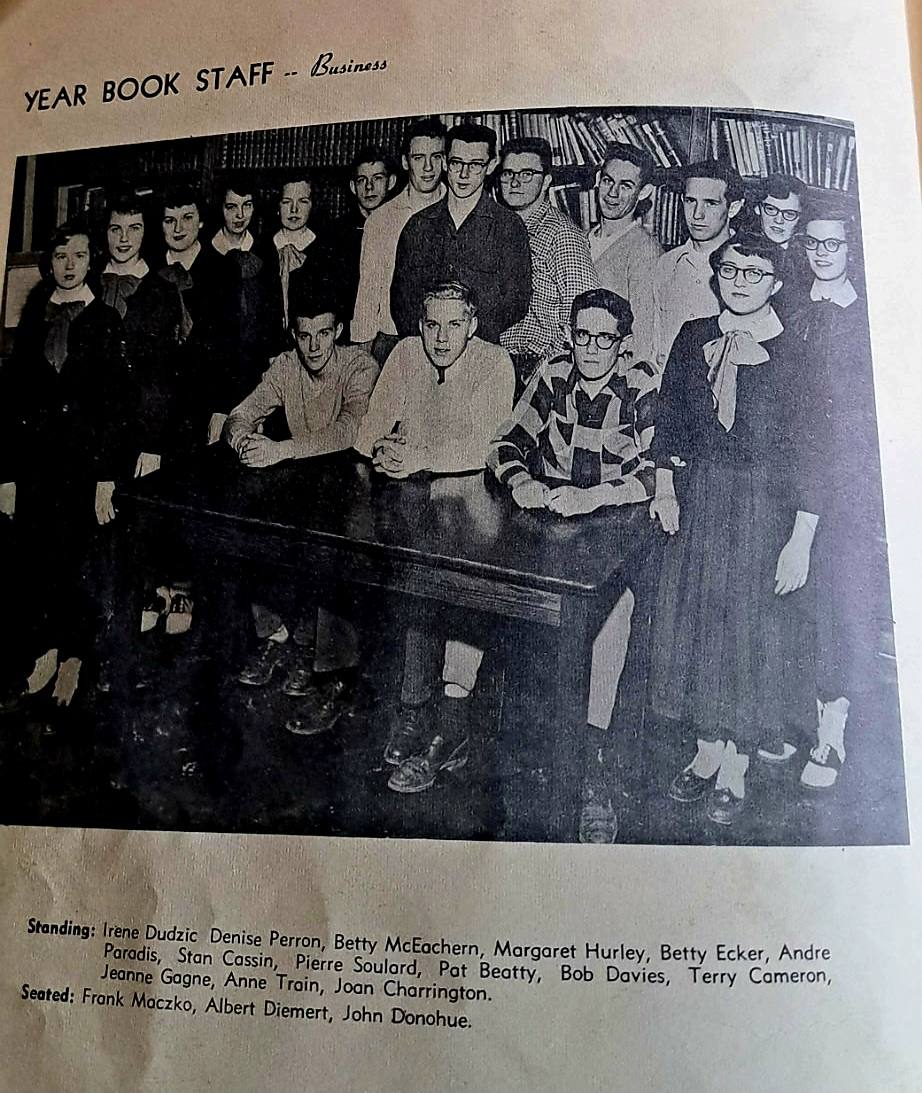
The yearbook also places him on the business staff and describes him as a basketball player and “high scorer for the Fighting Irish.” This is a useful correction to any picture of the reluctant sailor as merely dutiful or subdued. His school life had sport, friends, jokes, and a reputation of its own.
Year Book Staff — Business. Bob is identified in the standing row.
VERY GOOD
ON THE SHIPS / AT SCHOOL
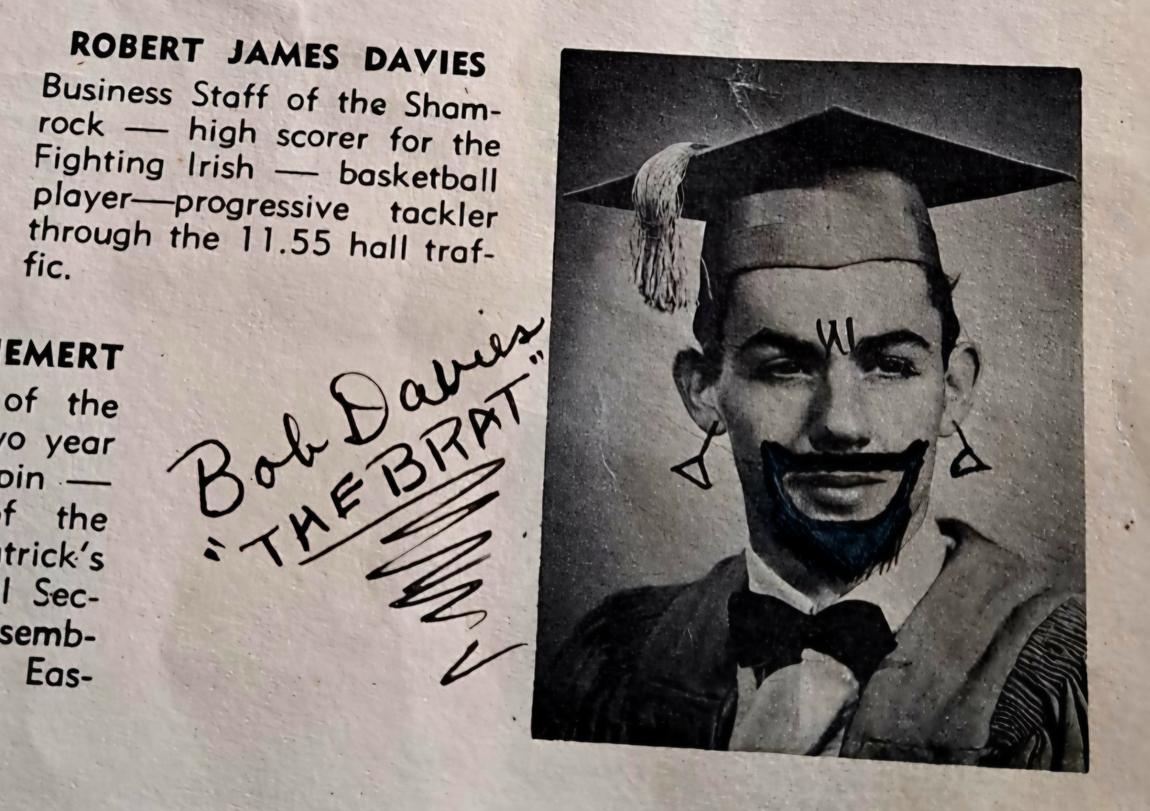
THE BRAT
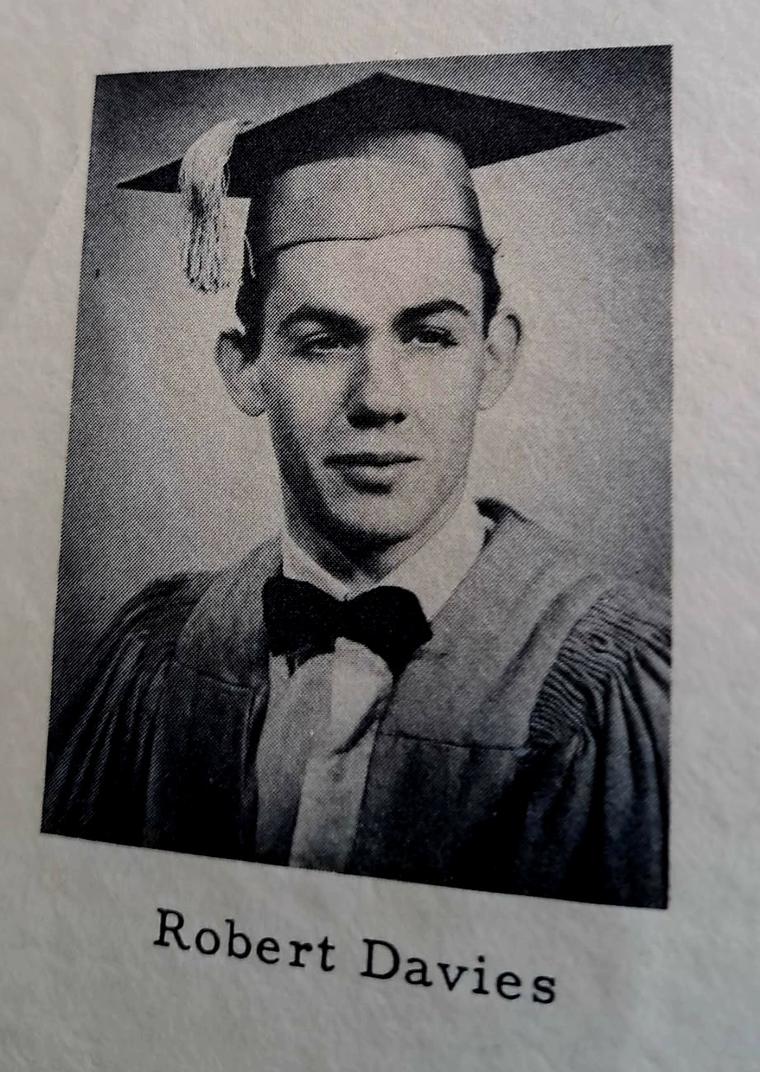
On his graduation page, somebody drew a beard, moustache, earrings and a large “W” on his portrait. Beside the photograph appears the handwritten name Bob Davies, “THE BRAT.” The signature resembles his, but who drew on the portrait and who supplied the nickname are not established.
The marked-up graduation page — evidence of a schoolboy his grandchildren never knew.The clean graduation portrait, 1955.
The contrast is more revealing than either label alone. Five ship officers saw a young worker and repeatedly wrote very good. Somebody at school saw the same young man and wrote The Brat. Both belong in the portrait.
What became of his last ship
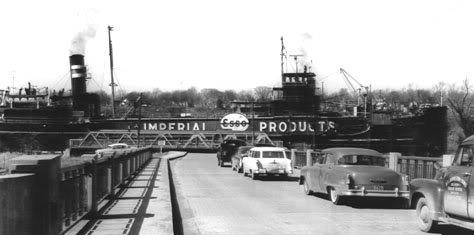
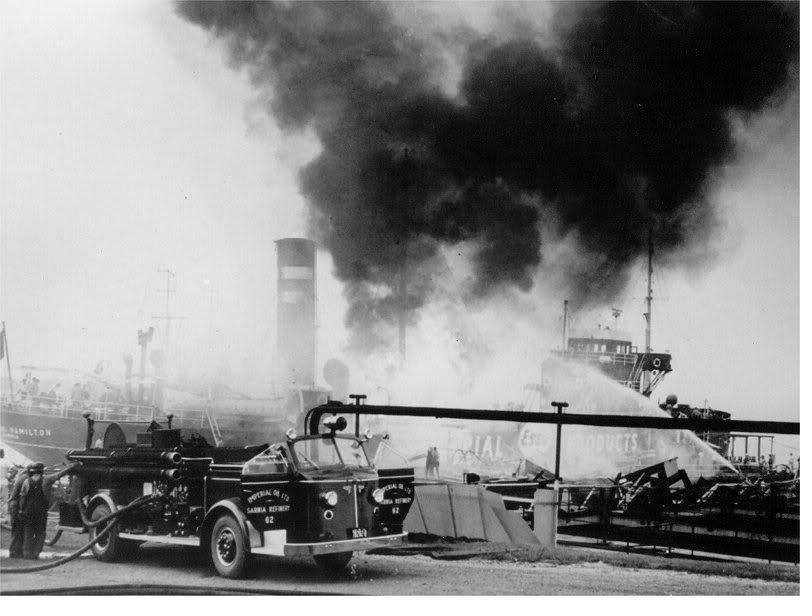
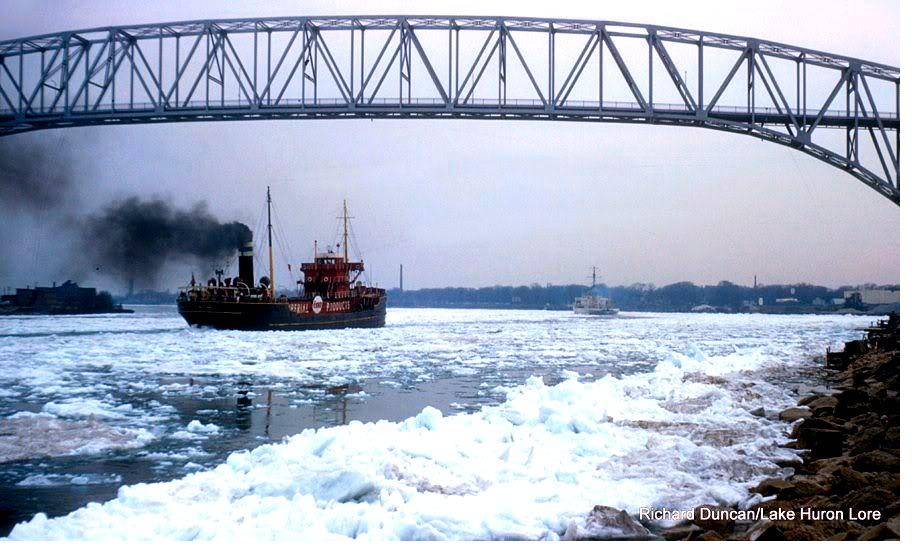
Six years after Bob left the Imperial Hamilton, the tanker returned to Imperial Oil's Sarnia terminal to load gasoline. On 4 September 1961 an explosion and fire destroyed much of the vessel and a large section of dock. Five crew members were injured; none was killed. Investigators did not establish a definitive ignition source.
The Imperial Hamilton burning at Sarnia, 1961.The same ship beneath the Blue Water Bridge, April 1959.
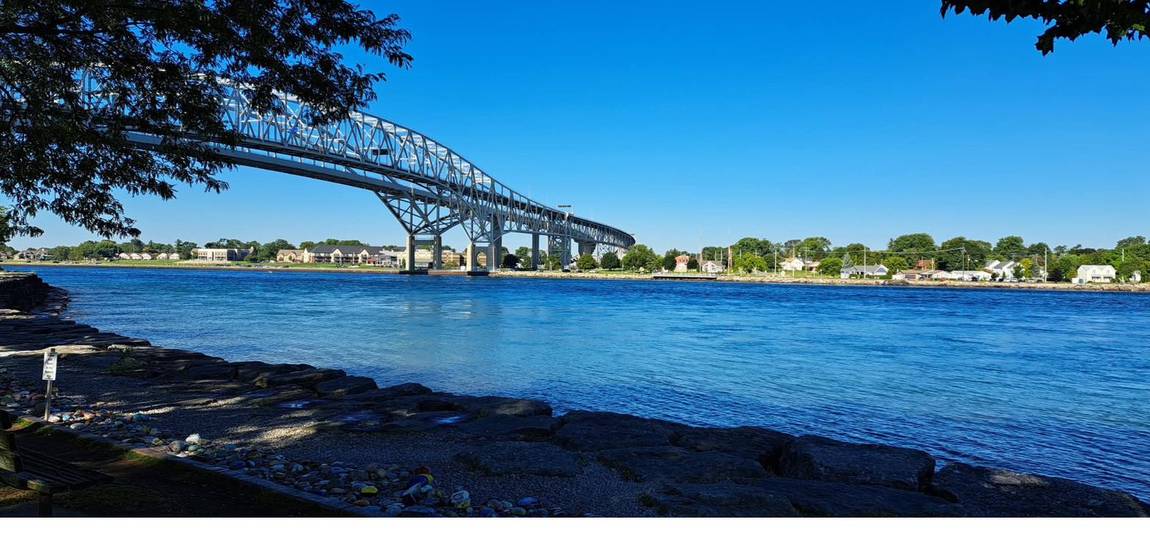
The Blue Water Bridge, 2025, photographed by Brenda. The family still returns to the same water.
Bob was twenty-five and living in Sarnia when his old ship burned. Whether he watched from the waterfront, heard the blast, or ever spoke about it is unknown.
His father
The man who got him the job
To understand why a fifteen-year-old ended up on a tanker, it helps to know the man who arranged the berth. Edward Davies did not merely know ships. They had been his working life since boyhood.
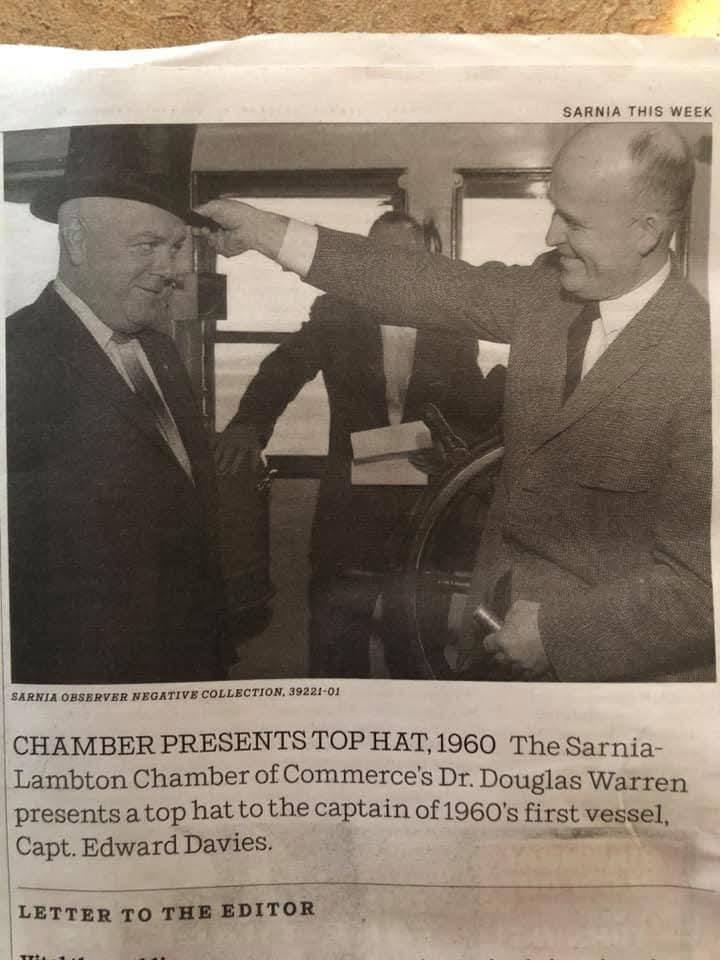
Sarnia, 1960. Captain Edward Davies receives the ceremonial top hat awarded to the master of the season's first vessel into port.
Family records preserve the later-life form Edward Alfred Reginald Clarence Davies. A newly recovered St. Paul’s baptismal extract gives the child’s names in a different order: Alfred Edward Clarence Reginald Davies, born 6 November 1905 to Alfred and Ellen Davies. The variation is preserved rather than harmonized away. His father died in March 1915 and his mother in July 1916, leaving him orphaned at about ten. The new baptism also explains why the 1921 census could record the future Captain Ted as Alfred Davies.
Family memory held that the orphaned boy moved “from sister to sister for maybe a little while.” We can now see one sister even at the moment of the second parental death: Ellen’s 1916 obituary says she had been residing with daughter Mrs. Kirby, and a newly recovered 1912 marriage register proves that Mrs. Kirby was Nellie Davies, daughter of Alfred and Ellen. That does not establish Ted’s residence or guardianship. The surviving record separately confirms one actual placement: on 1 June 1921, the federal census places fifteen-year-old Alfred Davies at 46 Bland Street in the household of his older sister’s family, Burton McKenzie, wife Alberta, and son Ray.
The 1921 sister is traceable across a difficult but unusually dense chain of records as Violet Alberta (“Bertha” / “Alberta”) Davies, later Hall and McKenzie. Her 1918 marriage names Alfred and Ellen as her deceased parents and Florence Myrtle Davies as witness; her son Roy Albert Hall was born in 1919; and later directory, census and birth records connect the Hall and McKenzie households. The exact 1916–1920 custody sequence — and whether anyone held formal guardianship — remains unknown. The latest Ted Jr. follow-up did not close that gap.
Deep research appendixThe full documentary reconstruction of Captain Ted’s family origins, orphan years, sister network and maritime career is preserved in a separate appendix. Read the Captain Ted appendix →
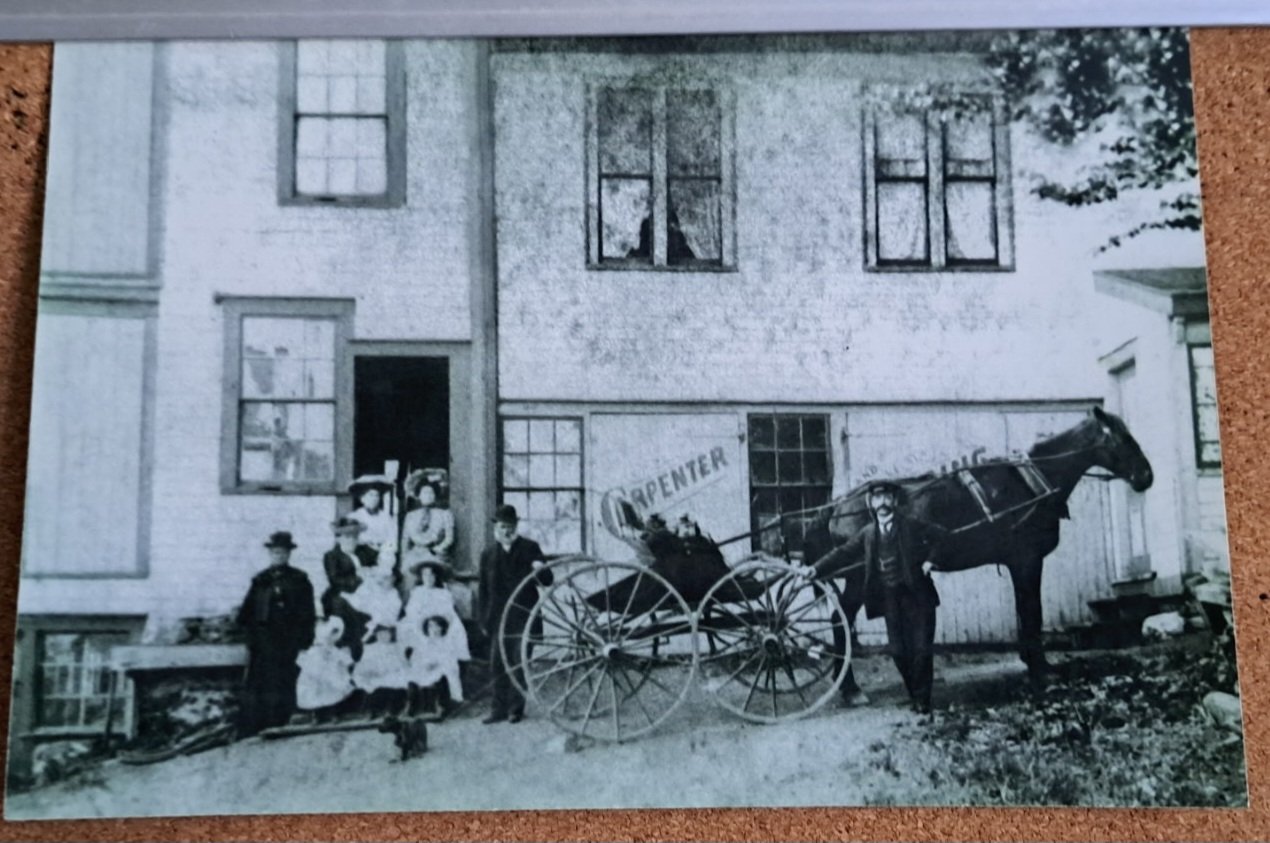
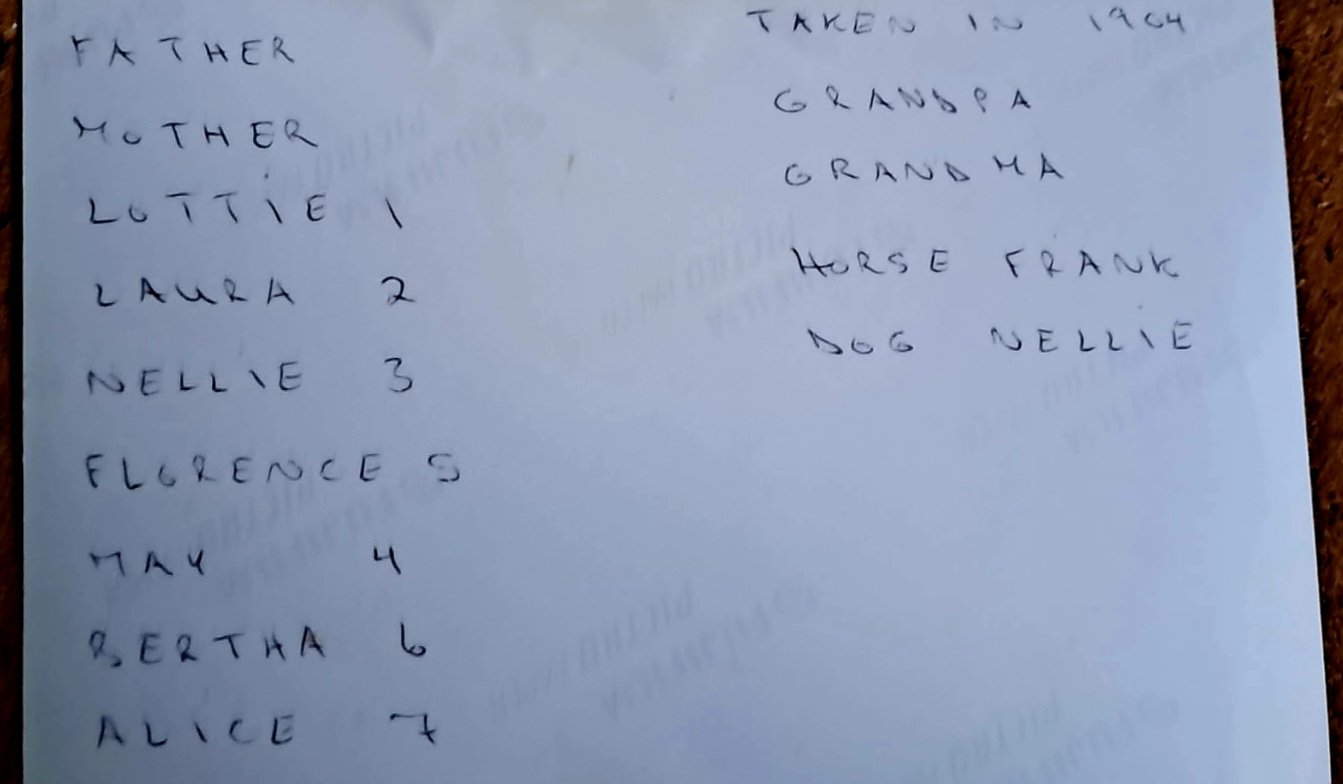
The Davies family in Halifax, 1904 — the year before Edward was born.The reverse identifies seven daughters, parents, grandparents — and Horse Frank and Dog Nellie.
A maritime career now better documented
A contemporary Imperial Oil source fills in much of the part that was once family lore. The Winter 1945 Imperial Oil Review identified Captain E. A. Davies as master of the S.S. Sarnolite, reported that he became a master in 1932, and stated that he had received the O.B.E. and acted as convoy commodore on seventeen wartime convoys. The same feature says the captains pictured had been specially mentioned by the Royal Canadian Navy for their service as convoy commodores.
The official confirmation is now in hand. The Canada Gazette of 1 January 1945 names Captain Edward Alfred Davies among the Additional Officers of the Civil Division of the Order of the British Empire. A surviving 1944 Imperial Oil recommendation, preserved in the Department of Transport honours file and reproduced in a Canadian merchant-navy awards compilation, says Davies had been master of Sarnolite and Arlington Beach Park during the war and had been an Imperial Oil employee since January 1926.
One published detail should not be carried forward uncritically. The 1945 Imperial Oil Review says Edward “signed on as seaman in 1907.” That is incompatible with the family chronology placing his birth in 1905 and also sits awkwardly beside the 1944 company recommendation dating his Imperial Oil employment from 1926. Until an earlier service certificate or another primary record resolves the conflict, 1907 is treated here as an unresolved publication detail, not as part of his biography.
The evidence also establishes an important distinction: Edward was a merchant-service captain, not — on the evidence found so far — a commissioned Royal Canadian Navy officer. As convoy commodore he carried responsibility for organizing and controlling merchant ships sailing under naval escort.
During the Second World War, Imperial Oil records describe Sarnolite carrying petroleum from Halifax toward Newfoundland defence installations. The surviving evidence does not show that every such voyage was one of Edward’s seventeen commodore assignments, so convoy routes and individual commands remain separate questions. What can now be stated is the vessel identity: Sarnolite, Official No. 134515, was later renamed Imperial Hamilton, the tanker Robert joined in 1955. The father–son hull connection is therefore documented; it does not mean Edward was still her master when Robert sailed aboard.
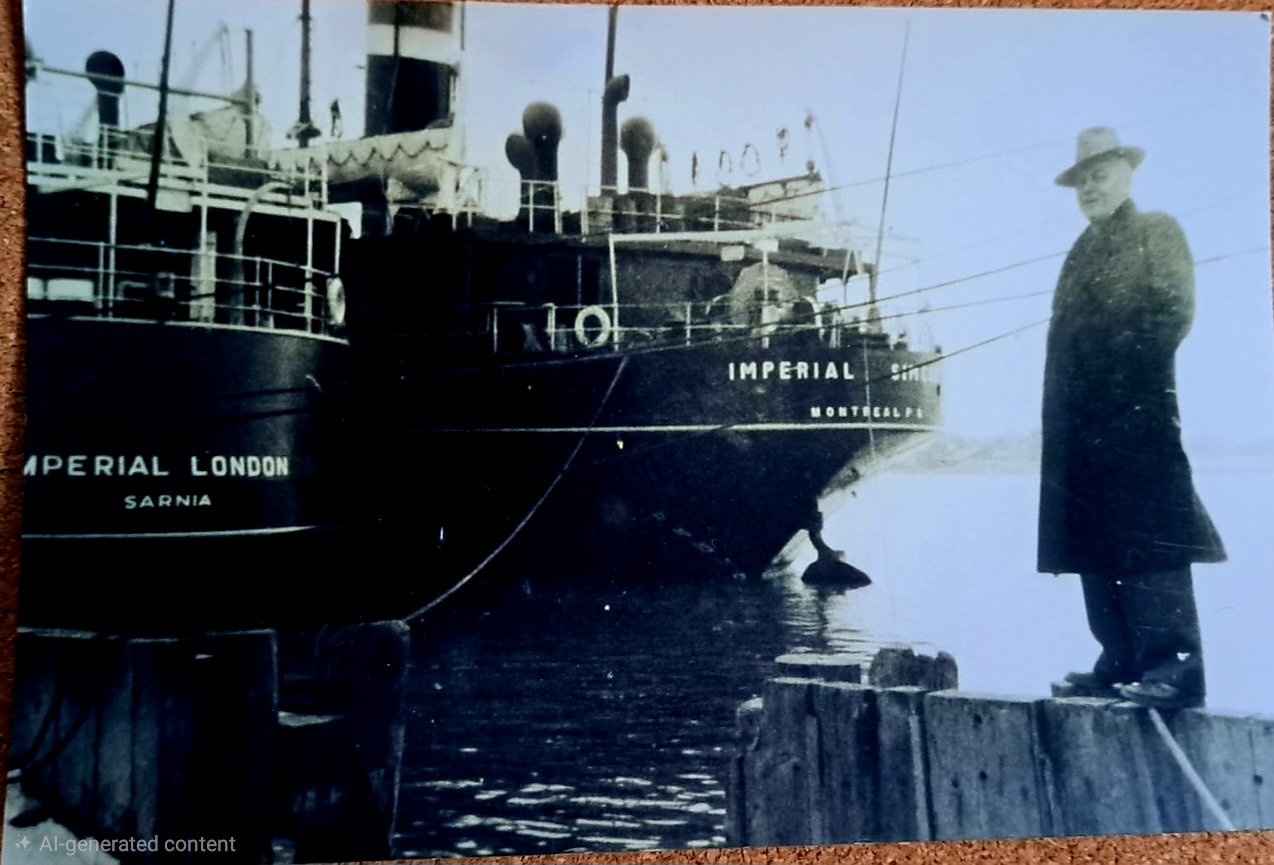
Captain Edward Davies on the dock beside the Imperial London, one of the tankers his son later crewed.
Edward and Eileen
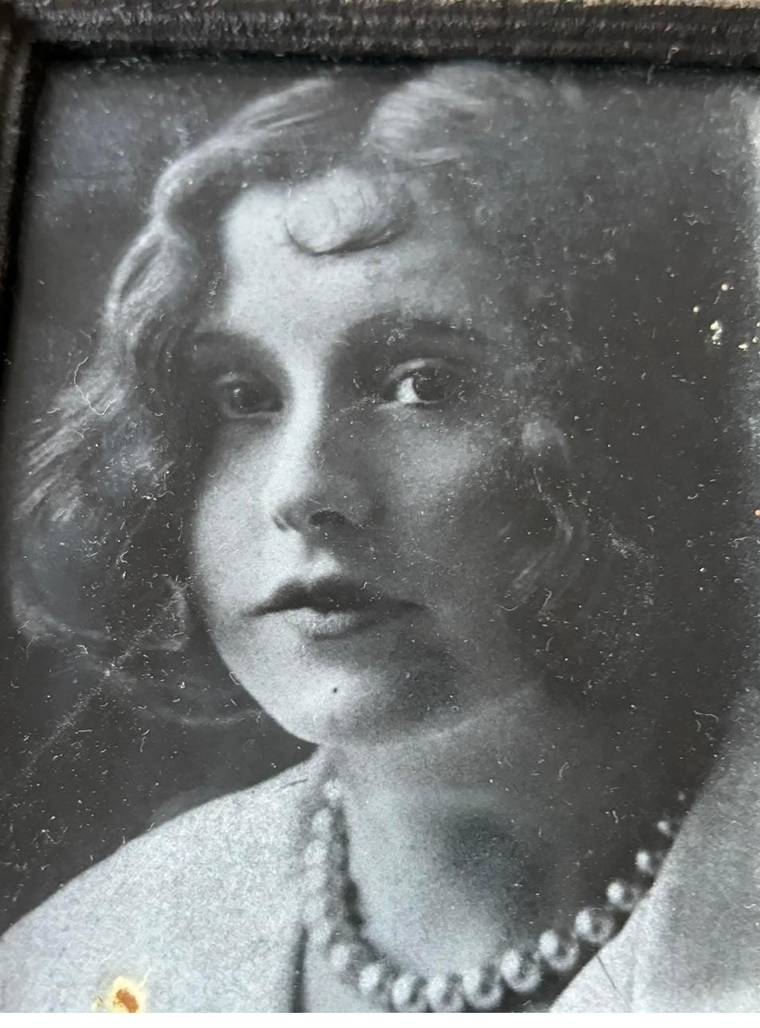
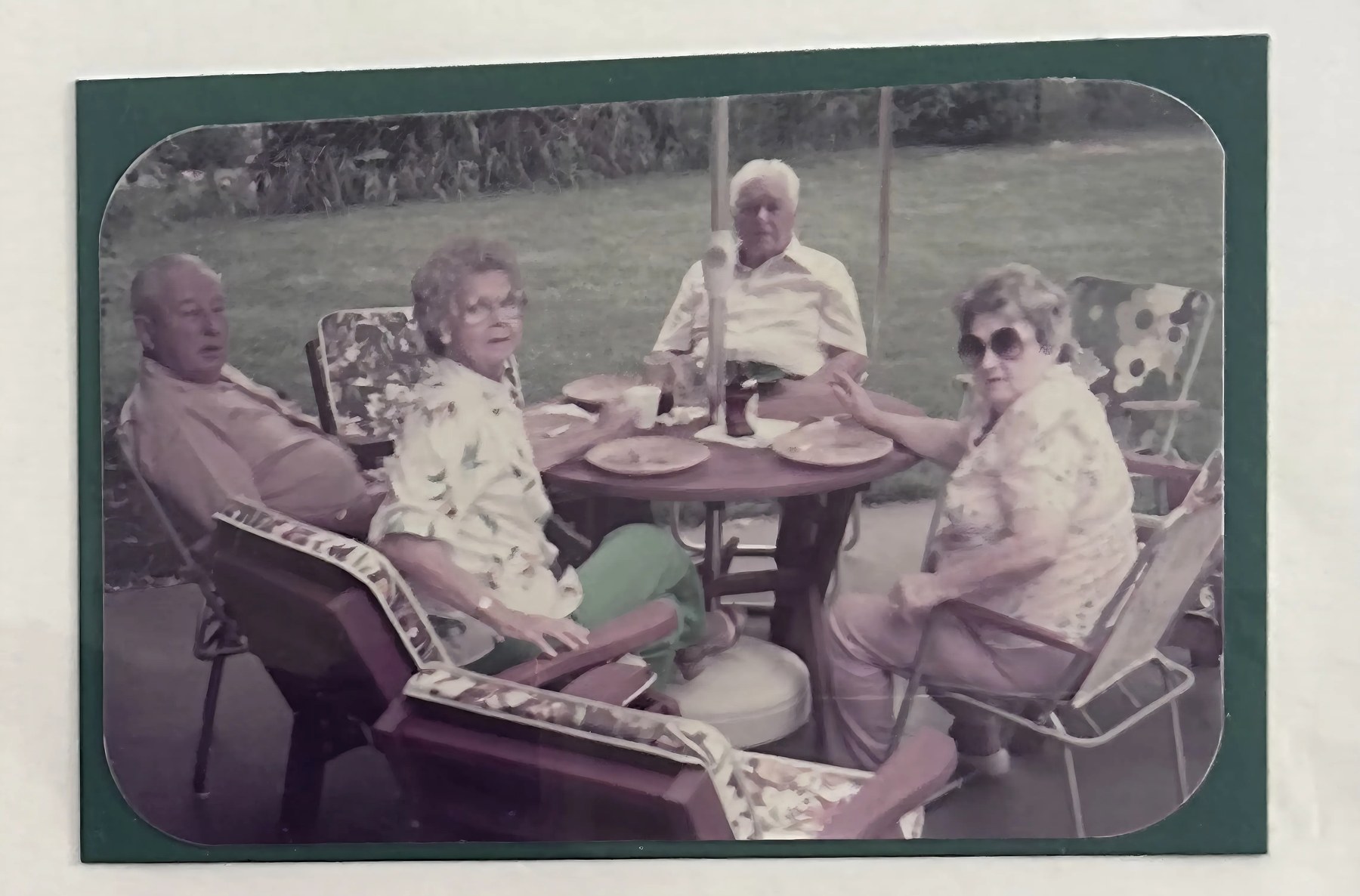
Eileen Supple. A long-maintained Davies family chart records her marriage to Edward at St. Mary's Cathedral, Halifax, on 16 February 1928.Both sets of great-grandparents in later life: the Strevels at left, Eileen and Edward Davies at right.
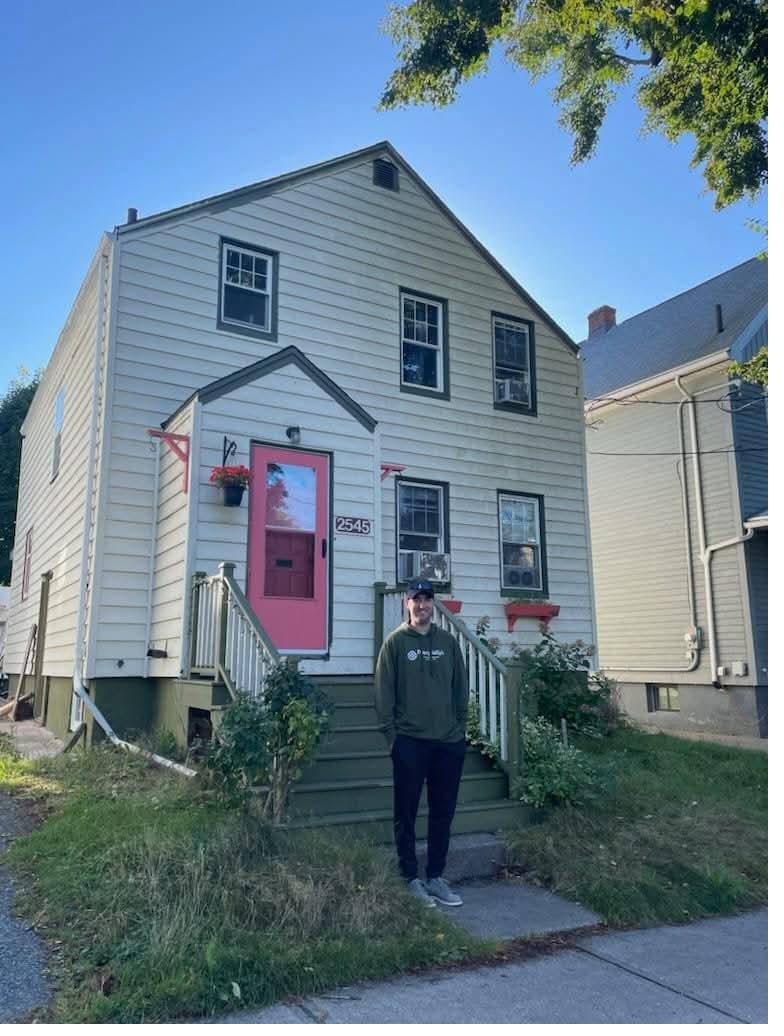
2545 Beech Street, Halifax — Robert's boyhood home, photographed by his grandson Eric Taylor in August 2024.
Robert was born in Montréal, raised for part of his childhood in Halifax, and later lived in Sarnia. The dates and reasons for those family moves remain incomplete. The Halifax setting matters, however: during the Battle of the Atlantic the city was one of the principal assembly points for merchant convoys, and Edward's documented wartime work placed him directly inside that maritime world.
By 1951, then, the father arranging Bob's summer berth was a man with decades of seafaring behind him, including wartime command. That does not tell us what Edward thought the job would do for his son. It does make the decision easier to place in context. He was sending Bob into a world he knew intimately — in peacetime, on inland waters, and at the bottom of the shipboard hierarchy.
Five children
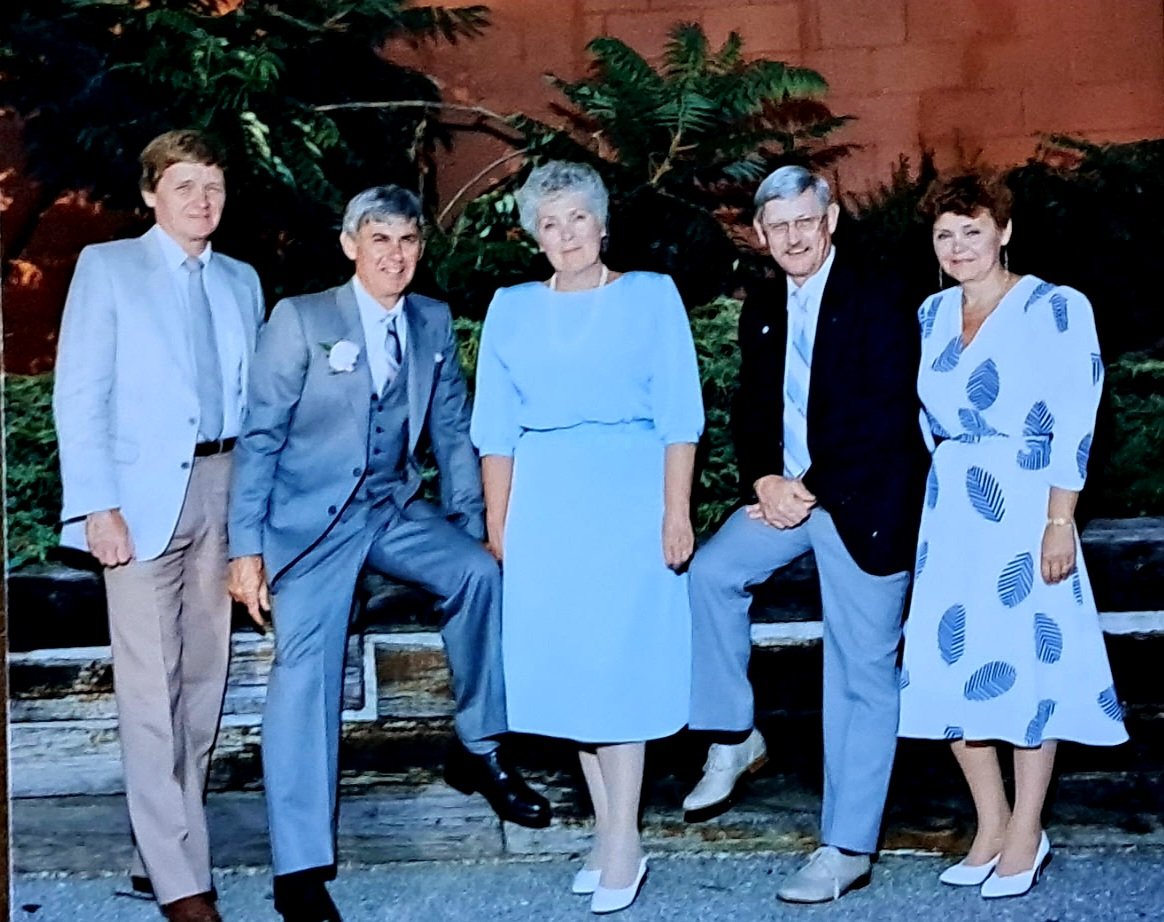
Edward and Eileen's children were Joan, Ted, Robert, Reg and Diane. Bob was the middle child. His older brother Ted was five years ahead of him and lived through the same household years covered by the discharge book. Family interviews begun in 2026 are therefore not an appendix to the research; they are evidence from people who were there.
The five Davies siblings, left to right: Reg, Robert, Joan, Ted and Diane.
The thing he wanted instead
He wanted the diamond
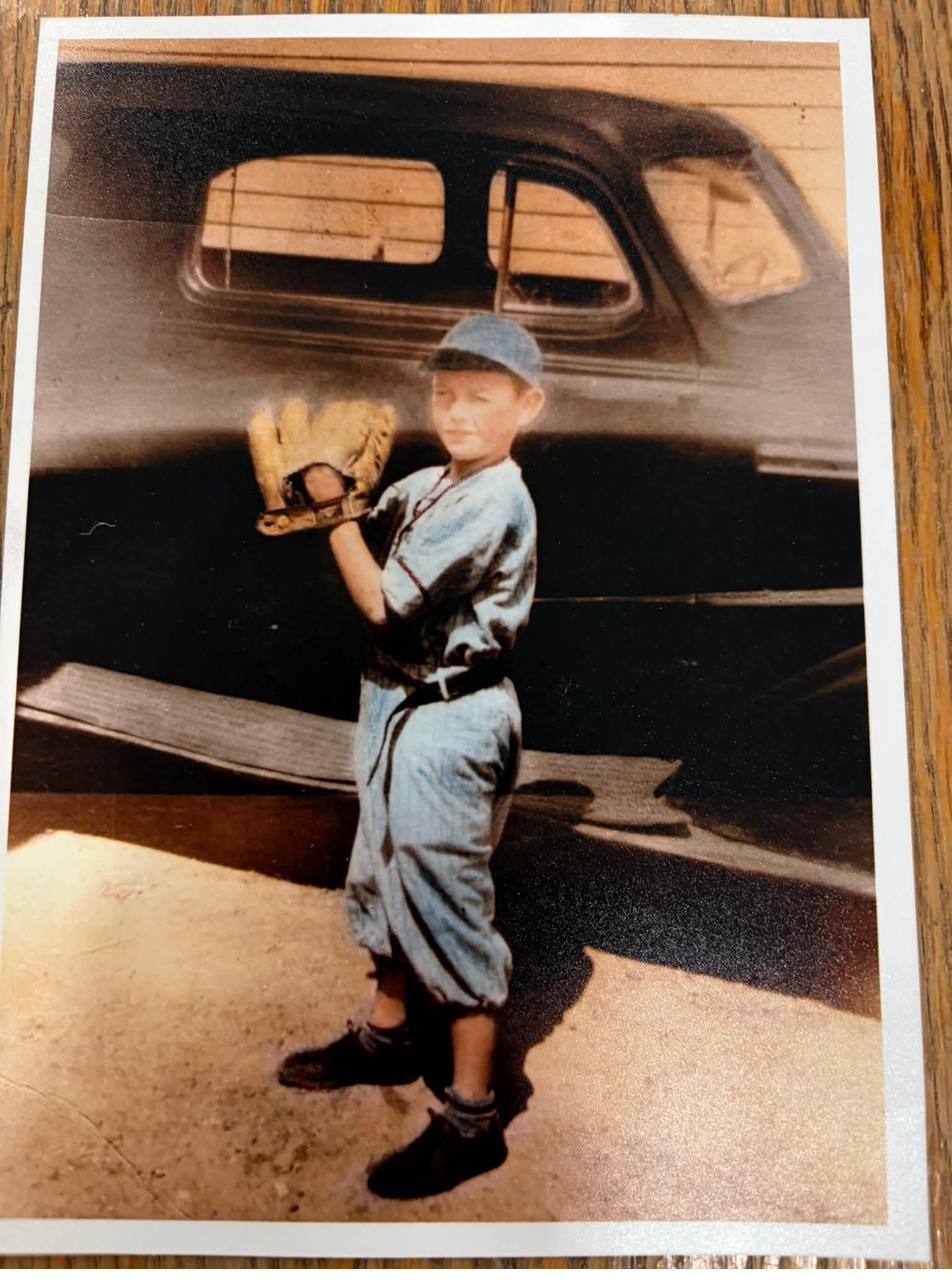
Brenda's note gives the five ship entries their counterweight: Bob wanted to play baseball. The family photographs show that this was not a decorative detail added later. Sport belonged to his life before, during and long after those summers.
Robert as a boy in baseball uniform. The photograph was colourized later; the exact date remains unknown.
Sarnia itself supplied plenty of baseball around him. The 1952 Sarnia Nationals won the Ontario Intermediate “A” championship during the same summer Bob spent aboard the Imperial London. That establishes the local sporting culture, not that Bob played for or followed that particular team.
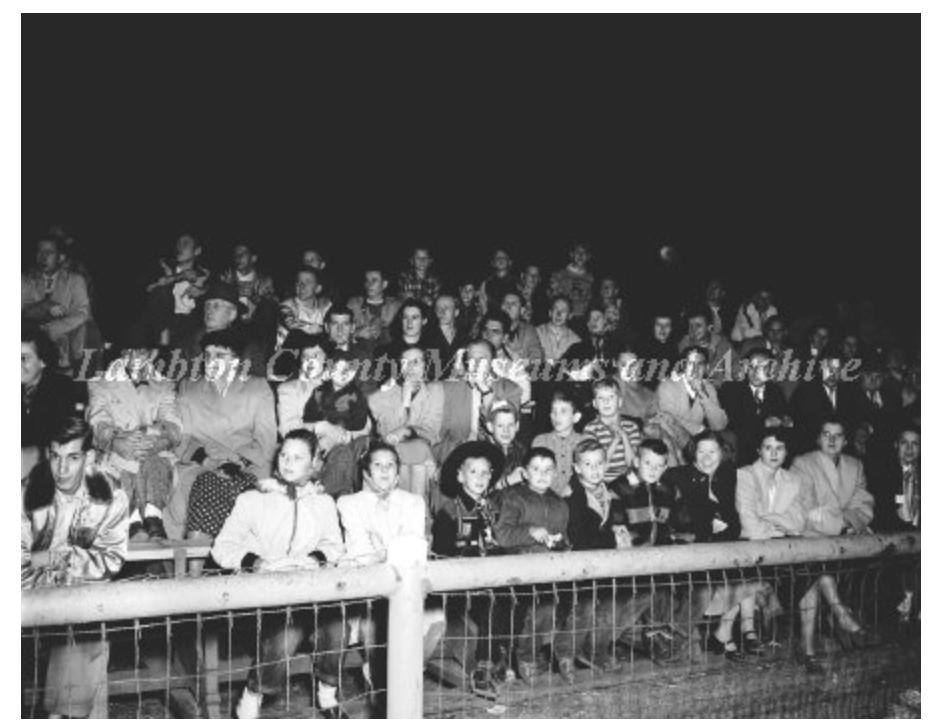
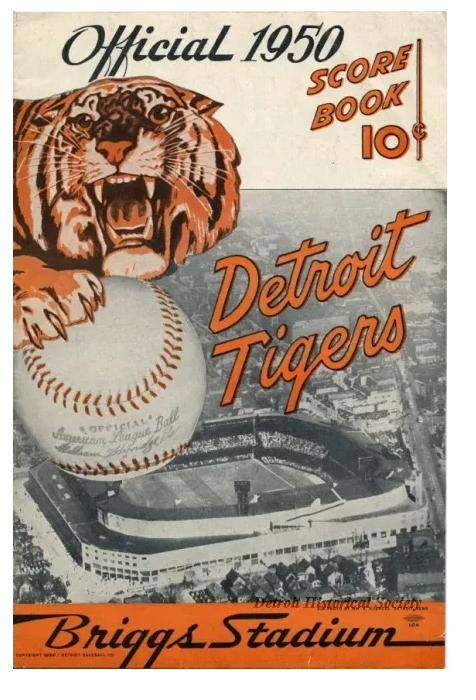
Sarnia spectators watching the Imperials, September 1950 — nine months before Bob's first voyage.Detroit Tigers scorebook, 1950. Detroit sat across the river from Bob's adult home.
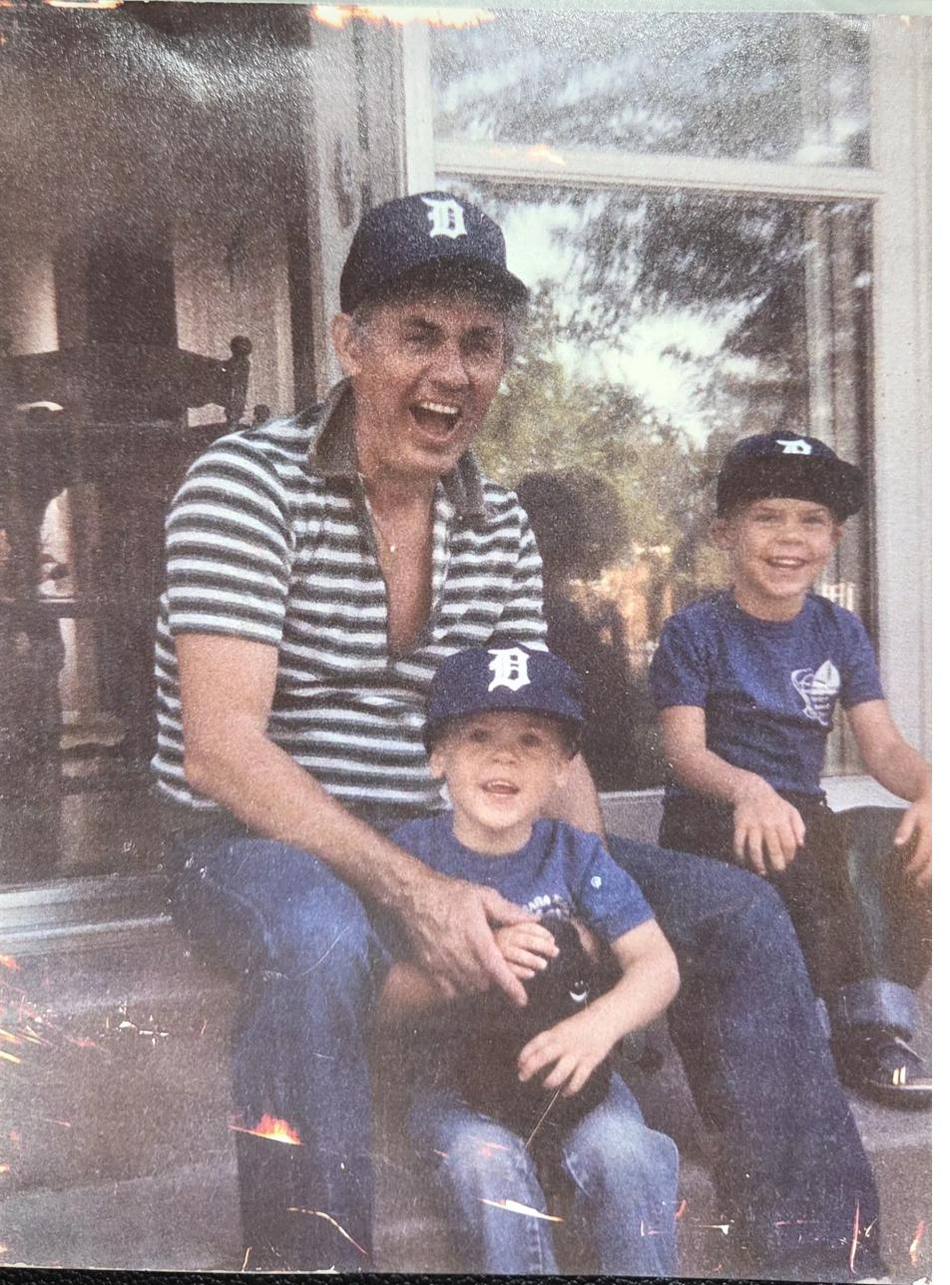
The Tigers became part of the grandfather his family knew. Brian remembers summer afternoons with a radio beside Bob and Tigers baseball on, and trips across the river to see games. We do not have equivalent evidence proving that teenage Bob was already a Tigers devotee during the ship summers, so that connection remains family belief rather than documented fact.
Robert with grandsons Brian and Greg in matching Tigers caps. The photograph survived a later house fire.
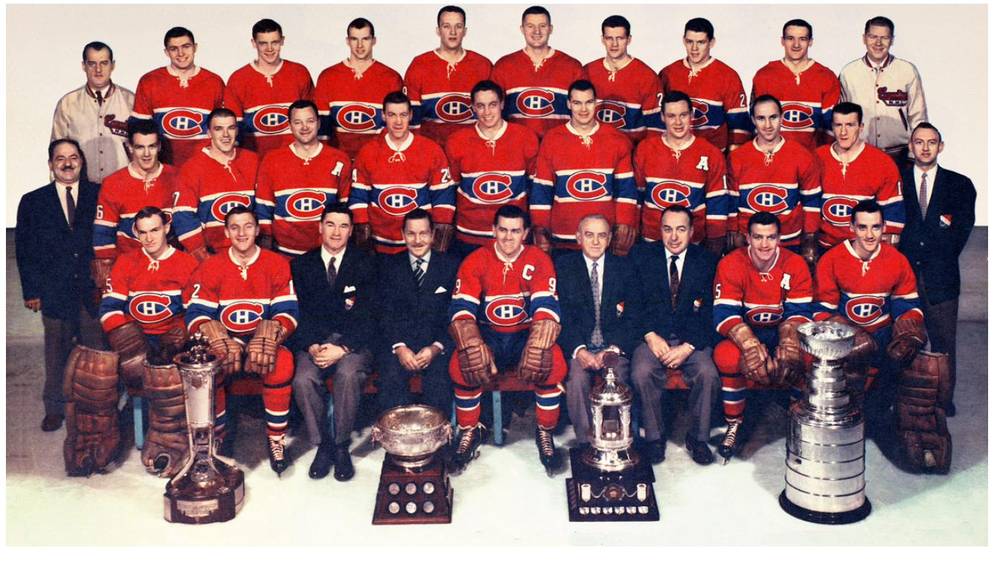
Montreal supplied the other lifelong team. Bob was born there, and family memory places the Canadiens alongside the Tigers among his loyalties.
The Montreal Canadiens during the era that followed Bob's last ship — five consecutive Stanley Cups, 1956–1960.
The payoff the book could never contain
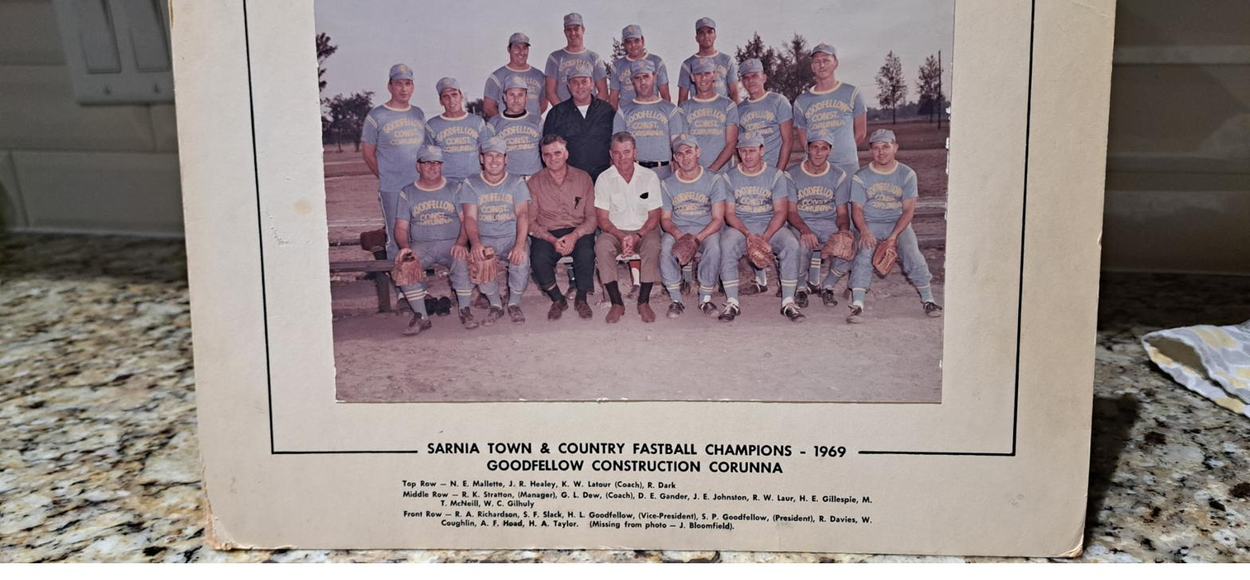
In 1969, fourteen summers after he left the Imperial Hamilton, a mounted team photograph names R. Davies among the Sarnia Town & Country Fastball Champions, Goodfellow Construction of Corunna. The printed name identifies him as a member of the team; the exact figure in the photograph has not yet been confirmed.
Sarnia Town & Country Fastball Champions, 1969 — R. Davies appears in the printed front-row name list.
Fourteen summers after his final tanker engagement, the printed roster places R. Davies among the 1969 champions. Organized ball remained part of his adult life.
A town under the story
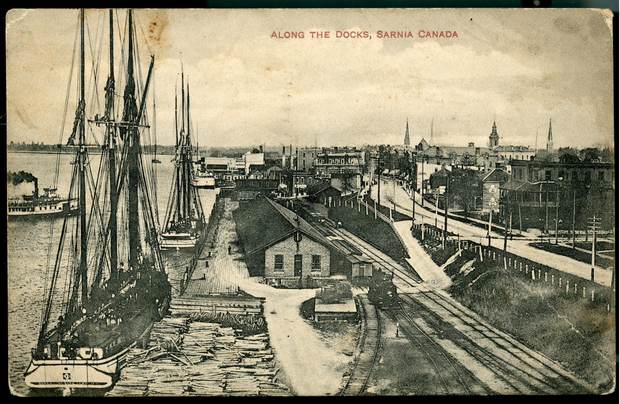
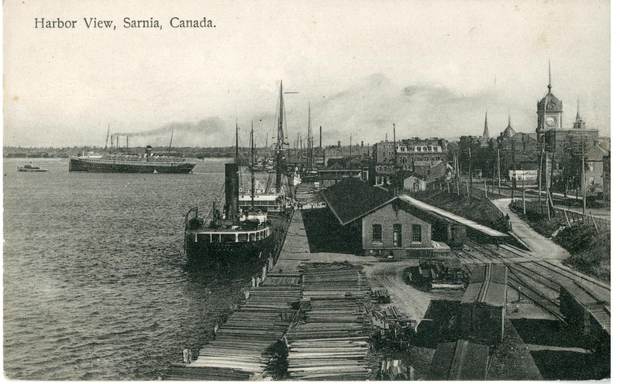
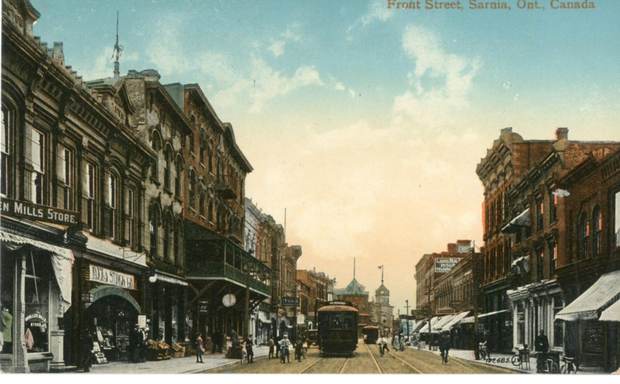
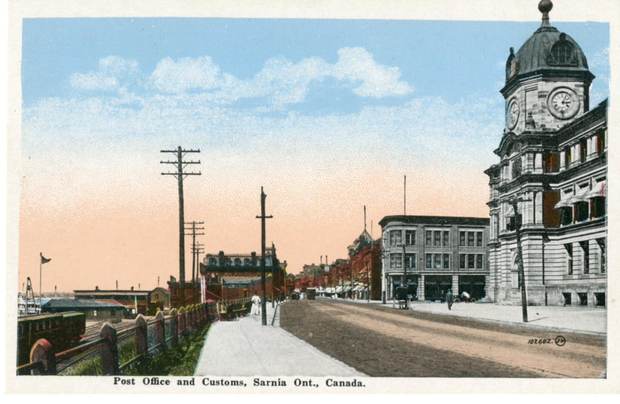
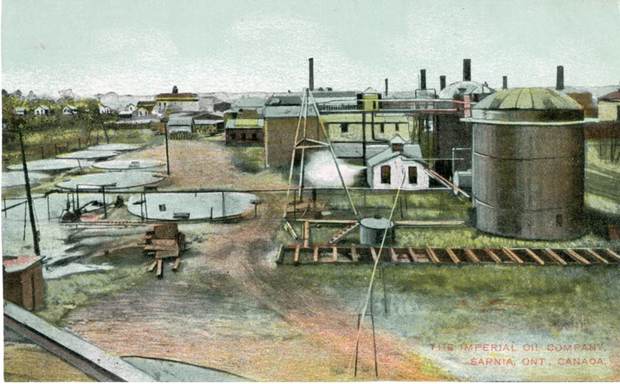
Along the docks, c. 1910.Harbour view, c. 1911.Front Street, c. 1910.Post Office and Customs, c. 1912.
Imperial Oil Company, Sarnia, c. 1910. None of the family is in these images; they show the waterfront and industrial town that would become the setting of Robert's life.
After Book 27710
What he did instead
The discharge book ends in August 1955. Robert's life does not. In fact, almost everything his family actually remembers about him comes after the final line.
“My dad always wanted to go to university and be a teacher.”Judy · his daughter
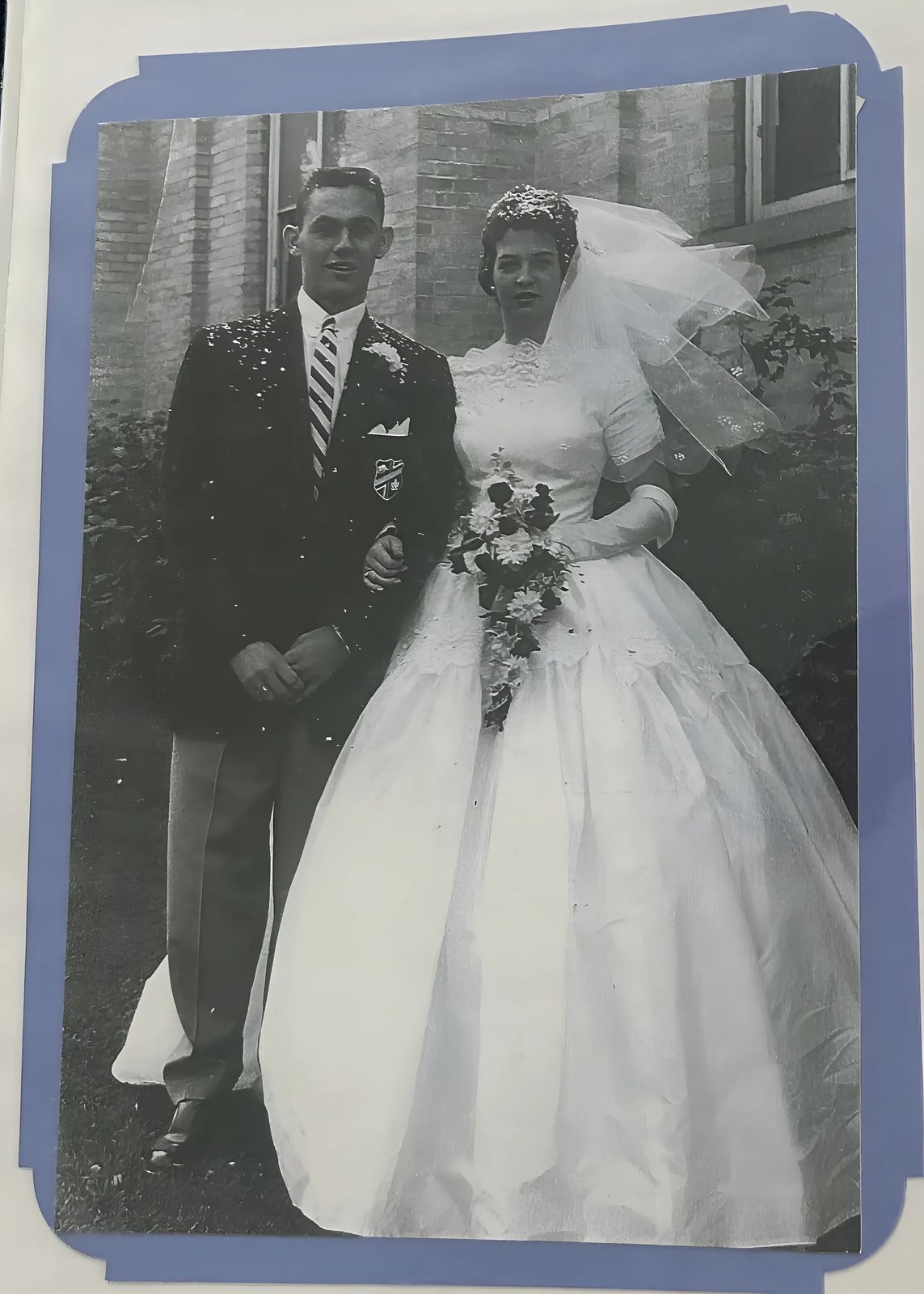
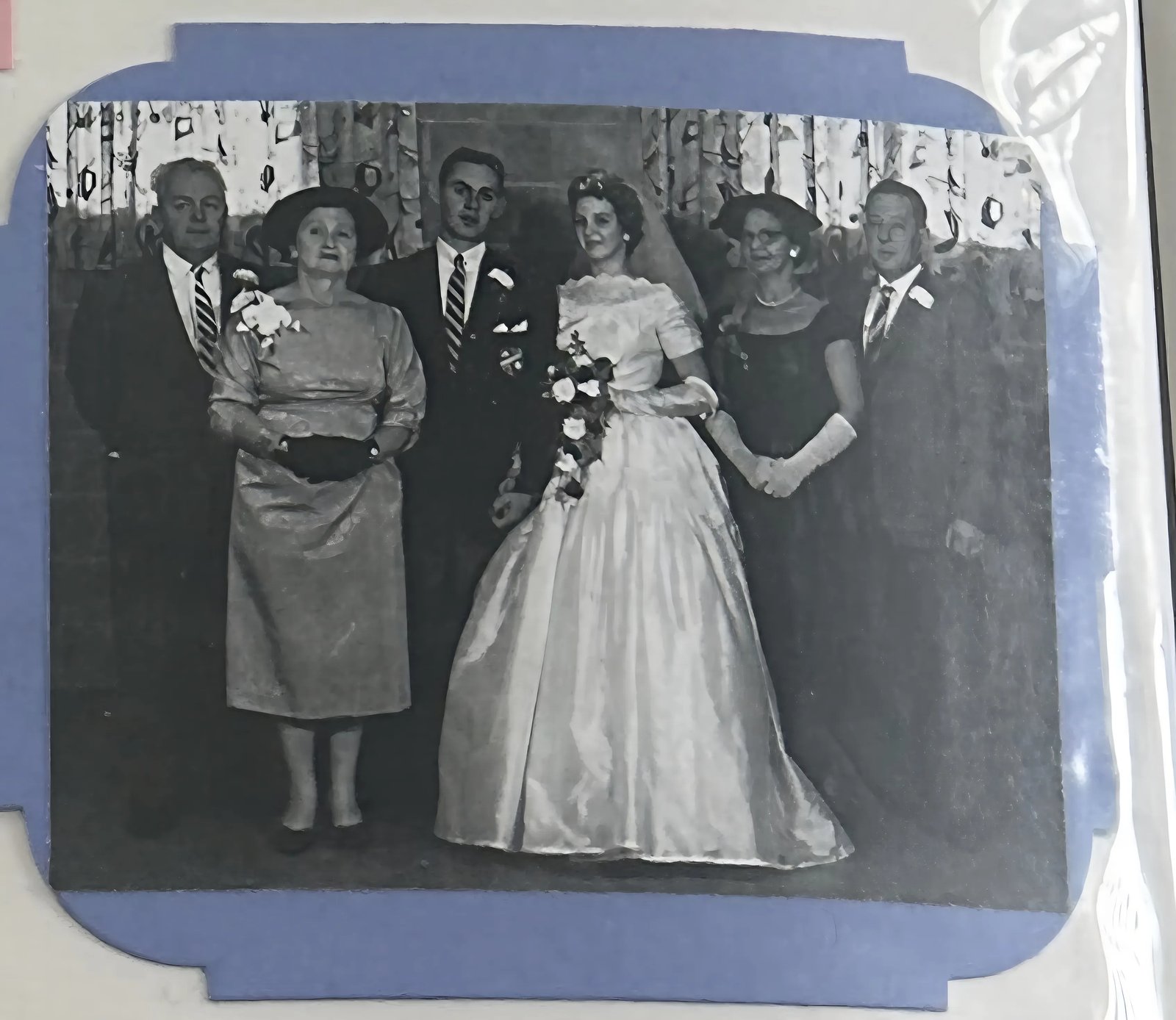
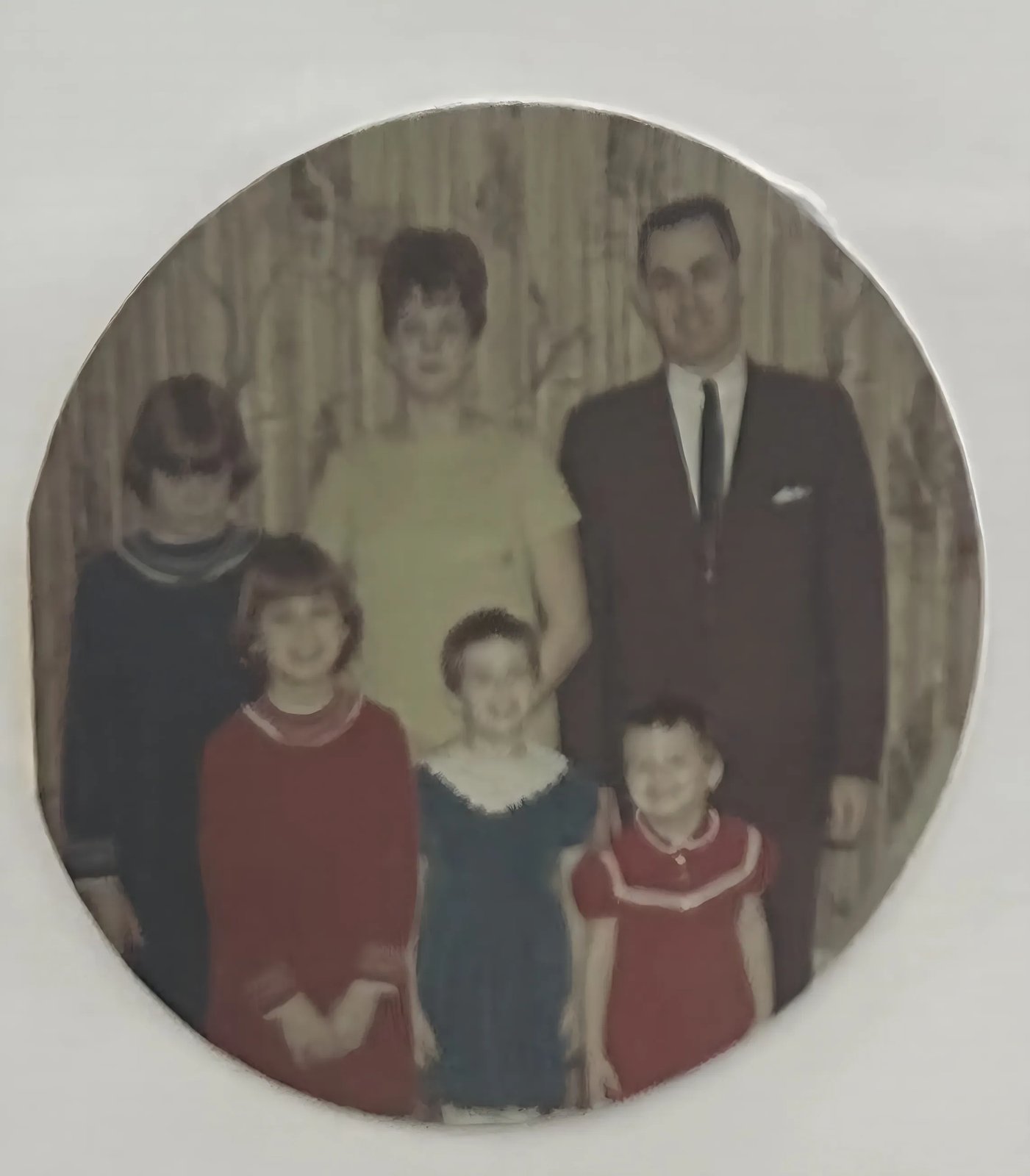
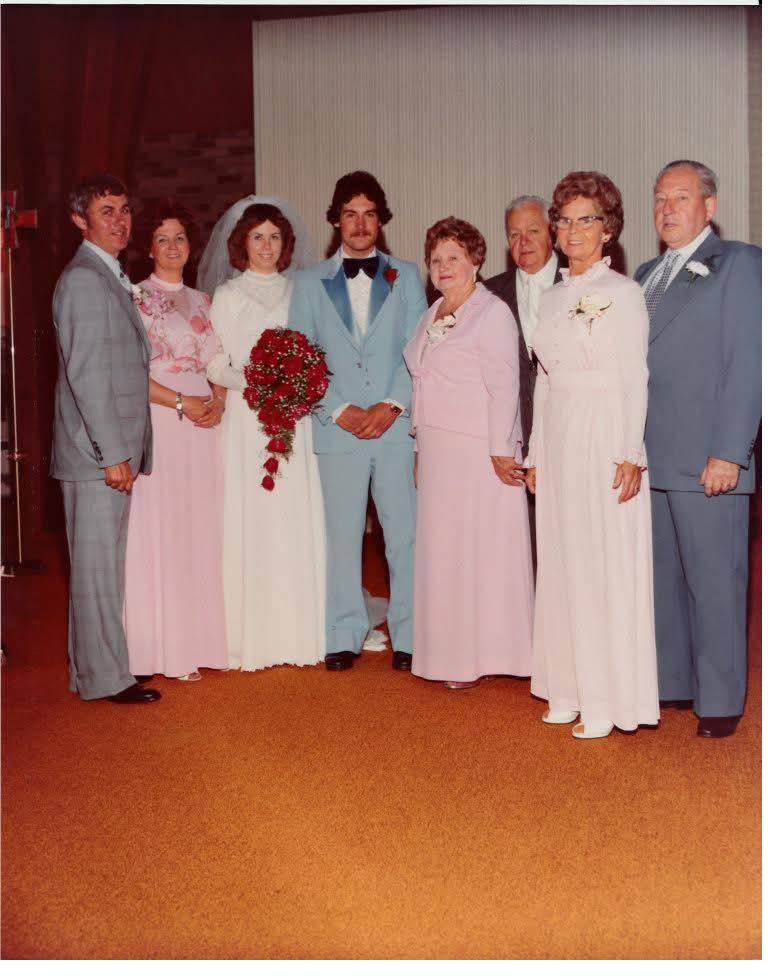
He did not become a teacher. His brothers Ted and Reg did, both eventually teaching at St. Patrick's. Robert's path went elsewhere. On 5 October 1957, at twenty-one, he married Donna Strevel. They raised four daughters: Brenda, Cheryl, Judy and Sandra.
Robert and Donna, 5 October 1957.Both families on the wedding day: the Davies and Strevel parents flank Robert and Donna.
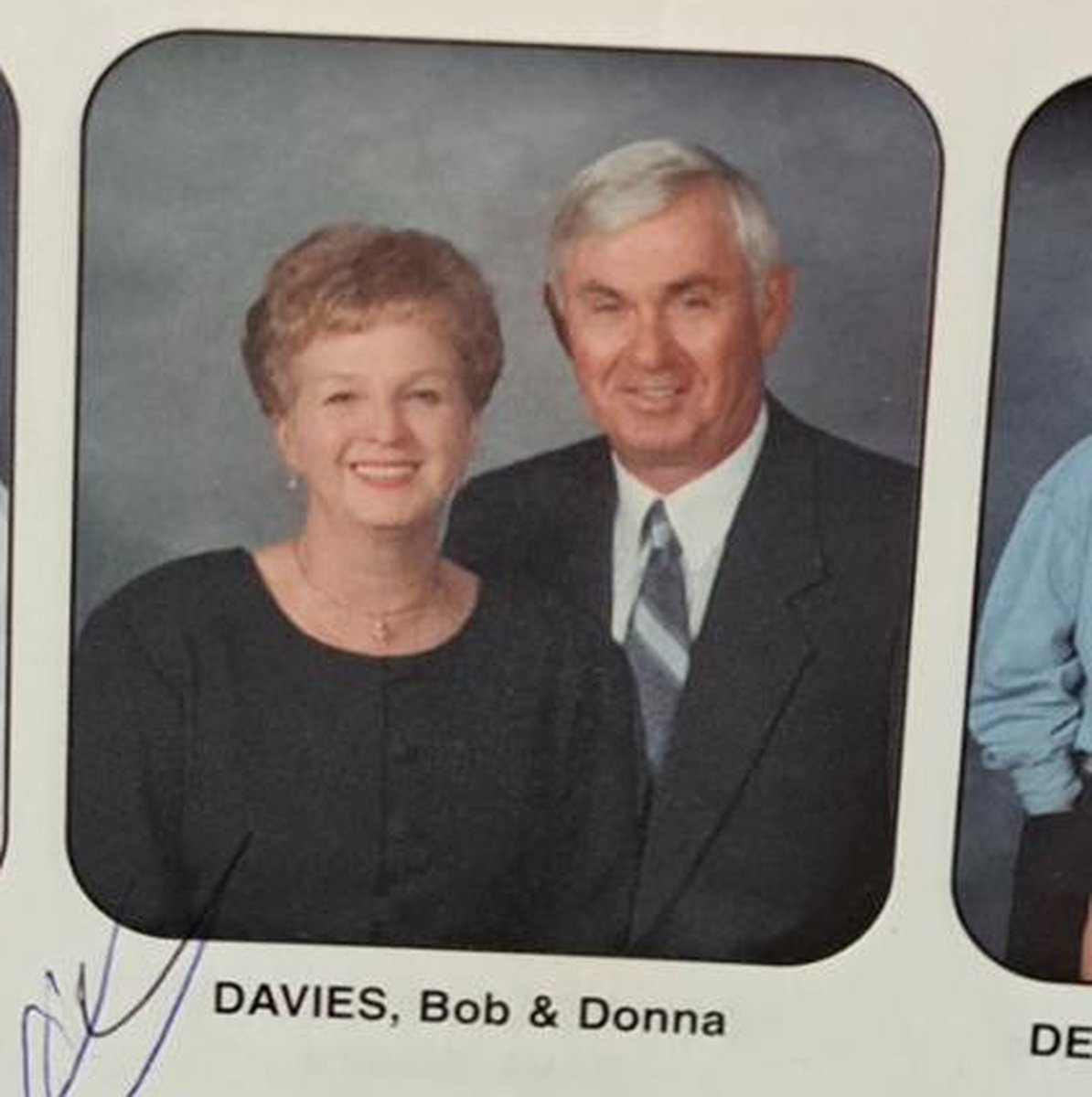
Robert and Donna with their four daughters, left to right: Brenda, Cheryl, Judy and Sandra. The date of the portrait remains unresolved.
Sandra remembers Donna making Christmas a major family occasion: the house done up for the holiday, a big dinner, and gifts for everyone. She remembers that Donna loved doing it.
Robert went ashore to work for Imperial Oil and remained with the company for his working life. Family testimony consistently remembers him as a refinery man and a committed union man. Sandra remembers an ordinary rhythm from those years: he came home from work, went jogging, had dinner, and then spoke with his father on the phone just after dinner, every day.
A parish that ran through the family
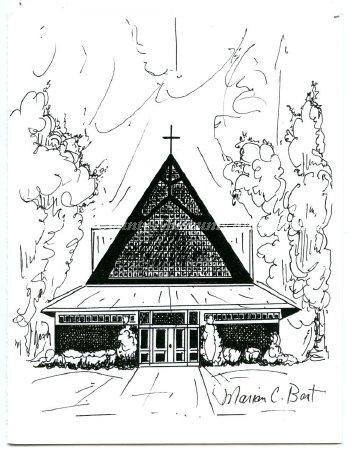
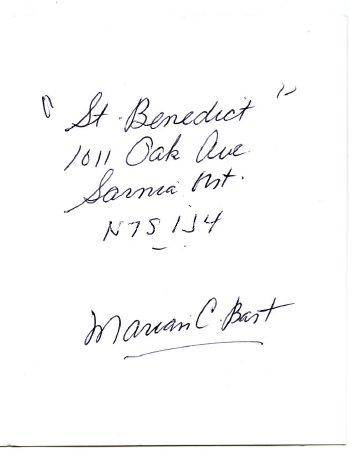
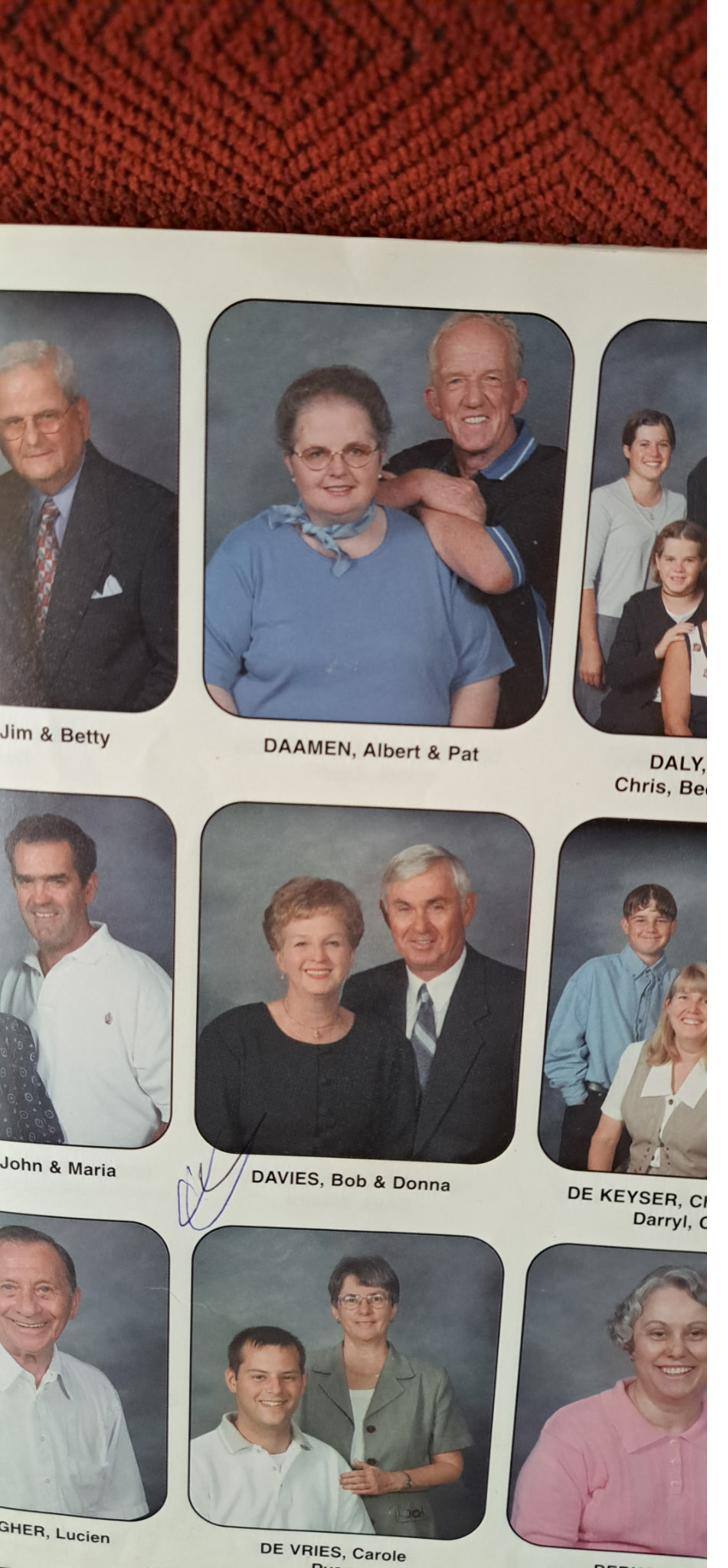
St. Benedict's at 1011 Oak Avenue became a recurring setting: worship, bingos, St. Vincent de Paul work, the breakfast programme, and the community life his daughters and grandchildren remember.
St. Benedict's, drawn by Marian C. Bast.The reverse, identifying the church and address.St. Benedict's parish directory, 1999 — Bob and Donna in print.
A family echo · not evidence about Bob
The same water, fifty years later
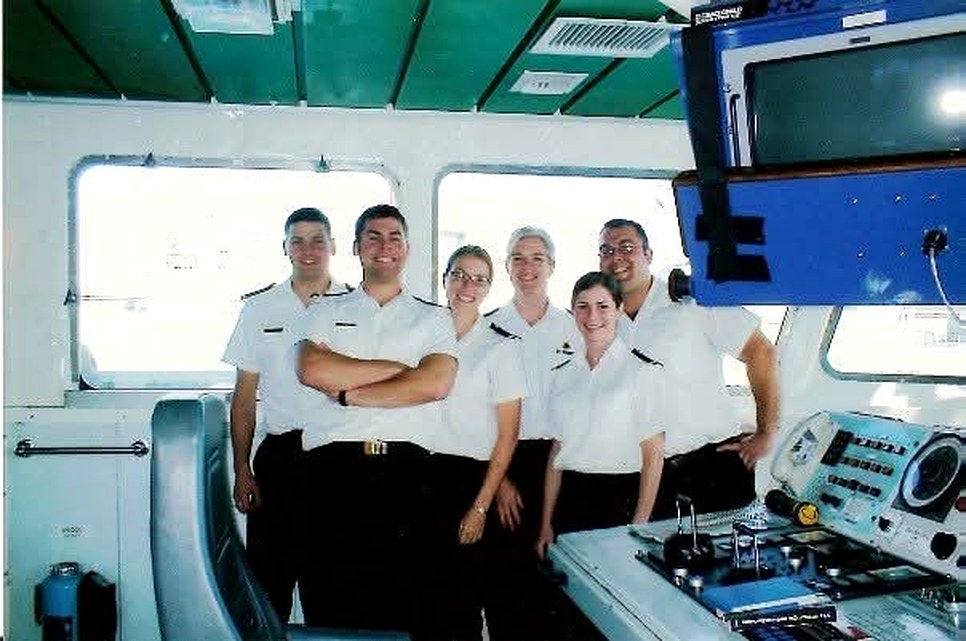
In 2003, Robert's grandson Brian sailed HMCS Kingston from Halifax, through the St. Lawrence and into the Great Lakes as a young naval officer. The route crossed water Robert had travelled as a teenager and used Seaway locks whose construction began while Bob was still working the older canal system.
Brian has said plainly that he did not want that period at sea either, although he completed it. The parallel cannot tell us what Bob felt. Its value is narrower and more personal: two generations did unwanted work on much of the same water, half a century apart.
In February 2004, while on training in Newfoundland, Brian telephoned his grandfather. It was their last conversation. Robert died that May.
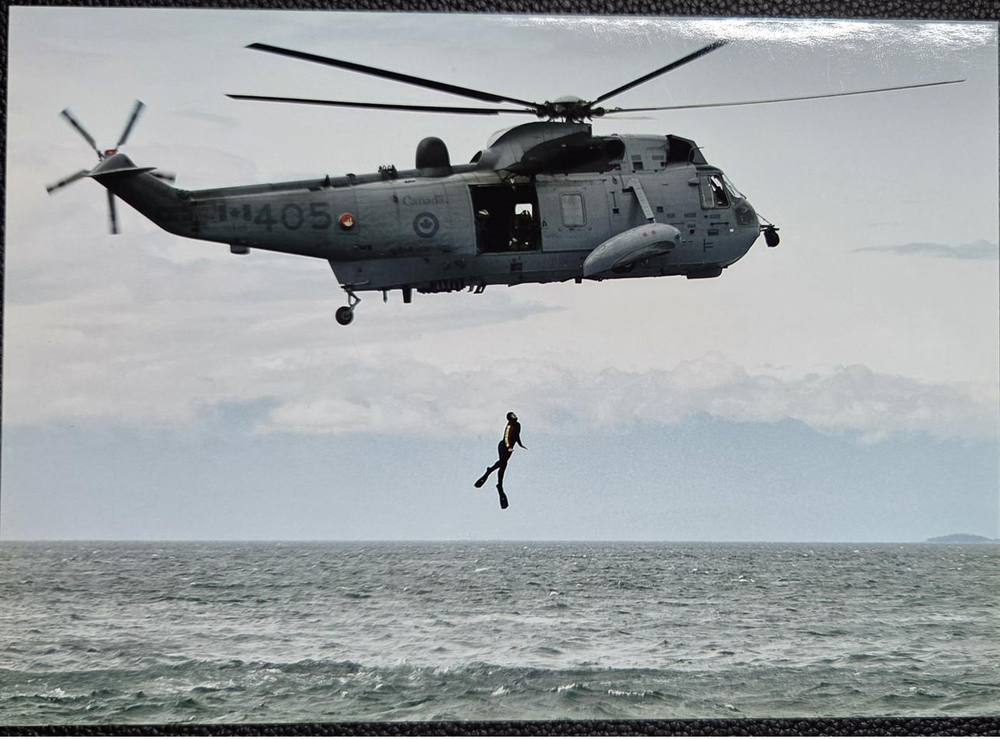
HMCS Kingston, Kingston, Ontario, summer 2003.A later naval training image from Brian's service — included here as part of the grandson's maritime thread, not Robert's evidence.
Part IV
The Man We Knew
The discharge book stops at nineteen. Family memory begins where the official record falls silent.
The part the family knows
After the book stopped
Robert came home from the Imperial Hamilton at nineteen and, as far as the family knows, never worked a ship again. Everything the family actually remembers about him happened after the book stopped.
Brian’s Royal Military College graduation, Kingston, May 2003. Robert is at the far right in a tan jacket.
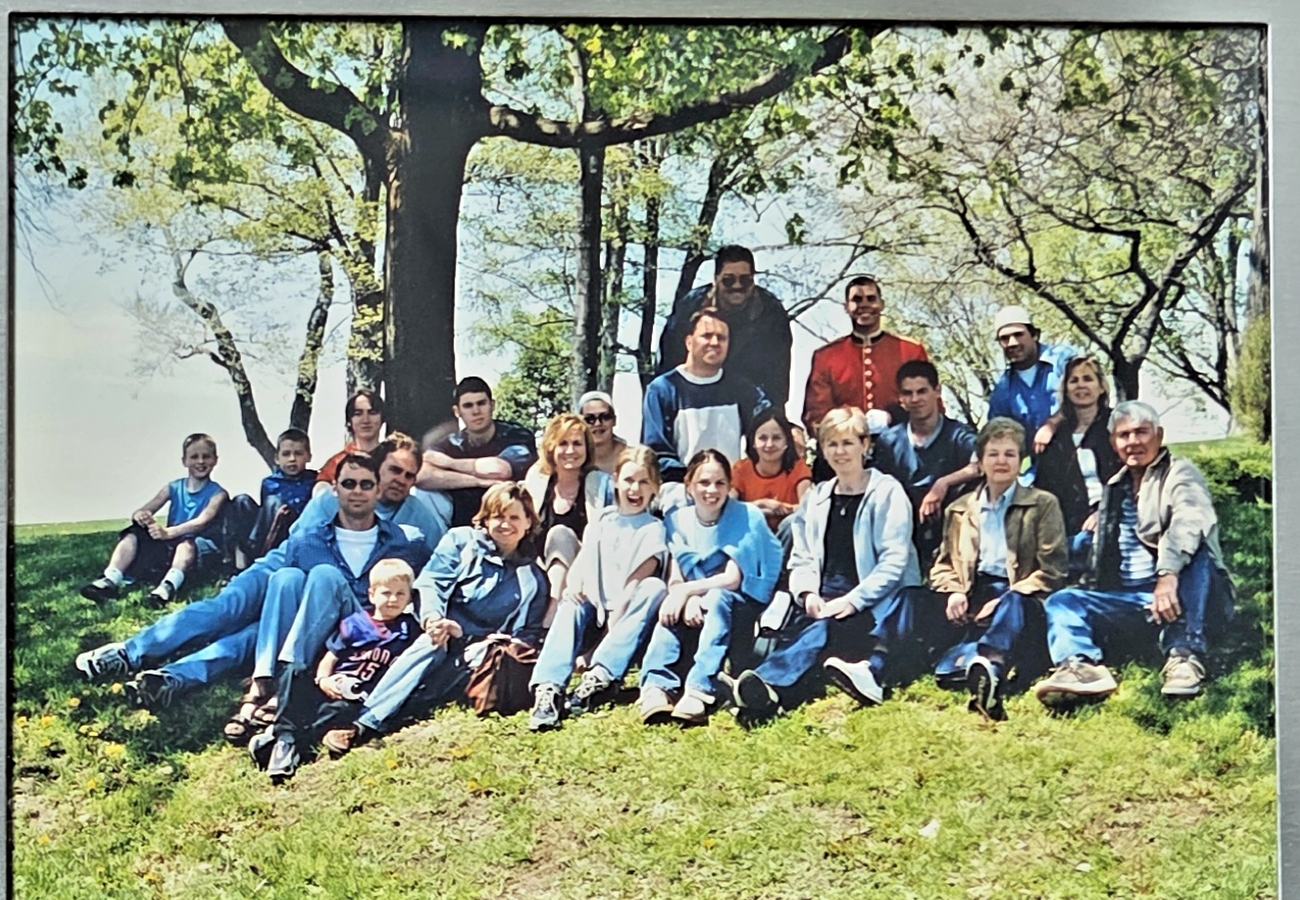
By then the family had become large. Robert and Donna's four daughters had twelve children of their own. Their Sarnia home was a gathering place — holidays, the pool, strawberries and rhubarb in the garden, the ordinary repeated visits that later become the most durable memories.
Brenda and Sandra remember Donna loving Christmas. Sandra remembers the house decorated, a big dinner and gifts for everyone; Brenda remembers how much time her mother put into shopping and preparing for the holiday. Robert always carved the turkey at Thanksgiving and Christmas. Brian still remembers the electric carving knife. Birthdays were family occasions too: Brenda remembers the grandparents coming for supper when there was no children’s party.
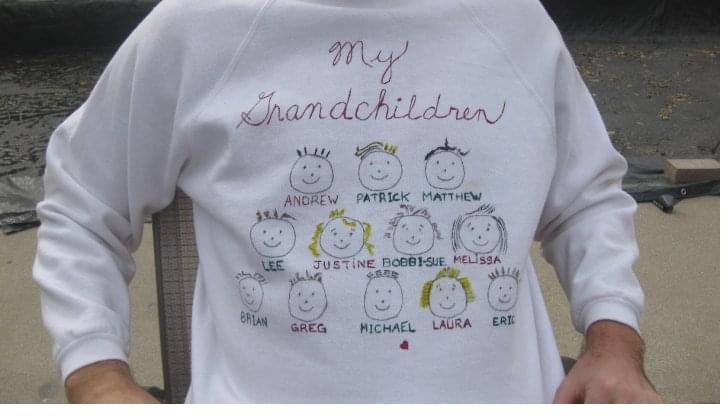
20 May 1978 — three generations at Brenda and George's wedding.Twelve grandchildren, stitched into one sweatshirt.
Judy remembers waiting for him to come home from the refinery, jumping into his arms from the landing, and finding the snack he had saved from his lunchbox. Later, when she pitched fastball, he caught for her after work and counted out one hundred pitches.
Melissa remembers the loonie or toonie for penny candy and long games in the pool. Brian remembers volunteering beside him at the St. Benedict's breakfast programme and being taken, around Grade 8 or 9, to deliver Christmas hampers to families who needed them.
That service appears independently in Judy's scrapbook: church work, bingos, St. Vincent de Paul, the breakfast club. So does the labour conviction. During a teachers' strike around 1998, Judy remembers her father joining the picket line in solidarity.
Sandra, Robert’s fourth daughter, wrote that she never felt less wanted, despite knowing that her dad would have loved to have had a son. She remembered him getting all four girls involved in sports — regular jogging and skill-building included. She did not always appreciate his intensity at the time, but later wrote that she was tremendously grateful for it: all four sisters remained actively engaged in physical fitness and continued to enjoy participating in and watching sports.
What stayed with Sandra most strongly was his example. She remembered her father as a constant in their lives, someone who made friends feel welcome and instilled values without preaching. When she went through difficult periods, she wrote that his example helped her see the way back. She described him as kind, engaged and accepting, and wrote that his strong faith may have contributed to him becoming a beacon for his daughters. Looking back years after his death, Sandra wrote that she and her sisters could see “how rich we really were to have him in our lives.” In the final version of her note, she added that all four remained forever grateful for him as a caring and involved grandfather.
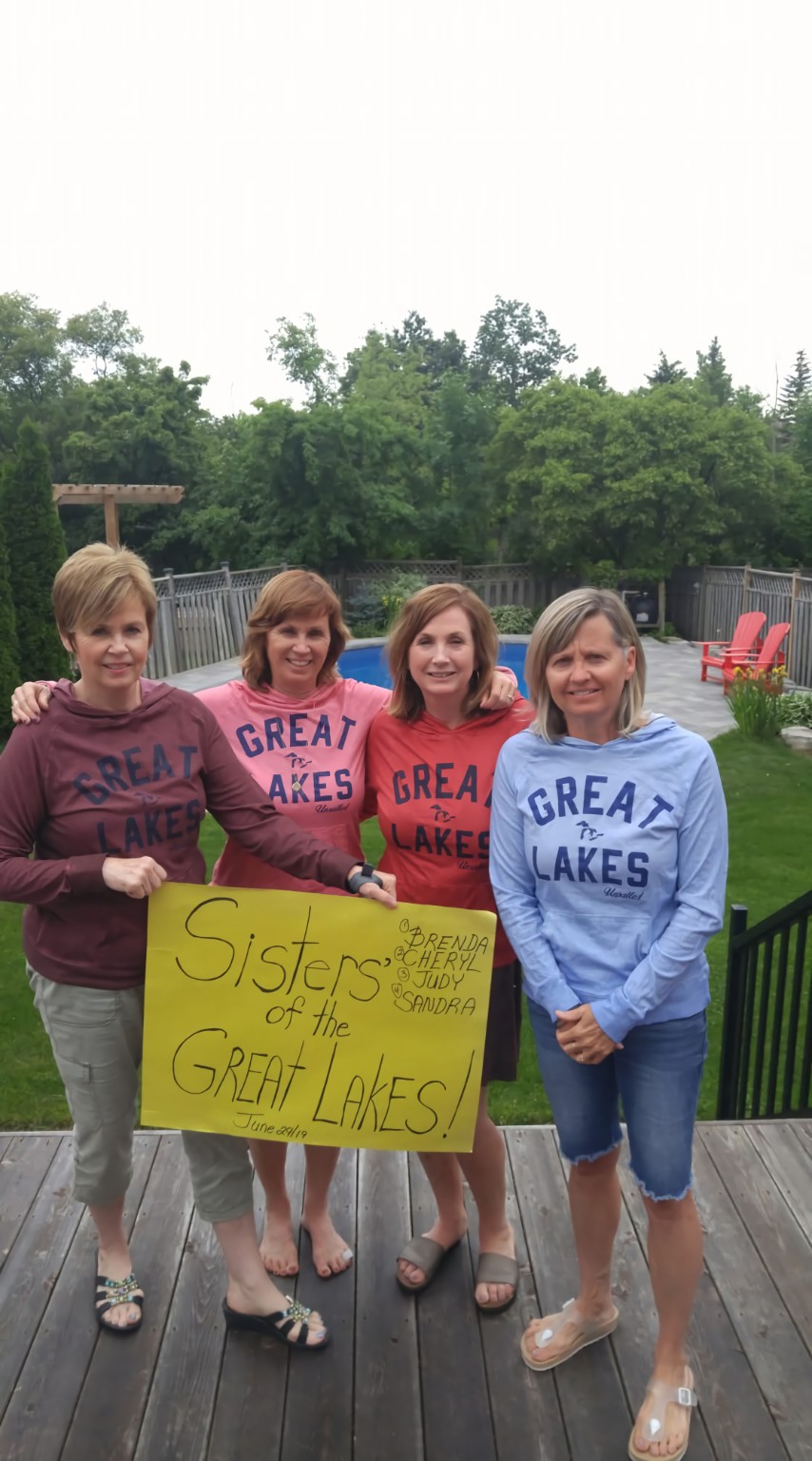
That active sisterhood is visible in the life the four daughters built together. In June 2019, Brenda, Cheryl, Judy and Sandra turned one sister trip into a challenge: take a dip in each of the five Great Lakes in a single day. Their rule was that everyone had to go under. Sandra remembers that Brenda made it only as far as her shoulders.
“Sisters of the Great Lakes,” June 2019. The four sisters marked a one-day dip in all five Great Lakes.
Education became a repeated profession in the family, although the evidence does not tell us that Robert caused that pattern. His brothers Ted and Reg taught — both eventually on staff at St. Patrick's, where Brian and Greg later attended. His daughters Judy and Sandra also taught, and grandchildren Michael, Laura and Melissa went into education. Robert's own wish to become a teacher is documented separately; any connection between that wish and the choices of later generations remains unknown.
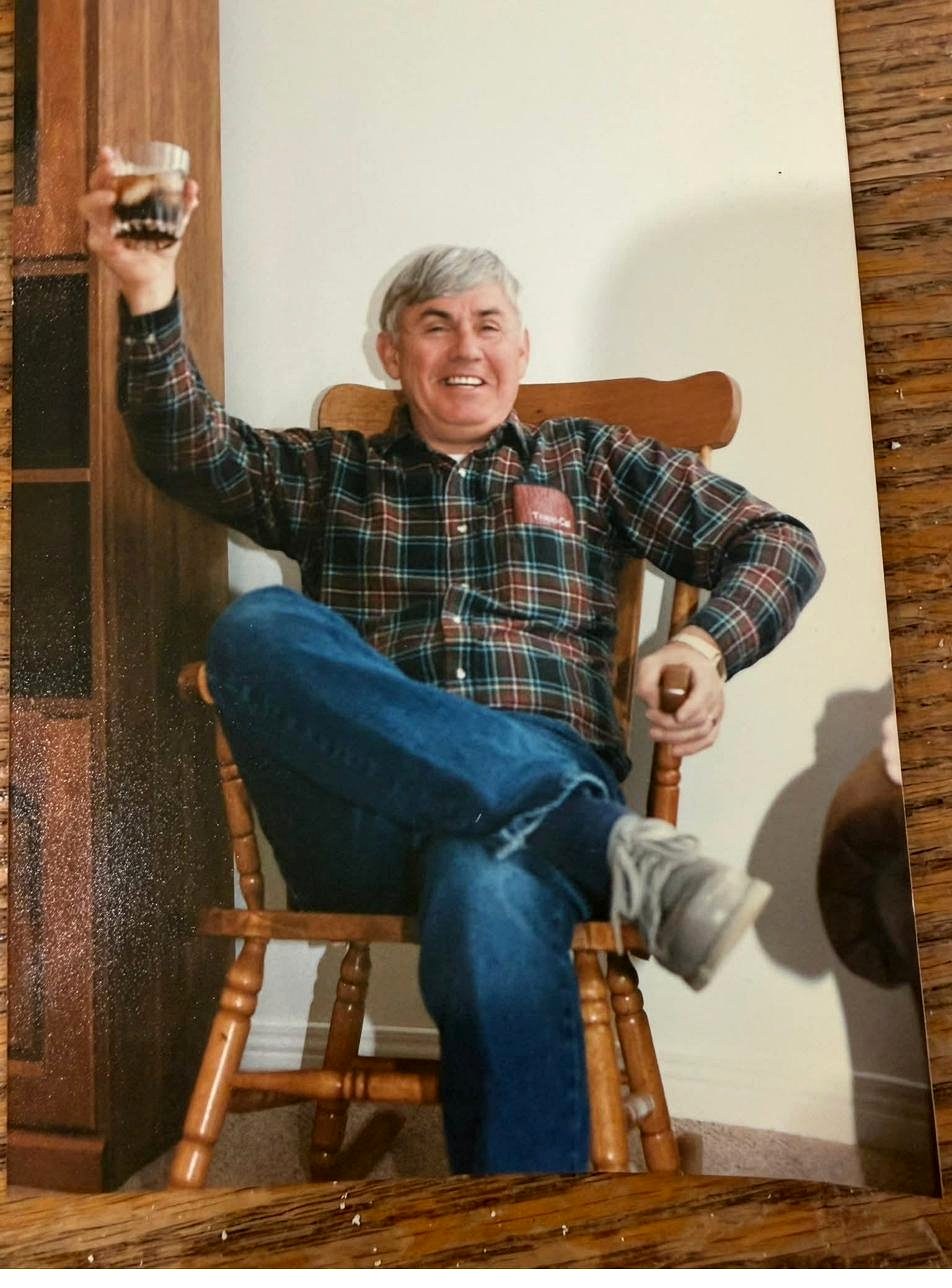
A later family-era image from 1999 — part of the record of the life after the ships.Robert Davies in the rocking chair — the man his children and grandchildren remember.
The little blue book gives us the teenager: five foot five, blue eyes, a ship every summer, VERY GOOD in every row. His family gives us the rest — the ballplayer, refinery worker, union man, volunteer, husband, father and grandfather. The point of preserving both is not to make one explain the other. It is to let the boy and the man occupy the same story.
Robert died in Sarnia in 2004, aged sixty-eight. Donna died in 2016. The documents can still answer questions about dates, ships and places. For the man himself, the most valuable evidence is now the memory of people who knew him.
Continue with the photographs. The family album collects the images separately from the narrative.
The principal anchors are Robert’s Continuous Certificate of Discharge No. 27710; the 1936 Saint Aloysius baptismal register; The Shamrock 1955; family photographs and attributed testimony; the Winter 1945 Imperial Oil Review; the official 1 January 1945 Canada Gazette O.B.E. appointment; and the census, civil-registration and directory records that now reconstruct part of Captain Ted’s orphan years. The Research Notebook keeps the fuller provenance, conflicts and active leads, while the Captain Ted appendix preserves the long-form reconstruction.
The investigation continues elsewhere
Research Notebook
The finished narrative ends above. Open questions, conflicting evidence, source notes and next archival leads now live on their own page.