The open discharge book, pages five and six, ship names and dates in fountain pen.

Continuous certificate of discharge · no. 27710

Five Summers on the LakesRobert James Davies · 1951–1955

He was fifteen the first time he signed on. He didn't want to go. He went anyway, five years running, and every master who signed him off wrote the same two words.

The number 27710 stamped in red ink.

The book's own number, stamped in red

The document

One line per voyage

A seaman's discharge book records the ship, where he joined, where he left, the job he did, and what the captain thought of him.

We have pages five and six. Five ruled entries, five summers — one of them written in pencil rather than ink, and very nearly lost because of it.

The book survived seventy years in this family. For a while it was the only thing we had. Then Brenda sent one sentence, and the sentence turned out to be the key to all of it.

"This is a log of ships my dad sailed on in high school summers. He didn't like it all because he wanted to play baseball. His dad got him the summer job."

Brenda — his eldest daughter

What the book says

Year
Ship · engagement
Age
1951
SS Imperial Simcoe
Deckhand · home trade
16 Jun, Sarnia → 26 Jul, Montreal
15years
1952
Imperial London
Deckhand · Great Lakes
13 Jun, Sarnia → 22 Aug, Montreal
16years
1953
Imperial Collingwood
Wiper · Great Lakes
6 Jun → 14 Aug, Sarnia to Sarnia
17years
1954
Imperial London
Deckhand · inland waters
17 Jun → 1 Sep, Sarnia to Sarnia
18years
1955
SS Imperial Hamilton
Deckhand · inland waters
22 Jun → 18 Aug, Sarnia to Sarnia
19years

The pencil line. The 1952 entry is in pencil, not ink, and has faded almost to nothing. It was briefly suspected of being ink bleeding through from the facing page — but it reads the right way round, where bleed-through would read backwards, and it sits exactly where a 1952 voyage belongs. Brian confirmed the year off the original book. Five summers stands.

A black rubber stamp reading V G and V G in two ruled boxes.

Report of characterFor ability: very good. For general conduct: very good. Every season, every master, without exception.

The facing page of the discharge book: five ruled rows of character reports, ratings and signatures.
Page 6 — the report of character. Five rows, matching five engagements: Home Trade, Great Lakes, Great Lakes, Inland Waters, Inland Waters. Two rubber-stamped, three written by hand. This page is the independent proof that there were five summers, quite apart from the pencil line opposite.Signed by C. F. Leslie · E. R. Dyer · J. Burns, 1st Mate · A. J. D—— · Geo. R. Thornton, 1st Mate · J. O. Williamson

Pages 1 and 2

The boy in the book

For seventy years this family had two photographed pages. In August 2026 the rest of the book was opened, and the front of it turns out to describe him — the only physical description of Robert Davies as a teenager that anyone has.

A form headed Continuous Certificate for Seamen, Department of Transport Canada, filled in by hand.
Continuous Certificate for Seamen — personal particulars. Department of Transport, Canada. Form 1667, printed September 1949.
Name of seaman, in fullRobert James Davies
Year of birth1935
Place of birthMontreal, Que.
Height5 feet 5 inches
Colour of eyesBlue
Colour of hairBlond
ComplexionLight
Tattoos or distinguishing marksNone — the field struck through
Officer's certificateNone

Five foot five, blue eyes, fair hair. A middle name nobody had written down: James. And a year of birth that is wrong.

Unresolved — the family's working theory

Every other record says Robert Davies was born on 2 April 1936. The Ancestry entry says so. Brenda's own post on what would have been his eighty-fifth birthday says so, and the arithmetic of his parents' ages agrees.

The book says 1935. It was written around 1951, closer to the fact than anything else we have — and it is the only document here he touched himself.

One year. And it lands on exactly the year that would make him sixteen in June 1951 rather than fifteen. A clerical slip could have produced any wrong year; this one produced the useful one.

The family's working theory is that he added a year to get aboard. It is unproven. We have not established what the minimum age actually was in 1951, and a simple mistake by whoever filled in the form would explain it just as well. The aunts have now been asked — none of them had ever heard the story, which removes a family legend from the evidence and leaves the two documents facing each other.

One observation survives either way: his father was the captain who arranged the berth, and you cannot misstate your age past your own father. If the year was fudged, it was fudged with Edward's knowledge — a family enterprise, not a boy's solo crime. Until a birth record or a told story surfaces, this stays a theory, marked as one.

The keepsake keeps his real birthday. Where it says he was fifteen, that is the 1936 date, the one the family has always kept. What the book says is here beside it, and the two are left to disagree.

A page headed Certificate of Discharge for Seamen with a handwritten place of birth and a signature.
Place of birth, and his own signature. Montreal, Que., in a shipping clerk's hand — and beneath it, Robert Davies, in his. Stamped by the Shipping Master's Office, Montreal.

Also on this page: S.C. No. 4443 and U.T. M/499-179, two identifiers whose meaning we haven't yet worked out. The officer's certificate columns are blank — he never held one. He was never anything but crew.

The four ships

What he actually worked on

All four were Imperial Oil tankers, all canal-size — a little over 250 feet, because that was what fitted through the old St. Lawrence locks. Between them they were built across thirty-one years, and he joined them at every stage of their lives.

A black-hulled tanker lettered Imperial Products under way in low sun.
Imperial Simcoe
Built 1930 as Simcolite6
Imperial Oil 1947–1965 · scrapped 1965
21 years old when he joined her
The stern of a tanker lettered Imperial London, Sarnia.
Imperial London
Launched at Collingwood, Ont., 1948
Imperial Oil 1948–1976 · lengthened 1969
4 and 6 years old — the newest he sailed
A black-hulled tanker, Imperial Collingwood, broadside in calm water.
Imperial Collingwood
Built 1947
Later Seaway Trader, Patricia II, Balbao Trader, and Rivas in 1995
6 years old — she outlived him
An older tanker, Imperial Hamilton, with a tall single funnel.
Imperial Hamilton
Built 1916 as Sarnolite
Imperial Oil 1947–1963
39 years old — by far the oldest

Photographs from Auke Visser's Other Esso Related Tankers Site, which gathers images from many private collections. Several show the ships after later rebuilding, so they are not all as he knew them.

1951 · Imperial Simcoe

Fifteen

He turned fifteen on the second of April, 1951. Ten weeks later he was a deckhand on a twenty-one-year-old tanker headed down the St. Lawrence.

A tanker lettered Imperial Products alongside a dock, with 1950s cars parked in the foreground.
Imperial Simcoe alongside. The cars date the scene to roughly the years he was aboard. This is the world of the job: a dock, a hull, and whatever was parked behind it.Auke Visser's Other Esso Related Tankers Site

The voyage ended on 26 July at Montreal — the city he was born in, as the book itself records two pages earlier. He would be set down there again the following summer. Almost certainly coincidence: the Simcoe was registered at Montreal. But twice in two years, the boy from Halifax by way of Sarnia came off a ship in the city where he started.

A tinted aerial postcard of an oil refinery: rows of white storage tanks, red brick buildings, tall stacks, rail sidings, a ship at the dock.
Aerial View of Imperial Oil Refinery, Sarnia, Ontario, c. 1950. The plant as it stood the year before he first signed on — tanks, stacks, rail sidings, a ship alongside, and workers' houses in the trees at the bottom edge.Photogelatine Engraving Co. · Southwestern Ontario Digital Archive, Leddy Library, University of Windsor · Public domain

Sarnia was not a small refinery town. Between the 1951 and 1956 censuses its population went from 34,697 to 43,4471 — roughly a quarter larger in five years. Imperial Oil had refined there since 1897, and what people later called Chemical Valley was assembling itself around him while he was in high school.

1952 · Imperial London

The pencil summer

The ship he joined at sixteen was four years old — practically new, and the newest thing he ever sailed. Four summers earlier she had gone down the ways at Collingwood, Ontario, in front of a crowd.

A ship's hull sliding into the water, throwing up spray, watched by a large crowd in hats.
Launch of the Imperial London, Collingwood, Ontario, 1948.7 He was twelve years old and living in Halifax when this happened.Auke Visser's Other Esso Related Tankers Site
A person in a fur stole swings a bottle against the bow of a ship beside the painted draft numbers.
The christening. The bottle, the bow, the draft marks counting up from the waterline.Auke Visser's Other Esso Related Tankers Site

Ten weeks that summer — out of Sarnia in June, off at Montreal on 22 August. It is the entry that nearly disappeared — written in pencil by whoever had the book that day, and faded now to a grey ghost of itself between two lines of confident ink.

1953 · Imperial Collingwood

Eleven weeks

The summer he was seventeen, he signed on as a wiper — an engine-room rating rather than a deck one. It is the only time in the book he isn't a deckhand.

Of all five summers this is the one where the dates line up with everything else that was happening. He signed aboard sixteen days after a tornado tore through his own city.

The city was still clearing wreckage when he went to work. We don't know what he made of any of it — nobody wrote that down, and we're not going to invent it.

1954–1955 · London · Hamilton

The last two

In 1954 he went back to the Imperial London, now six years old, for his longest engagement yet — eleven weeks, into September. That same year, construction began on the modern St. Lawrence Seaway5 that would make the canal-size hull obsolete. He spent his last summers working a system that was about to be rebuilt around him.

Looking down onto a tanker's deck from above: pipework, hatches, catwalk and winches.
A canal tanker's deck from above. Pipework, hatches, catwalk, winches. This is what a deckhand's summer actually looked like.Auke Visser's Other Esso Related Tankers Site

His last ship was the oldest. The Imperial Hamilton had been built in 1916 as the Sarnolite; she was thirty-nine years old, older than his own father.

A night postcard: refinery lights along a dark shore, reflected in long streaks across the water.
Sarnia skyline at night, from the shore of the St. Clair River at Port Huron, Michigan. Postmarked 1955 — his last summer. The lights are the refineries. It is very nearly the sightline Brenda photographs from the other bank today.Kramer News Co. · Southwestern Ontario Digital Archive, University of Windsor · Public domain

He came off her on 18 August 1955, nineteen years old. As far as anyone in the family knows, he never sailed again.

September to June · St. Patrick's

The other nine months

The ships were only ever the summers. From September to June, all five of those years, he was a student at St. Patrick's High School, Sarnia — a Fighting Irish. His yearbook surfaced while this book was being written.

A grey yearbook cover reading Presenting The Shamrock for 1955, with the St. Patrick's H.S. crest.
The Shamrock, 1955. St. Patrick's H.S., Sarnia — the yearbook of his graduating year. The crest carries the school motto, Esse quam videri11: to be, rather than to seem.
A halftone yearbook photo of a young man in a leather football helmet, captioned Bob Davies.
Bob Davies, Fighting Irish football. Leather-helmet era.

Football, and basketball too — the graduates' blurb calls him “high scorer for the Fighting Irish,” which sits well beside the discharge book's own measurement of him: five foot five.

A yearbook page: a graduation photo defaced in ink with a beard and moustache, beside a large ink signature reading Bob Davies, The Brat.
His page in the graduates' section — improved by a classmate's pen. Beard, moustache, a “W,” earrings; beside it, in ink, Bob Davies, “THE BRAT.” The printed blurb: “Business Staff of the Shamrock — high scorer for the Fighting Irish — basketball player — progressive tackler through the 11.55 hall traffic.” Nobody now knows who held the pen, or whether the nickname was theirs or his own.

The nickname was invisible to the next two generations — his eldest grandson, who knew him longest of the twelve, says he'd never have guessed it in a million years. And then remembered the summer parties: turning up unannounced on a bike to find the pool and the yard strewn with empties. Judy's addendum, within the hour: “And the aftermath of our family parties too!” The Brat, it turns out, was merely dormant.

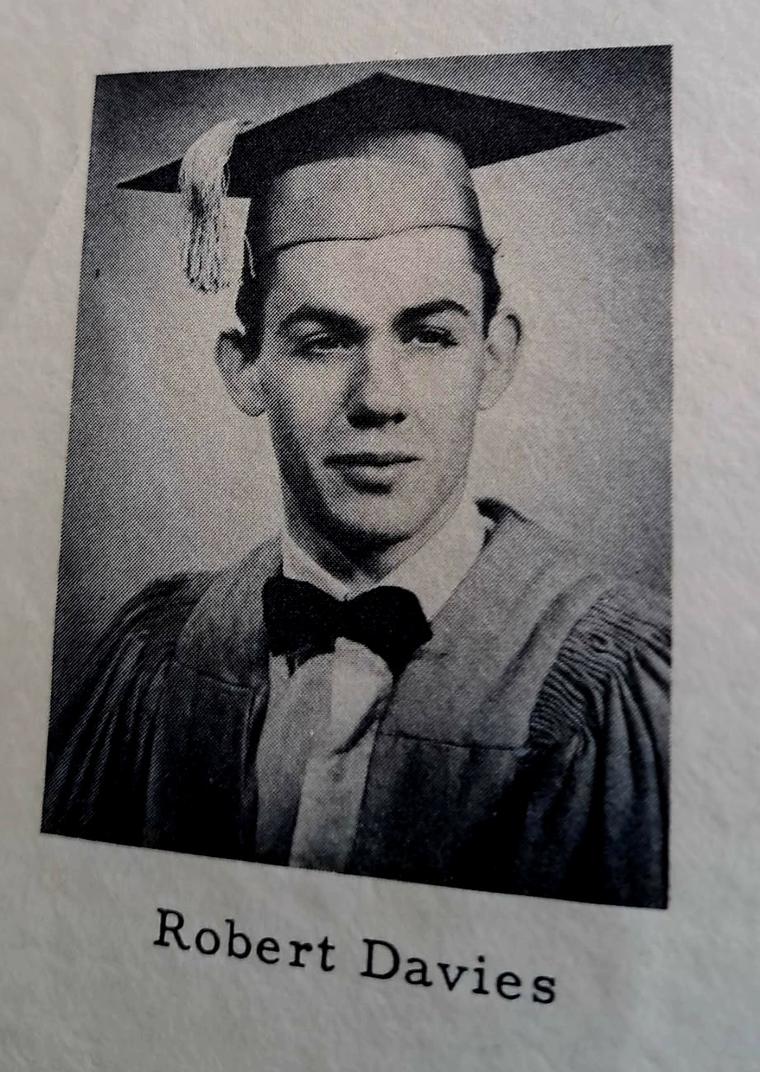
A yearbook graduation portrait: young man in cap and gown with bow tie, captioned Robert Davies.
Robert Davies, graduate. The clean print, before his friends got to it.

He finished at St. Patrick's in 1955. On 22 June that same summer he boarded the Imperial Hamilton. The yearbook and the discharge book are the two halves of the same five years — one for the winters, one for the summers — and both closed within weeks of each other in June 1955.

Sarnia · 4 September 1961

What became of the Hamilton

Six years after he walked off her, the Imperial Hamilton came into the Imperial Oil terminal on the St. Clair River at Sarnia to load gasoline. She arrived on the Sunday. At eight o'clock on the Monday morning she blew up.

Thick black smoke pouring from a burning tanker at a dock, with firefighters and hoses in the foreground.
The Imperial Hamilton burning at Sarnia, 1961.Auke Visser's Other Esso Related Tankers Site

The explosion shattered hundreds of windows along the riverfront and tore out a 150-foot section of the Imperial Oil dock.8 The stern half of the ship became a ball of fire, fed by four thousand barrels of gasoline already in the after holds. It was late afternoon before the fire was under control, and by then she was a burned-out hulk.

Nobody was killed. Five of the crew were hurt; two didn't need hospital. Investigators never established what caused it — the damage was too complete. Imperial Oil's own theory was that the hot, humid September air had stopped the gasoline vapour dispersing, so it collected in the empty holds until a spark was enough.

Thousands watched from the Sarnia waterfront and from Port Huron across the river. Robert was twenty-five and living in Sarnia. Whether he stood among them, nobody ever said.

A tanker working through heavy ice beneath a large steel arch bridge.
The Hamilton in the ice under the Blue Water Bridge, off Port Huron, April 1959. Two years before the fire, and on the same stretch of water the family still walks along.Photograph by Richard Duncan, Lake Huron Lore collection
The Blue Water Bridge in bright daylight seen from a rocky shoreline.
The same bridge, 2025. Photographed by Brenda. She and Brian both name this as one of their favourite places to be.

His father

The man who got him the job

Newspaper photograph: one man places a top hat on another man's head beside a ship's wheel.
Chamber presents top hat, 1960. Dr. Douglas Warren of the Sarnia-Lambton Chamber of Commerce presents a top hat to the captain of 1960's first vessel, Capt. Edward Davies.9Sarnia Observer Negative Collection, 39221-01, reproduced in Sarnia This Week

There was a local tradition: the master of the first ship of the season into port got a top hat. In 1960 it went to Robert's father.

So the summer job wasn't a favour someone pulled. It was a ship's captain putting his son on the bottom rung — deckhand, then wiper, then deckhand again. Whether the masters who wrote very good, very good knew whose son they were rating is a reasonable guess, and only a guess.


Edward Alfred Reginald Clarence Davies was born in Halifax on 6 November 1905. His father died in March 1915, when Edward was nine. His mother died in July 1916, when he was ten. An infant sister, Alice, had died in 1906. Two other sisters, Nellie and Charlotte Sophia, lived in Halifax the rest of their lives.

Somebody raised him — and while this book was being assembled, the family began to answer. Brenda's account of the story as it came down: “I think we went from sister to sister.” Edward's grown sisters lived in Halifax all their lives, so the shape fits — though her memory that he was “about 2ish” when his parents died sits against the records, which put him at nine and ten. Brian's own theory reaches further: that from his mid-teens the sea finished the job — a crew for a family — which would explain the life that followed, and the son he put aboard at fifteen. The two accounts are compatible, and one document could settle the early years: the 1921 census, which would show fifteen-year-old Edward and exactly whose household — or whose ship — he was in.

A soft-focus studio portrait of a young woman with wavy hair and a pearl necklace.
Eileen Supple. Born Halifax, 25 April 1909. She married Edward and outlived him by a matter of months — both died in 1993, in Sarnia.
A white two-storey wood-frame house with a pink front door, number 2545.
2545 Beech Street, Halifax. Robert's boyhood home. Photographed by his grandson Eric Taylor, August 2024. Cheryl found it in 2015; several of the family have been since.

Robert was born in Montreal in 1936 and raised in Halifax. When and why the family moved — and when they moved again to Sarnia — is still one of the things we haven't worked out.


Four children, and two of them still here

Edward and Eileen had four: Ted, born around 1931; Robert, 1936; Reg, two years younger, who died around 2015; and a daughter, Diane, the youngest. Ancestry's tree lists one son. It was wrong by three.

And the part that changes what this book is for: Ted is alive, at about ninety-five. Diane is alive, at about eighty-six.

Ted was the older brother — five years ahead of Robert, in the same house, through every year the discharge book covers. He watched his younger brother leave for those ships. Everything this book calls an open question, he may simply remember.

Which reframes the whole enterprise. Until now this has been an exercise in reading documents because the people were gone. Two of them aren't.

What he'd rather have been doing

Baseball

A boy in a pale baseball uniform and cap holds up a catcher's glove in front of an old sedan.
Robert, as a boy. The colour was added later — the original is black and white, and nobody is sure by whom, or exactly when the photograph was taken.

Sarnia had a real baseball culture to be part of. The 1952 Sarnia Nationals took the Ontario Intermediate "A" championship10 — the summer he spent on the Imperial London — and were inducted into the Sarnia-Lambton Sports Hall of Fame in 1994. The town was thick with it: Sarnia Imperial Football took the Sr. O.R.F.U. in 1951, the Jr. "B" Sarnia Sailors the O.H.A. in 1950, Polymer's softball team the Ontario Sr. "B" in 1952.

A night photograph of a crowd packed into bleachers behind a wire fence, coats and headscarves, all faces turned to the field.
"Fans watch the Imperials play." 28 September 1950. Sarnia people in the stands ten months before his first voyage. He was fourteen.Lambton County Archives — Sarnia Observer Negative Collection, LCA S.O 01177-01

The radio at his side

Across the river was Detroit, and Detroit was the Tigers. Brian remembers his grandfather in the summertime with a radio beside him, lounging, the game on — and he crossed the river more than once to sit in the stadium itself. It was something he carried into the next generation, the way the caps in that porch photograph suggest.

A 1950 Detroit Tigers score book cover: a snarling orange tiger, a baseball, and an aerial view of Briggs Stadium.
Official 1950 Detroit Tigers score book, Briggs Stadium. Ten cents. The season before his first voyage.Detroit Historical Society

What we know for certain is the grandfather: the radio, the games, the Tigers cap. Whether the boy on those ships already had the same habit — a set somewhere in Sarnia, a Detroit signal carrying across the water — is what the family believes rather than what any document shows. It is a good belief. We have left it as one.

A laughing man in a Detroit Tigers cap on a porch step with two small boys in matching caps.
Sarnia, thirty-odd years later. Robert with Brian and Greg, his first two grandsons. The scorch marks are from the fire at Brian's parents' condo; the photograph came through it.

And Montreal

The other team was the Canadiens, and that one came from the beginning of his life rather than the middle of it. He was born in Montreal in 1936, and the book he carried at sea says so in a clerk's hand. Twice — in 1951 and again in 1952 — a ship set him down there.

A formal team photograph of the Montreal Canadiens in red sweaters, seated in rows behind several trophies including the Stanley Cup.
The Montreal Canadiens. Between 1956 and 1960 they won five consecutive Stanley Cups — a run no other club has matched. He came off his last ship in 1955, married Donna in 1957, and became a father while it was going on.Hockey Hall of Fame

He was raised in Halifax, not Montreal, so the loyalty attached to the city he was born in rather than the one he grew up in — a team claimed rather than inherited. Two cities, one on each shoulder, and neither of them the one he actually lived in.


He got to play

And here is the thing the ledger could never tell us. In 1969, aged thirty-three, R. Davies is listed in the front row of a mounted team photograph: Sarnia Town & Country Fastball Champions12, Goodfellow Construction, Corunna.

A mounted team photograph of a fastball squad in pale uniforms, with a printed caption and name list below.
Sarnia Town & Country Fastball Champions, 1969 — Goodfellow Construction, Corunna. Front row, fifth name: R. Davies. The identification is by name on the mount; which figure he is has not yet been confirmed.

Fourteen summers after he came off the Imperial Hamilton, the boy who wanted to play ball instead of scrubbing a deck was playing ball on a championship side. Nobody arranged that berth for him.

Two older men sitting in lawn chairs on a porch in summer clothes.
Robert, right, and his older brother Ted. One of the few photographs of the two of them together. Ted is still living.

Numbers

Two books, two lives

Book 27710 belonged to a fifteen-year-old who wanted to be somewhere else. College number 22669 belonged to his grandson, at the Royal Military College, Stone Frigate, 1999–2003.

A Sea King helicopter over open water with a diver falling from the door toward the sea.
Dive course, mid-2000s. By his own account a belly flop, and a fair summary of his feelings about the whole course. He did it because it was good for his career.

Brian graduated in 2003 and went to sea as a naval officer, including a sail from Halifax up the St. Lawrence that summer — Quebec City, Kingston, Toronto, Hamilton. The same river his grandfather came down at fifteen. He didn't especially want to be there either. He did it well anyway.

Two generations, the same water, the same reluctance, the same very good ratings. Edward is the one who actually chose it — and he's the one who got the top hat.

Sarnia · before and after

The town underneath

Long before any of this, Sarnia was a harbour town of schooners and storefronts. These postcards date from 1910 to 1912 — Edward was a small boy in Halifax, Robert was a quarter-century from being born, and the refinery that would give the family its living was still low sheds and a handful of tanks.

Masted schooners tied along a working waterfront with railway tracks.
Along the Docks, c. 1910
A harbour view with a steamer at a wooden wharf.
Harbor View, c. 1911
A busy commercial street with a streetcar, awnings and shopfronts.
Front Street, c. 1910
A wide street beside a large stone building with a clock tower.
Post Office and Customs, c. 1912
Low industrial sheds and a large riveted tank on bare ground.
Imperial Oil Company, c. 1910

Nobody in this story is in these pictures. They are here because the town in them is the one that became his — the same river, the same waterfront, forty years earlier.Southwestern Ontario Digital Archive, Leddy Library, University of Windsor · Public domain


St. Benedict's

And the constant through all of it: 1011 Oak Avenue. St. Benedict's has been the family parish the whole way through — Robert and Donna's, their daughters', and still is.

A pen-and-ink drawing of a steep A-framed church with a cross at the peak and a great triangular window.
Drawn by Marian C. Bast
Handwriting on the reverse giving the church name and address.
The reverse, in her hand
A page of a church directory showing rows of family portraits with printed surnames beneath.
St. Benedict's parish directory, 1999. Centre row: DAVIES, Bob & Donna — the parish membership in print, five years before he died.

Steep roof, a wall of glass, a cross at the peak — a parish church built in the confident modern manner of the years when his daughters were small.Lambton County Archives

After the ships

What he did instead

“My dad always wanted to go to university and be a teacher.”

Judy — his daughter

He never got there. That road belonged to his brothers: Robert had two, Ted and Reg, and both became teachers.

His own road: married at twenty-one, daughters arriving soon after, he went ashore to Imperial Oil — the company whose ships he had crewed — and stayed for his whole working life. A refinery man, and by every family account a staunch union man. The family's understanding is that the young family is what closed the door on university; that is their inference, and it is recorded here as one.

The five character reports still read differently in light of all this — just not the way the wrong draft had it. Very good, very good, five masters running: the working habits of a man who would spend his life at jobs he hadn't dreamed of, and do them properly, because people depended on him. The wish Judy typed stayed a wish. The work did not.

Kingston · spring 2003

The last one of all of us

An extended family of about thirty people of all ages seated together on a grassy slope beneath tall trees.
Kingston, May 2003 — the whole family in one frame. Robert is on the far right, white hair and a tan jacket. He was ill by then but well enough to travel.
A 1970s wedding group: bride and groom flanked by two older couples in formal dress.
20 May 1978. Brenda and George's wedding — and the only photograph we have with three generations of the family standing together. Left to right: Robert, Donna, Brenda, George, Eileen, Edward, and Donna's parents Norbertha and William Strevel.
A white sweatshirt embroidered 'My Grandchildren' with twelve names and twelve small faces.
Twelve. Andrew, Patrick, Matthew · Lee, Justine, Bobbi-Sue, Melissa · Brian, Greg, Michael, Laura, Eric.

Robert Davies died in 2004 in Sarnia, aged sixty-eight, and is buried there. Donna, who married him on 5 October 1957, died in 2016. Four daughters. Twelve grandchildren. A house everyone came back to at every holiday — with a pool, a garden that grew strawberries and rhubarb, and pies made from both.

He came home from that last ship at nineteen and did not go back to the water. Everything the family actually remembers about him happened after the book stopped.

The family album — what came after, in pictures →

What we still need

This is where you come in

Every one of these is sitting in somebody's drawer, attic or memory. Blurry photographs are fine. Disagreements are useful — if two of you remember it differently, say so.

Edward's own discharge book

Same red serial number, same ruled columns, one line per voyage. If Robert's survived seventy years in this family, his father's might have too. This is still the big one.

1935 or 1936?

The book says 1935. Everything else says 1936. The aunts have been asked and none had heard the story — so what remains is paper: a birth certificate, a baptismal record, anything with a date on it.

Ted, and Diane — before anything else

Robert's older brother Ted is alive at about ninety-five; his sister Diane at about eighty-six. Ted was in the house for every year in this book. He is the only person left who can answer the 1935 question from memory rather than inference, who may know who raised their father, and who was there for the move from Halifax. Everything else on this list can wait. This cannot.

What was the actual minimum age?

The theory that he added a year needs a rule to have been broken. We have not found one. What would settle it: the age provisions of the Canada Shipping Act as they stood in 1951, an Imperial Oil hiring policy, or a union agreement of the period. A search-engine summary is not a source and is not being used as one.

Reg, and photographs of the four

Reg died around 2015. We have no photograph of him, none of Diane, and none of the four Davies children together. Somebody has one.

Edward's medals and his war

Each campaign star covers a specific place and date range, so the set would tell us where he sailed. Photograph them front and back, and every scrap of paper that came with them. The paperwork is worth more than the metal.

Who did Edward sail for?

The 1960 top hat is documented, but nothing we have yet names his employer. Draft one assumed Imperial Oil. We can't prove that, so this draft doesn't say it.

Montreal, Halifax, Sarnia

Born in one city, raised in another, working out of a third by fifteen. Nobody has the sequence or the reason.

Robert's obituary

He died in Sarnia in 2004. A search turned up two other Robert Davieses and neither is him. The Sarnia Observer archive is the place to look.

The Imperial Sarnia clipping

Pat Goodall's brother Robert is described as a cook aboard the Imperial Sarnia — a ship and a job that appear nowhere in book 27710. There was a real Imperial Sarnia in service across exactly these years. Is that our Robert on a voyage we don't have, or a different Robert altogether?

Did he see the Hamilton burn?

September 1961, his own home town, his own last ship, thousands watching from the waterfront. Somebody in the family may have heard him mention it.

The child on his left

In the photograph with Trixie, Brenda is on one side. The guess for the other is Cheryl. A guess isn't good enough.

Which cottage

Cheryl photographed two adjacent cottages at Bright's Grove and couldn't be certain which was Edward and Eileen's. Does anyone remember the door, the view, the road?

Answered since draft one

  • The Halifax street — 2545 Beech Street.
  • The faded line is 1952, in pencil — a real fifth summer.
  • The boy in the baseball uniform is Robert.
  • The young woman in pearls is Eileen Supple.
  • The two men on the porch are Robert and his brother Ted.
  • The dog was called Trixie.
  • Robert and Donna married 5 October 1957; Brenda and George 20 May 1978.
  • All four ships identified, dated, and their fates traced.
  • His full name — Robert James Davies.
  • What he looked like at fifteen: 5 ft 5, blue eyes, blond hair.
  • The 1952 voyage ended at Montreal, not Sarnia.
  • He was a Tigers man — the radio, the games across the river.
  • St. Benedict's, 1011 Oak Avenue, is and was the family parish.
  • His school — St. Patrick's H.S., the Fighting Irish, yearbook and all.
  • His nickname, per the 1955 Shamrock: “The Brat.”
  • He graduated in 1955 — weeks before boarding his last ship.
  • What came after: Imperial Oil for good — a refinery man and a union man. The teaching went to his brothers.
  • The second brother's name: Reg. And there was a fourth child — a sister, Diane.
  • He played championship fastball in 1969.

Source notes

Tap any red number in the text to see its source without leaving the page. The full list is here as well, so the references work whether or not scripts load.

  1. 1CensusCensus of Canada, 1951 and 1956. Sarnia's population rose from 34,697 to 43,447 between the two census years — roughly a quarter, in the five years Robert was sailing.
  2. 2ArchiveLambton County Archives and Lambton County Museums, accounts of the 21 May 1953 Sarnia tornado. One county account dates the storm to 22 May; the discrepancy is unresolved.
  3. 3Date2 June 1953. A one-time national holiday was declared in Canada.
  4. 4Date27 July 1953. Robert had signed aboard the Imperial Collingwood on 6 June and was discharged 14 August, so he was at sea for the whole of it.
  5. 5ContextSt. Lawrence Seaway Management Corporation. Construction began in 1954 — the summer Robert made his longest engagement, aboard the Imperial London.
  6. 6VesselCompiled Imperial Oil fleet records via Auke Visser's Other Esso Related Tankers Site. Built 1930 as Simcolite; served Imperial Oil 1947–1965; scrapped 1965.
  7. 7VesselCompiled Imperial Oil fleet records. The Imperial London was launched at Collingwood, Ontario in 1948 and served until 1976; she was lengthened in 1969.
  8. 8ArchiveContemporary accounts of the Imperial Hamilton fire, 4 September 1961, Imperial Oil terminal, St. Clair River, Sarnia. Five crew injured, none killed; cause never determined.
  9. 9ArchiveSarnia Observer Negative Collection, item 39221-01, reproduced in Sarnia This Week. Caption: “CHAMBER PRESENTS TOP HAT, 1960 — The Sarnia-Lambton Chamber of Commerce's Dr. Douglas Warren presents a top hat to the captain of 1960's first vessel, Capt. Edward Davies.”
  10. 11ObjectThe Shamrock, St. Patrick's High School yearbook, Sarnia, 1955 (family copy). The motto appears on the school crest on the cover: “to be, rather than to seem.”
  11. 12ObjectMounted team photograph, 1969. Printed caption: “Sarnia Town & Country Fastball Champions — 1969, Goodfellow Construction Corunna.” R. Davies is listed fifth in the front row. Which figure he is has not been confirmed.
  12. 10RecordSarnia-Lambton Sports Hall of Fame, team inductees. The 1952 Sarnia Nationals, Intermediate “A” Ontario baseball champions, were inducted in 1994.

What's confirmed

The ships, dates, ratings and character reports come straight off discharge book 27710, now photographed page by page. The personal particulars — full name, height, eye and hair colour, complexion, place of birth, and the recorded year of birth of 1935 — are transcribed from the certificate's own first pages. Robert's birth and death; Edward's and Eileen's; Donna's dates and the marriage date; Edward's 1960 captaincy — all documented. The vessel histories, the 1948 launch and the 1961 fire come from compiled Imperial Oil fleet records. The school years, the sports, the nickname and the 1955 graduation are documented in The Shamrock, St. Patrick's H.S. yearbook, 1955. Robert's lifelong Imperial Oil career and union membership, his brothers' teaching careers, and the four Davies siblings and their dates are family testimony from Brenda and Judy. The 1969 fastball championship and the 1999 parish directory are documented on the objects themselves. Sarnia's census figures, the 1953 tornado, the coronation, the Korean armistice and the start of Seaway construction are from institutional sources. The 1952 Sarnia Nationals championship is confirmed by the Sarnia-Lambton Sports Hall of Fame. That Robert was a Detroit Tigers follower — the radio in the summer, the games across the river — is Brian's own memory of him.

What isn't

Whether the 1935 in the book is a misstatement, a clerical error, or correct — and what the minimum age for engagement actually was in 1951. Edward's employer and his war service. Where the family lived between 1936 and 1951. The date of the baseball photograph. Wages, cargoes, ports, watch schedules and union membership. Whether Robert was already following the Tigers as a boy in the years he was sailing, or watched his last ship burn. Who raised Edward between 1916 and his teens — Brenda's account and the records currently disagree on his age when orphaned. Where the two brothers taught, and whether early fatherhood is truly what closed the door on university — the latter is the family's inference. The minimum age for engagement in 1951: unestablished, and load-bearing for the age theory. Which figure in the 1969 team photograph is Robert. Any reading of what he felt about the work, his father, or the ratings in the book.

On method

Nothing here is invented. There are no imagined quotations and no filled-in gaps. Where we don't know, it says so. Robert died in 2004 and four daughters and twelve grandchildren remember him, so we don't need to imagine his voice. We need to write down yours.

Images and sources

Ship photographs from Auke Visser's Other Esso Related Tankers Site, drawing on many private collections; individual photographers credited where the source names them, including Richard Duncan and the Lake Huron Lore collection. Continuous certificate of discharge no. 27710 (family). Sarnia Observer Negative Collection 39221-01, via Sarnia This Week. Family photographs via Brenda, Cheryl, Judy, Sandra and the Davies cousins. Lefebvre family tree, Ancestry. Statistics Canada. Lambton County Archives and Lambton County Museums. Imperial Oil corporate chronology. St. Lawrence Seaway Management Corporation. Canadian War Museum. Sarnia-Lambton Sports Hall of Fame. Detroit Historical Society. Hockey Hall of Fame. Southwestern Ontario Digital Archive, Leddy Library, University of Windsor (public-domain postcards). The Shamrock, St. Patrick's High School yearbook, Sarnia, 1955 (family copy).

Assembled as a private family memorial, for family circulation only. Not for publication or redistribution.

Last updated 14 August 2026 · assembled by Brian
Corrections welcome and expected
There is also a version written for the great-grandchildren →
The family album →