1904Before Ted
Family / Ted
The family before his birth
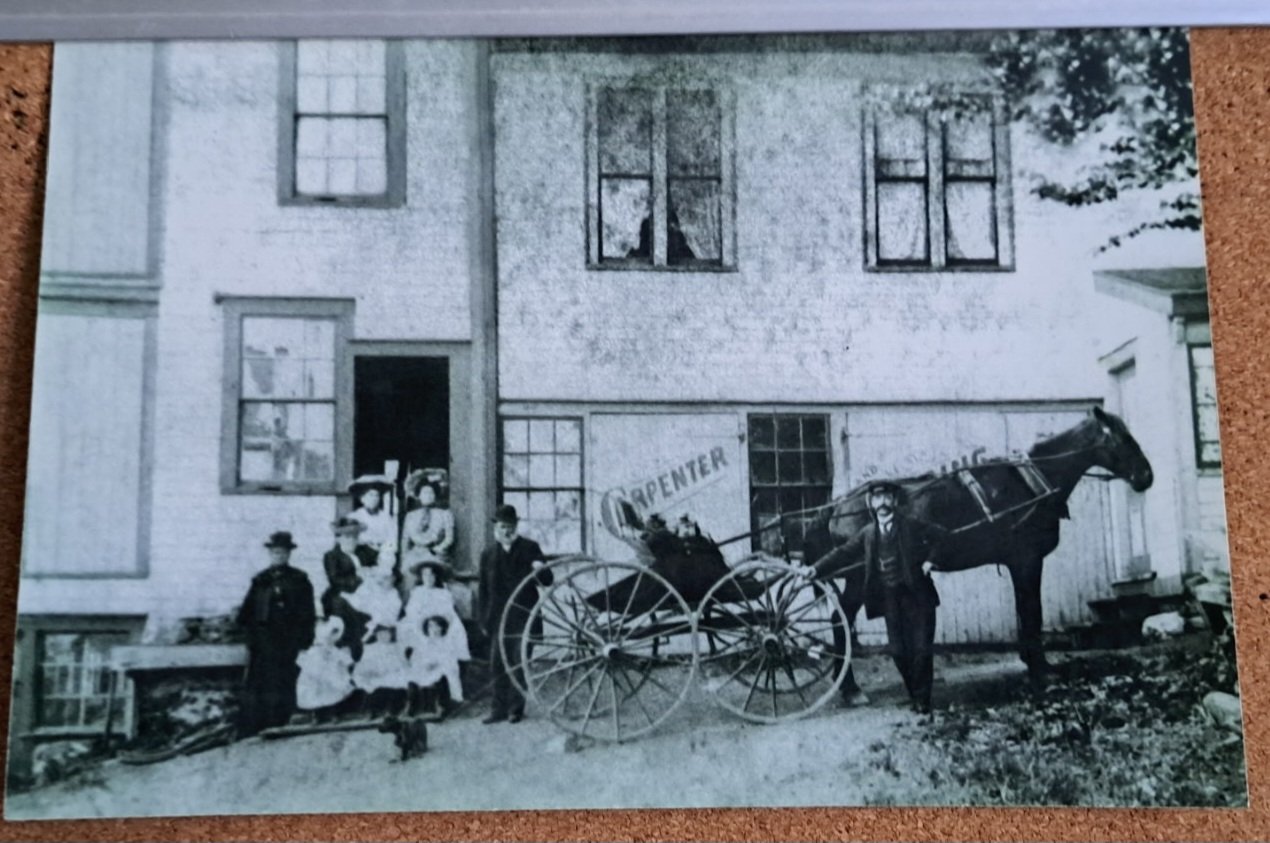
The annotated carpenter-shop photograph records Alfred, Ellen and the older Davies daughters in Halifax. [S2]
Family origins, orphan years, sister network, and maritime documentary reconstruction.
This is the deep evidence record supporting the finished Captain Ted story. It preserves the full genealogy, orphan-years reconstruction, wartime context, contradictions, source register and unresolved questions.
The project distinguishes four kinds of statements. The distinction matters because the surviving record is unusually good in some places and genuinely incomplete in others.
| Label | Meaning | Use in narrative |
|---|---|---|
| DOCUMENTED FACT | An original or contemporary record directly states the fact or relationship. | May be stated plainly, with the record named. |
| VERY HIGH CONFIDENCE | Several independent records converge, but one direct naming record is still desirable. | May be used if the remaining caveat is visible. |
| STRONG INFERENCE | The evidence fits well, but a plausible alternative remains. | Use qualified language. |
| FAMILY RECOLLECTION | Oral/family memory, preserved with speaker and wording. | Valuable context; do not convert into documentary fact. |
The central discipline of this appendix is therefore simple: contradictions remain visible. Names are not harmonized merely because a cleaner family tree would be easier to read, and a later source is not allowed to erase an earlier record simply because the later version is more convenient.
| Question | Current status |
|---|---|
| Who were Ted’s parents? | Alfred Davies and Ellen Davies — very high confidence; a direct 1905 baptism/birth image remains desirable for formal closure. |
| Was Ted orphaned young? | Yes. Father died in 1915 and mother in 1916; Ted was about ten. |
| Did sisters help raise him? | At least one sister-household placement is documented in 1921. A wider “sister to sister” pattern is family recollection, now partly corroborated. |
| Which sister is documented in 1921? | Violet Alberta Davies, later appearing as Bertha/Alberta and as Hall/McKenzie — very high confidence through the multi-record chain. |
| Who had legal guardianship? | Unknown. Probate/guardianship records remain the best unsearched source class. |
| Was he a decorated wartime master? | Yes. Canada Gazette proves the O.B.E.; Imperial Oil Review identifies him as Sarnolite master and commodore of 17 convoys. |
The 1891 Halifax census is the earliest strong household-level anchor presently in the reconstruction. It places Alfred and Ellen together in Halifax with older children. Alfred is recorded as a carpenter/joiner, independently anticipating the 1916 obituary’s description of him as a “well known carpenter.” The record also indicates that older family members were born in England while a very young child was born in Nova Scotia, tightening the family’s migration window. [S1]
One detail matters because it changes how the family structure should be described: the 1891 household includes a one-month-old male infant. That child does not survive into the later family narrative presently reconstructed. For that reason, Ted should not be described without qualification as Alfred and Ellen’s “only son.” The safe formulation is “their only known surviving son” unless the 1891 infant is separately resolved. [S1]
Alfred’s own birthplace remains a live conflict. Contemporary census evidence favors England; a maintained family chart places him in Montgomeryshire, Wales. The appendix preserves the conflict rather than choosing one without a birth or marriage record that settles it.
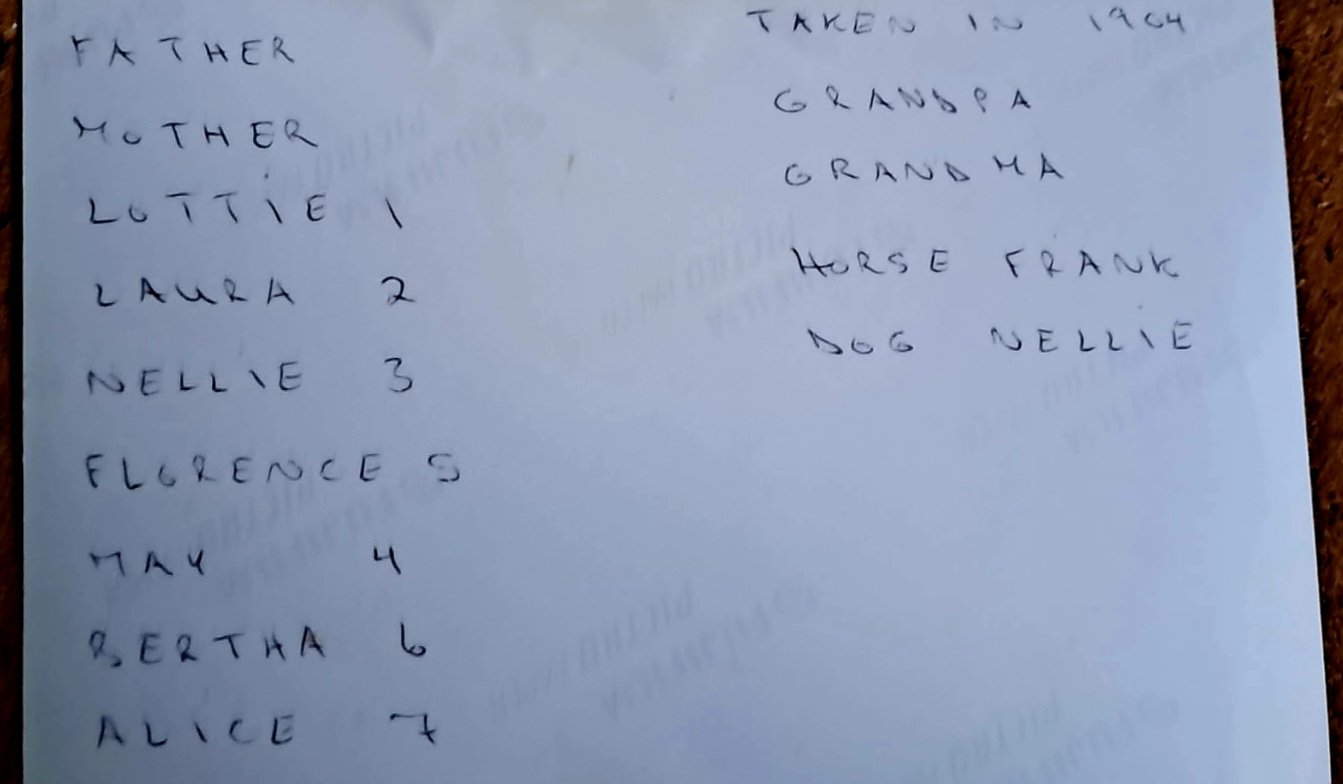
A 1904 family photograph, annotated within the family, identifies the daughters as Lottie, Laura, Nellie, May, Florence, Bertha and Alice. Ted had not yet been born. The photograph is a family artifact rather than a civil record, but it is unusually useful because later contemporary sources reproduce much of the same sibling structure. [S2]
| Family-artifact name | 1916 obituary form | Current note |
|---|---|---|
| Lottie | Mrs. Lottie Turner | Strong name continuity; husband still requires primary marriage/death linkage. |
| Laura | Mrs. DuVoisin | Strong candidate mapping; exact married-name bridge should be retained in source notes. |
| Nellie | Mrs. Kirby (candidate mapping) | Not yet formally proven; Nellie is also strongest candidate for later Spryfield/McNeil aunt, so do not collapse identities prematurely. |
| May | Mrs. Mitchell (candidate mapping) | Plausible ordering correspondence, not yet a direct spouse-name proof. |
| Florence | Florence | Later appears as Florence Myrtle Davies, witness to Violet Alberta’s 1918 marriage. |
| Bertha | Bertha | Later records indicate that the sister formally recorded as Violet Alberta also used Bertha/Alberta. |
| Alice | Not listed among survivors | Alice died young; family/derivative record gives 1906. |
This mapping is deliberately graded. The obituary’s order and the family photograph’s order align strikingly, but exact married-surname assignments should be treated as separate proof questions unless a marriage/death registration names both sides.
The original 1911 census image, LAC image e001970791, places Alfred and Ellen at 92½ Pleasant Street, Halifax, with a young male son. The father is again associated with the carpenter trade. The boy’s handwritten given name is difficult enough that the census should not be made to do more than it can: it materially strengthens the parent-child reconstruction, but it does not eliminate the value of a direct baptism or birth record naming Edward/Alfred. [S3]
Alfred died in 1915. A derivative record gives 22 March 1915, but the civil death registration remains desirable for exact-date and birthplace closure. Ellen died the following year. Her July 1916 obituary is one of the most important period sources in the reconstruction: it calls her the widow of the late Alfred Davies, “the well known carpenter,” places her at 56 Tower Road, and names the surviving children Mrs. Lottie Turner, Mrs. DuVoisin, Mrs. Kirby, Mrs. Mitchell, Florence, Bertha and Alfred. [S4]
The obituary’s “Alfred” is crucial. Five years later the 1921 census again records a fifteen-year-old Alfred Davies. Captain Ted’s documentary name is Edward Alfred Davies. The recurrence of Alfred in contemporary family records materially strengthens the proposition that the boy was sometimes recorded or known by his second given name.
If Ted was born 6 November 1905, he was nine when his father died and about ten when his mother died. Family recollections that he was orphaned around nine or ten are therefore chronologically sound even though the exact custody arrangement remains unknown.

Ted was eight when the First World War began in August 1914 and turned nine that November. Halifax became a centre of Canadian wartime shipping, crowded with troop movements, naval activity and merchant traffic. By 1917, as German U-boat losses mounted, merchant ships were gathering into escorted convoys; the Canadian War Museum describes scenes in Bedford Basin in which ships formed up every few days, some wearing the jagged “dazzle” camouflage intended to complicate submarine targeting. [S17]
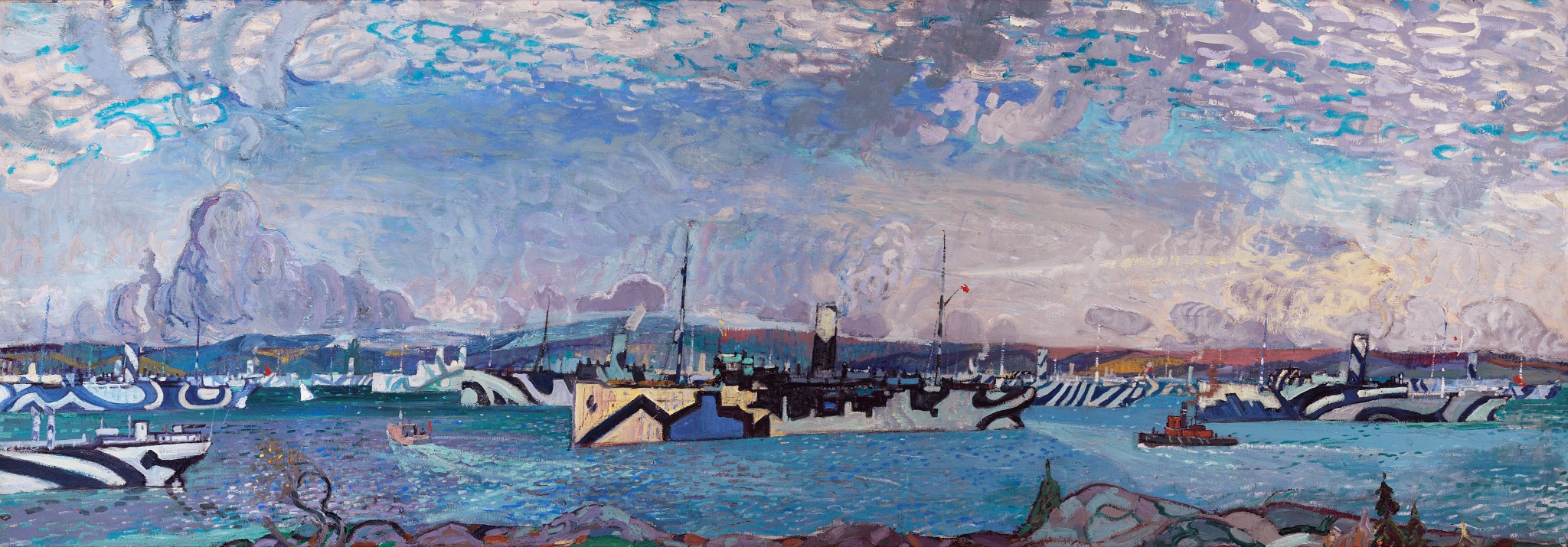
That chronology matters. The convoy-and-dazzle image belongs primarily to 1917 onward, not to the first years of the war. It also overlapped with a much more intimate collapse in Ted’s life. Alfred died in 1915. Ellen followed in 1916. At about ten years old, Ted lost both parents while the port around him was being reorganized for industrial war. We should not invent what that felt like or assume who immediately took him in; the records only allow us to say that the stable parental household documented in 1911 was gone.
Ted was twelve when the French munitions ship Mont-Blanc and the Norwegian vessel Imo collided in Halifax Harbour. At about 9:05 a.m., Mont-Blanc exploded. Parks Canada records roughly 2,000 deaths, thousands of injuries, widespread destruction, fires and a tidal wave; a major snowstorm the next day hampered rescue and relief. [S16]
For this family history, the most responsible sentence is also the simplest: we do not yet know where Ted was living that morning. We therefore cannot place him in a particular damaged house, assign him an injury, or describe his psychological response. But a twelve-year-old living somewhere in Halifax was growing up inside a city whose physical and social landscape had been violently altered.
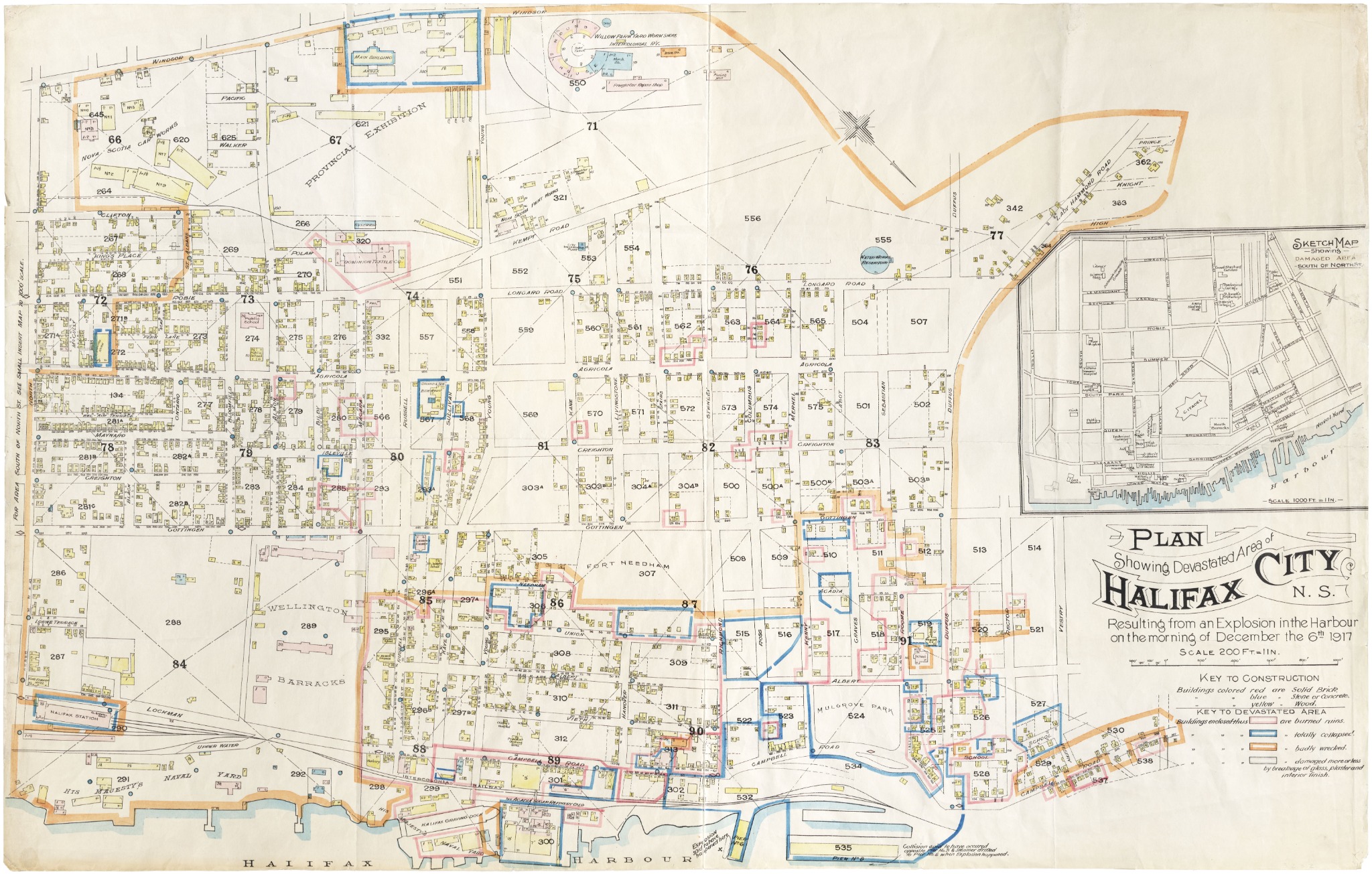
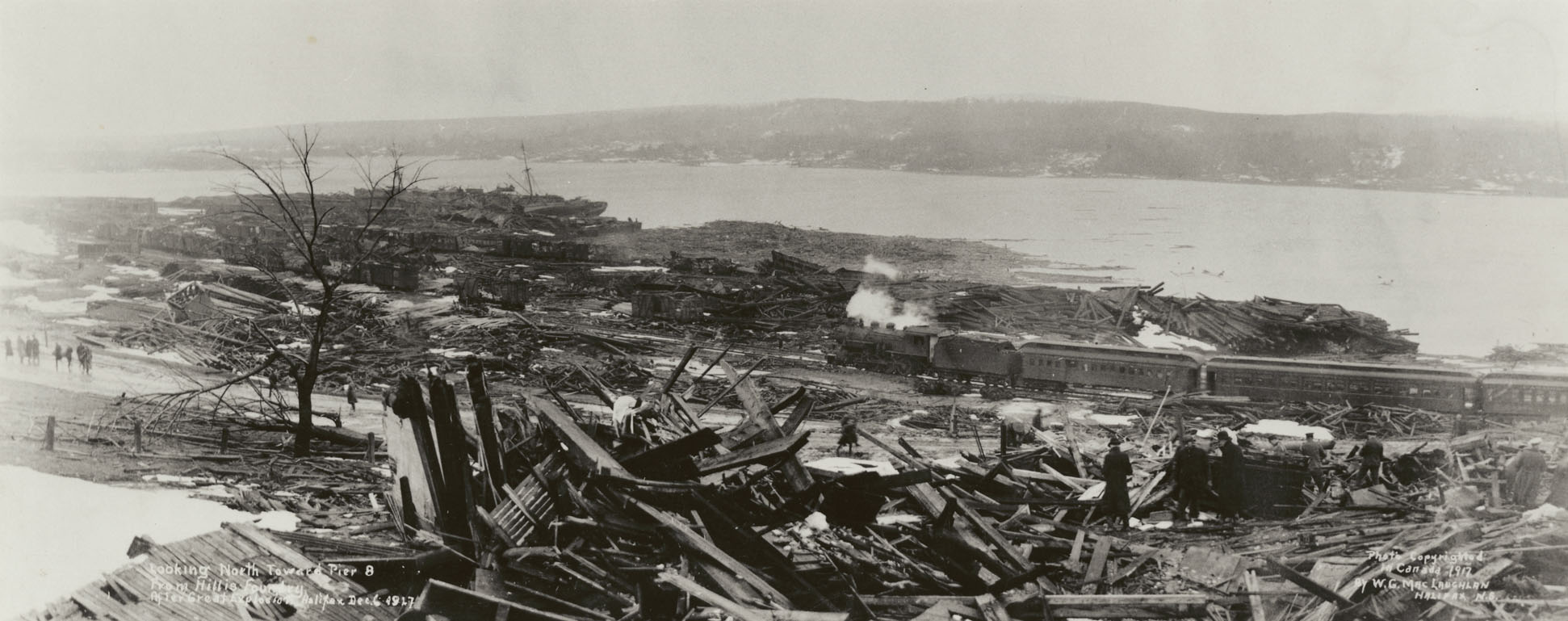
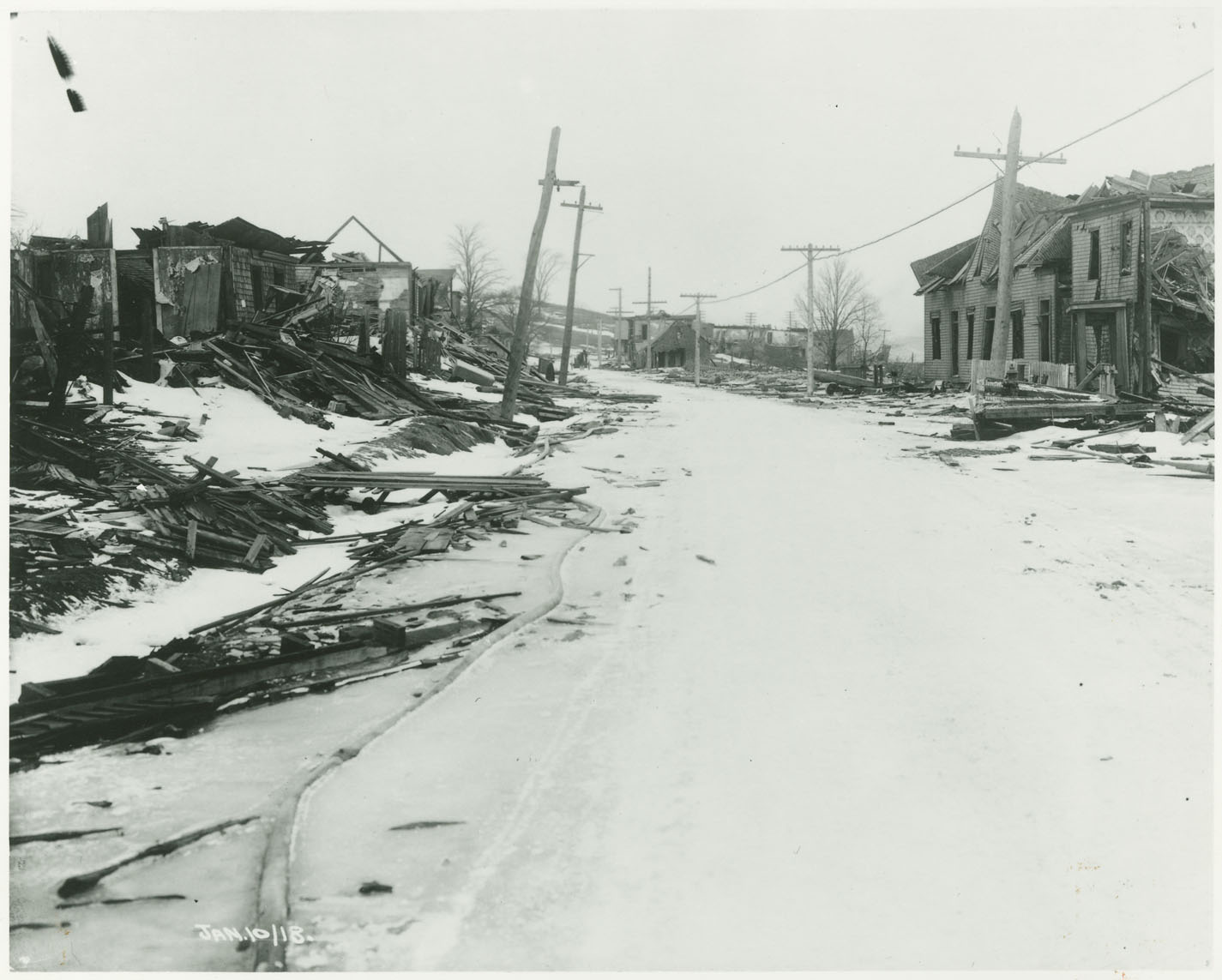
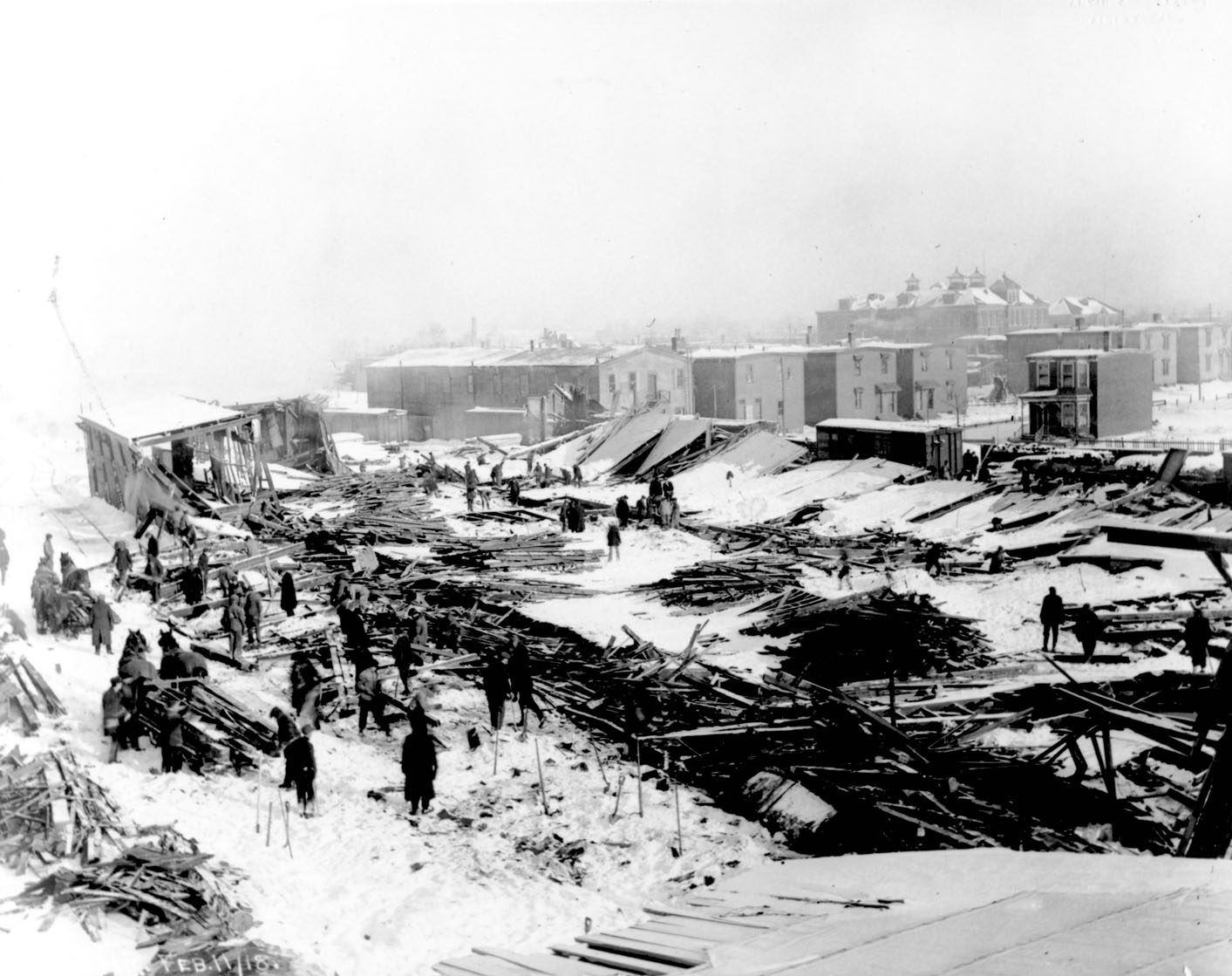
The city had barely begun to rebuild when the 1918 influenza pandemic arrived. Halifax and Dartmouth closed or restricted schools, churches, theatres and other gathering places during the October outbreak, while hospitals and temporary facilities treated influenza patients in a city still dealing with Explosion reconstruction. [S18] Rebuilding continued through the early post-war period, including the Relief Commission’s work in the devastated North End and the Hydrostone development. A Halifax Municipal Archives historical review notes that Halifax’s short post-war prosperity broke sharply in 1921 as the city entered a deep economic downturn. [S19]
That is the larger setting for the 1 June 1921 census. When the record finally catches Ted again at fifteen, he is not in his parents’ household but at 46 Bland Street with his sister’s family. The census gives us the household. Halifax’s wartime and post-disaster history gives us the world around it.
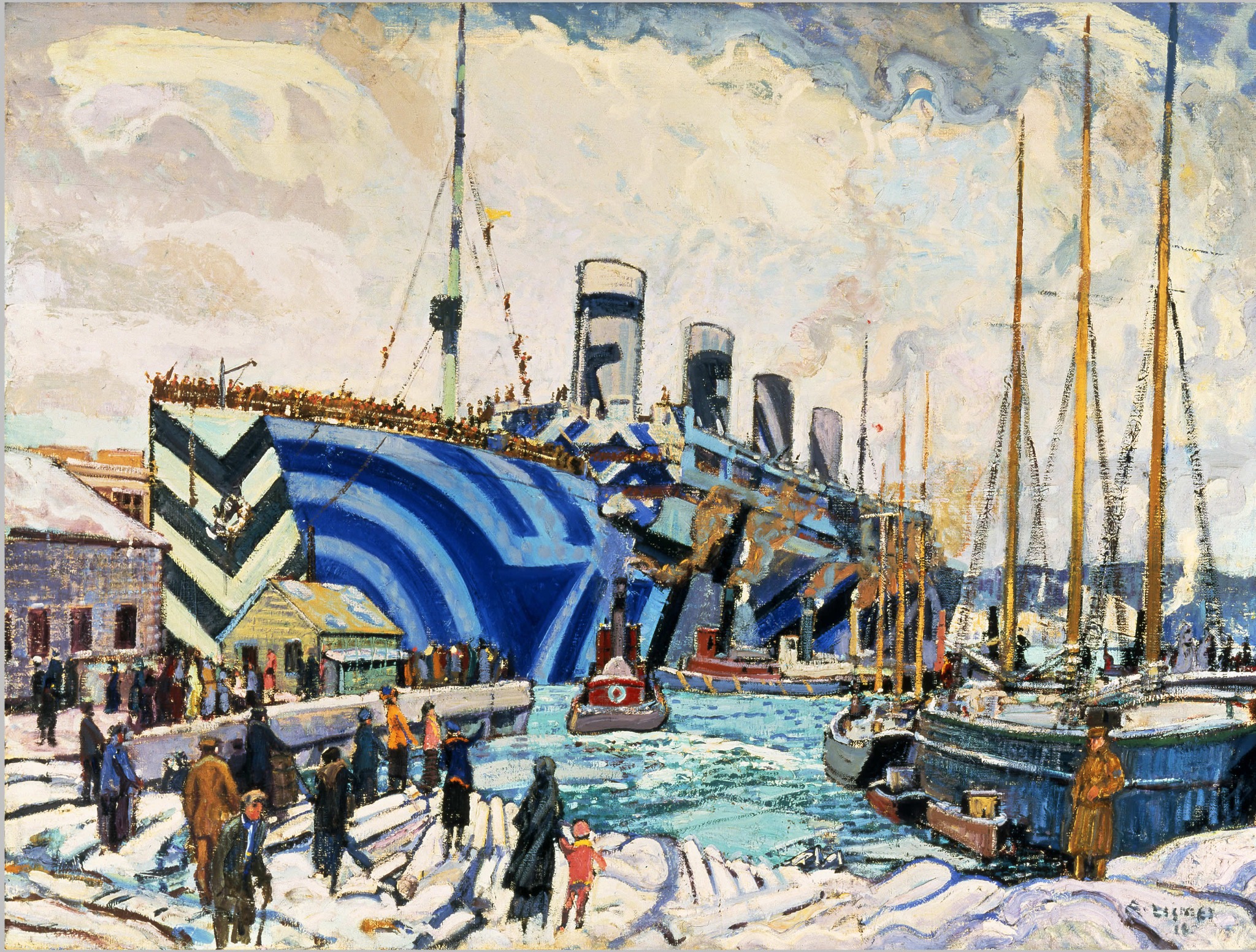
Ted’s later maritime career should not be explained away as an inevitable product of these events. We do not have evidence that the Explosion, the convoys or any single childhood experience caused him to go to sea. The historical continuity is nevertheless striking: he came of age in a port where ocean shipping, convoy organization and the U-boat threat had become visible parts of civic life, and by the Second World War he was himself a merchant master trusted to commodore convoys through submarine-threatened waters.
That is as far as the evidence should take us. It does not give us Ted’s private memories of 1917. It does give us a clearer understanding of the Halifax adolescence from which Captain Edward Alfred Davies eventually emerged. [S16–S19]
The timeline is a reading aid, not a new source. Documentary claims remain governed by the evidence grades and source register below.
The family record and the city’s history become more legible when placed on the same line. Red markers are Ted or Davies-family events; blue markers are larger Halifax or wartime events. The two threads are shown together without claiming that every public event can be reconstructed as Ted’s personal experience.
The annotated carpenter-shop photograph records Alfred, Ellen and the older Davies daughters in Halifax. [S2]
Family and derivative evidence places his birth in Halifax on 6 November; a direct baptism or birth image remains desirable.
The census places Alfred and Ellen there with a young male son, anchoring Ted inside the parental household before the losses that followed. [S3]
Halifax becomes an increasingly militarized Atlantic port, with troop movements, naval activity and merchant shipping reshaping the harbour.
Ted loses his father. The exact civil date still awaits primary-record closure.
Her obituary places her at 56 Tower Road and names the surviving sibling group, including the son recorded as “Alfred.” Ted is now orphaned. [S4]
Escorted convoy assembly becomes part of the harbour’s wartime rhythm. On 6 December, the Halifax Explosion devastates the North End and Narrows. Ted’s exact location that morning remains unknown. [S16–S17]
Her marriage to Charles Michael Hall names Alfred and Ellen as deceased and Florence Myrtle Davies as witness — evidence of the continuing sibling network. [S5]
Halifax rebuilds while the influenza pandemic closes public gathering places. The First World War ends on 11 November. [S18]
Ted’s sister Violet gives birth to Roy; the family is recorded at 25 Wellington Street. [S6]
Burton Ronald McKenzie marries Violet Alice Hall. Conflicting bride details remain visible, but the surrounding evidence ties the later household into the same family chain. [S8]
The census records “Alfred Davies,” 15, brother-in-law, living with Burton, Alberta and Ray McKenzie — the first hard residential answer after the orphaning. [S9]
Family records place Ted’s marriage to Eileen Supple at St. Mary’s Cathedral. They would raise five children, including Robert James Davies.
A second Atlantic war again fills Bedford Basin with merchant ships assembling for escorted crossings.
The Imperial Oil Review identifies Ted as master of S.S. Sarnolite and credits him with seventeen convoy-commodore assignments; the Canada Gazette independently proves his O.B.E. [S13–S14]
Robert James Davies sails aboard Imperial Hamilton, the same hull Ted had commanded a decade earlier as Sarnolite. The records prove the shared ship, not a father-and-son overlap. [S15]
The strongest advance of the August 2026 research was not a single “guardian” document. It was the recovery of a network: older sisters marrying, witnessing one another’s records, sharing or reappearing at the same addresses, and remaining close enough that later generations remembered regular visits.
| Date | Record | What it contributes |
|---|---|---|
| 7 Feb 1918 | Violet Alberta Davies marries Charles Michael Hall | Names parents Alfred and Ellen as deceased; father a carpenter; Florence Myrtle Davies is witness. [S5] |
| 15 Aug 1919 | Roy Albert Hall birth | Names father Charles M. Hall and mother Violet B. Davies; address 25 Wellington Street. [S6] |
| 1919–20 | McAlpine directory | “Hall, Bertha” at 25 Wellington — strong evidence that Violet/Bertha naming variation is not a later invention. [S7] |
| 1920–21 | McAlpine directory | Burton MacKenzie, chauffeur, boards at 25 Wellington. [S7] |
| 23 Nov 1920 | Burton Ronald McKenzie marries Violet Alice Hall | Creates the Hall→McKenzie bridge, while preserving serious contradictory fields. [S8] |
| 1 Jun 1921 | Census, 46 Bland Street | Burton + Alberta + Ray + Alfred Davies, 15, brother-in-law. [S9] |
| 25 Jun 1921 | Ronald Edward McKenzie birth | Names Burton Ronald + Violet Alice Hall; Ronald is her second living child. [S10] |
| 1931 | Census | Bert/Burton + Bertha with Roy and Ronald; age sequence matches the 1919/1921 births. [S11] |
Taken together, these records transform “sister to sister” from an unsupported family phrase into a plausible reconstruction with at least one hard residential anchor. They still do not prove that Ted moved in a specific sequence or that any particular sister held legal guardianship.
This is the most complex identity chain in the appendix and should be preserved in detail because it explains the 1921 sister-household record.
On 7 February 1918, Violet Alberta Davies, age 17, single, Church of England, born in Halifax, married Charles Michael Hall. Her parents are recorded as Alfred Davies and Ellen Davies, both deceased; her father’s occupation is carpenter. Florence Myrtle Davies witnessed the marriage. Violet signed her own name. [S5]
This is a direct parent-naming primary record for one of Ted’s sisters and places Florence in close contact with her immediately after the parents’ deaths.
Roy Albert Hall was born in Halifax on 15 August 1919. The registration names Charles M. Hall as father and “Davies, Violet B.” as mother, with residence 25 Wellington Street. Mrs. Violet Hall made the return. [S6]
The middle initial “B.” is not expanded by the record and should not be invented. It is nevertheless notable beside the directory’s “Bertha Hall” at the same address and the later McKenzie census name Bertha. The safest conclusion is that this woman used several given-name forms across records.
On 23 November 1920, Burton Ronald McKenzie, a 21-year-old chauffeur, married Violet Alice Hall. The registration contains fields that conflict with the 1918 marriage: Violet is marked “spinster,” her birthplace appears as Windsor rather than Halifax, and her father appears as Alfred Hall rather than Alfred Davies; the mother is Ellen Davis. [S8]
The remaining historical question is what happened to Charles Michael Hall between Roy’s 1919 birth and Violet’s 1920 marriage to Burton. A military personnel file, death registration, divorce/annulment record, or other legal context may explain why the later register describes her as a spinster. Until that question is answered, the family-history narrative should avoid speculative explanations.
The 1921 census calls Burton’s wife Alberta. The 1931 census calls her Bertha. The 1919–20 directory calls a Hall woman at 25 Wellington Bertha. The 1918 marriage calls her Violet Alberta Davies. These are not identical labels, but the chain is now strong enough to describe her as Violet Alberta Davies, later Hall and McKenzie, who also appears under Bertha/Alberta forms. [S5–S11]
Roy Albert Hall is the key child-level bridge in the Hall→McKenzie reconstruction. His 1919 birth registration identifies Violet Davies/Hall as his mother and 25 Wellington as the family address. In the 1921 census, Burton and Alberta McKenzie have a son Ray, about one. In 1931, Bert/Burton and Bertha McKenzie have an eldest son Roy, about twelve, followed by Ronald, about ten. [S6, S9, S11]
The identification Roy Albert Hall = Ray/Roy McKenzie is therefore very high confidence. Age, mother, residence transition, and sibling chronology converge. Ronald’s 1921 birth registration further says that he was Violet’s second living child, exactly consistent with Roy being the first. [S10]
The 1921 census at 46 Bland Street is the first hard residential answer to the question of who had Ted after his parents died. The household contains Burton McKenzie, wife Alberta, son Ray, and Alfred Davies, age 15, single, relationship “brother-in-law.” Alfred is Nova Scotia-born; the parental birthplace columns are recorded as England/England. [S9]
The 1921 return survives as several continuation panels. Showing the panels together matters because the identification does not rest on one handwritten name: address, relationship, age, birthplace and the continuation columns all belong to the same enumerated household.


What it does not prove is equally important. It does not tell us when Ted moved into the household, whether he had lived with another sister before 1921, whether Burton or Violet had legal guardianship, or whether the arrangement was formal at all.
Ted Jr. directly remembered one of his father’s sisters and her husband living in Spryfield. He remembered the married surname McNeil. Later in the same conversation he again described her as “my dad’s sister,” said his mother and father went there often, said she was close to them, and recalled that the family sometimes walked roughly three miles to visit. [S12]
This is strong evidence of the continuing family network in Ted’s married life. It does not prove that the Spryfield aunt was one of his childhood guardians. Nellie is presently the strongest candidate because a derivative record places her death in Spryfield in 1950, but the identity remains open until a marriage/death record names the spouse or parents.
Florence has two independent points of relevance. Family conversation raised “Flo” as a sister who may have visited Ted later in life, though Ted Jr. did not clearly confirm her by name. Separately, Florence Myrtle Davies appears as witness at Violet Alberta’s 1918 marriage. That primary record places her within the active sibling network during the orphan years. [S5, S12]
Period directories associate Joseph Kirby with 25 Wellington, the same address at which Violet/Bertha Hall and Roy are documented. Ellen’s obituary names a married daughter “Mrs. Kirby.” This creates a compelling sister-network hypothesis: Violet may have been living in another sister’s household when Roy was born, and Burton may later have boarded there. But Joseph Kirby has not yet been proven to be the husband of a Davies daughter. The address pattern is a lead, not a fact.
Ronald Edward McKenzie’s June 1921 birth registration gives the family residence as 55 Cunard Street. A 1921–22 directory places Christopher C. Turner at 55 Cunard, while Ellen’s 1916 obituary names Mrs. Lottie Turner. This may be another sister-household node. Again, the marriage/death bridge is still needed before Christopher C. Turner can be called Lottie’s husband.
| Statement | Evidence level | Safe wording |
|---|---|---|
| Ted was orphaned around age ten. | DOCUMENTED chronology | State plainly. |
| Older sisters were an active family network. | DOCUMENTED + strong pattern | State plainly that the network existed; avoid assigning custody without proof. |
| Ted lived with a sister by 1921. | DOCUMENTED | State plainly. |
| Ted went “from sister to sister.” | FAMILY RECOLLECTION, partly corroborated | Use “family memory held…” or “the family later believed…” |
| A particular sister had legal custody. | OPEN | Do not state. |
| Ted lived with named sisters in a specific sequence. | OPEN | Do not state. |
| Nellie was the Spryfield McNeil aunt. | STRONG CANDIDATE | Do not state as fact until spouse/parents are named. |
The family’s maritime story is consistent that Ted went to sea young, but the interview does not support a precise starting age. When Ted Jr. was asked how young his father had been, he said only that he was “young.” The age “12 or 13” was then proposed by the interviewer and was not independently supplied or confirmed by Ted Jr. [S12]
This correction matters. Ted’s transition to sea should be researched through seaman records, master-certificate files and other direct chronology rather than by importing Robert’s schooling or an interviewer-supplied age. The Imperial Oil Review’s statement that Edward “signed on as seaman in 1907” is plainly incompatible with a 1905 birth and remains an unresolved printed anomaly, not a literal start date. [S13]
Family records place Edward’s marriage to Eileen Supple on 16 February 1928 at St. Mary’s Cathedral, Halifax. The parish/civil image remains desirable for primary closure, but the marriage is well established at family-record level.
Edward and Eileen had five children in the project’s current family reconstruction: Joan, Ted/Edward, Robert, Reg and Diane. Later testimony is especially valuable here because Ted Jr. and Diane are living witnesses to the family structure and to their parents’ relationships with the older Halifax generation.
The Spryfield testimony is important in this later context. Ted Jr. remembered that his parents regularly visited his father’s sister there and that the children walked out to see her. This shows that at least some of the sibling relationships that mattered in Ted’s youth remained active after he married and became a father. [S12]
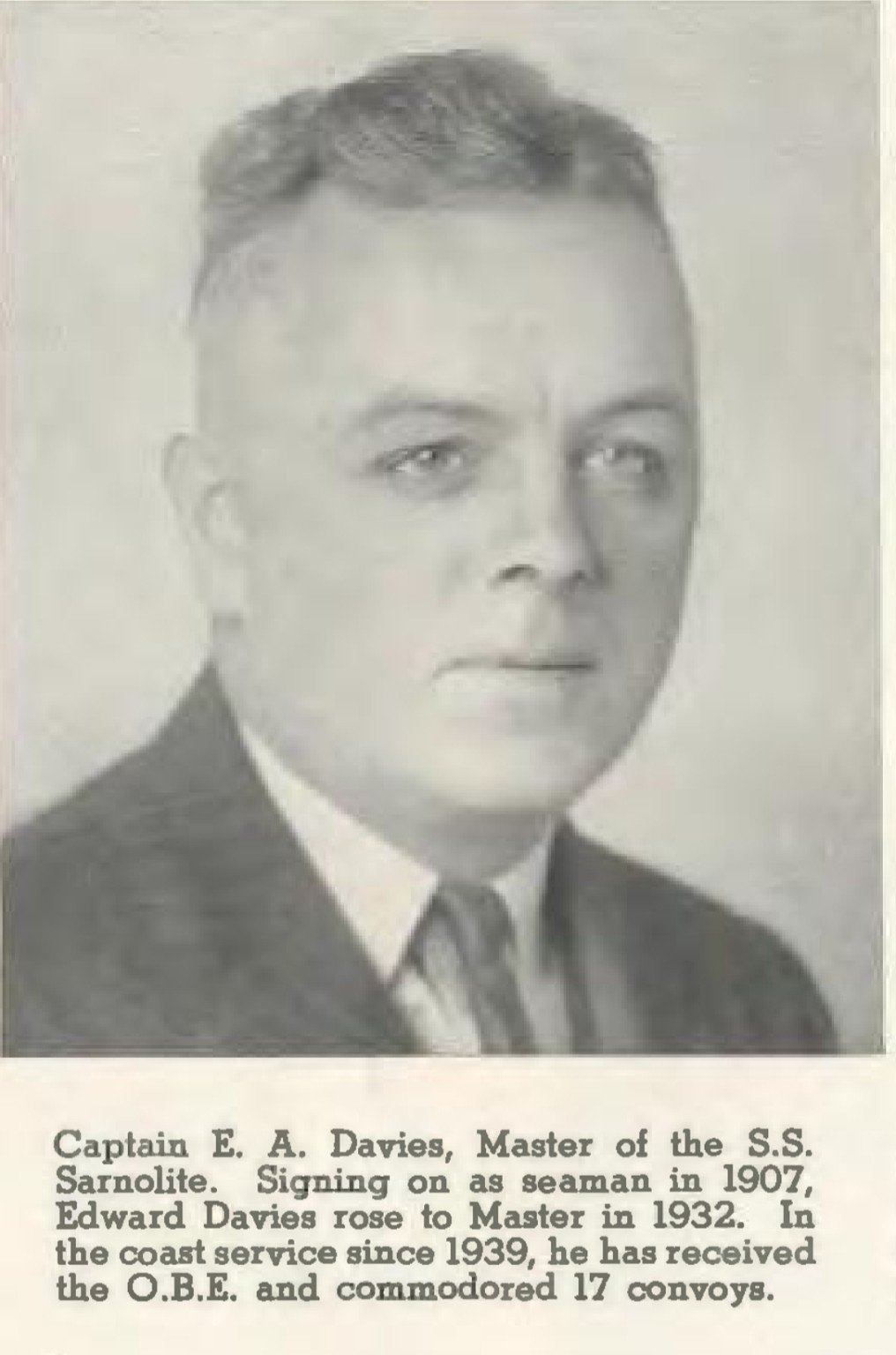
By the Second World War, Ted had become a master mariner. The Winter 1945 Imperial Oil Review identifies “Captain E. A. Davies, Master of the S.S. Sarnolite,” states that he had risen to Master in 1932, had been in coast service since 1939, had received the O.B.E., and had commodored seventeen convoys. The same feature says the tanker masters were specially mentioned by the Royal Canadian Navy for their service as convoy commodores. [S13]
The O.B.E. is independently proven by the official Canada Gazette of 1 January 1945, which names “Captain Edward Alfred DAVIES” among the Additional Officers of the Civil Division of the Order of the British Empire. The earlier project “verification debt” on the honour is therefore closed. [S14]
One printed anomaly remains: the Review says he “signed on as seaman in 1907.” Because this conflicts with a 1905 birth, the date should be quoted only as an anomaly or omitted from narrative prose until a master’s certificate or seaman file explains it.
“Commodored seventeen convoys” is easy to read as a line on a service record. The contemporary sources make clear that it represented repeated responsibility inside one of the most dangerous transport systems of the war. Imperial Oil’s own 1945 account did not describe tanker work in restrained terms: the company emphasized the volatile petroleum cargo, the possibility of submarine and air attack, and the danger that a hit could turn both ship and surrounding water into fire. [S13]
The same Imperial Oil Review issue that identifies Captain E. A. Davies as Master of S.S. Sarnolite also describes Sarnolite and Royalite carrying petroleum from Imperial Oil’s Halifax refinery to the wartime base at Argentia, Newfoundland. The company described those routes as “submarine-infested waters” in which casualties occurred. That does not prove which of Ted’s seventeen commodore assignments followed that exact route, but it establishes the operational environment of his ship and service. [S13]
The 1945 Imperial Oil Review credits Captain E. A. Davies with seventeen assignments as convoy commodore. [S13]
Imperial Oil described its wartime tanker crews as sailing above roughly three million gallons of petroleum - highly flammable cargo with obvious consequences if torpedoed or bombed. [S13]
The Royal Canadian Navy’s official Merchant Navy history says that, once a merchant vessel was hit, its seamen had only about a 50 percent chance of survival. This is theatre-wide context, not a statistic specific to Sarnolite. [S25]
Canada’s official history records 59 Canadian-registered merchant ships sunk by enemy or probable enemy action and about 1,600 Canadian merchant-seamen deaths during the war. [S25]
Germany’s submarine campaign aimed at the merchant lifeline connecting North America with Britain and the Allied war effort. Convoy was the answer: merchant ships sailed together under escort so that scarce warships could concentrate protection around them. The system reduced vulnerability, but it did not remove it. U-boats used patrol lines and “wolf pack” tactics to find convoys and mount coordinated night attacks; in 1942 they also entered the Gulf and St. Lawrence, bringing the submarine war directly into Canadian waters. [S24]
The broader Atlantic numbers show the scale of the contest. Canada’s official naval history records hundreds of HX and SC convoys and hundreds of merchant ships lost from those streams. Those figures describe the wider convoy war, not Ted’s personal convoy list. They matter here because they explain why a contemporary commendation for repeated convoy leadership carried real weight. [S24]
The 1945 Imperial Oil Review reproduces a Naval Service letter explaining that merchant masters were repeatedly asked to serve as commodores in Canadian coastal convoys. It describes this as an additional responsibility and credits those masters with being valuable to the general control and defence of shipping. Ted therefore remained a merchant-service master, not a commissioned RCN officer, while also taking on a coordinating leadership role within the convoy. [S13]
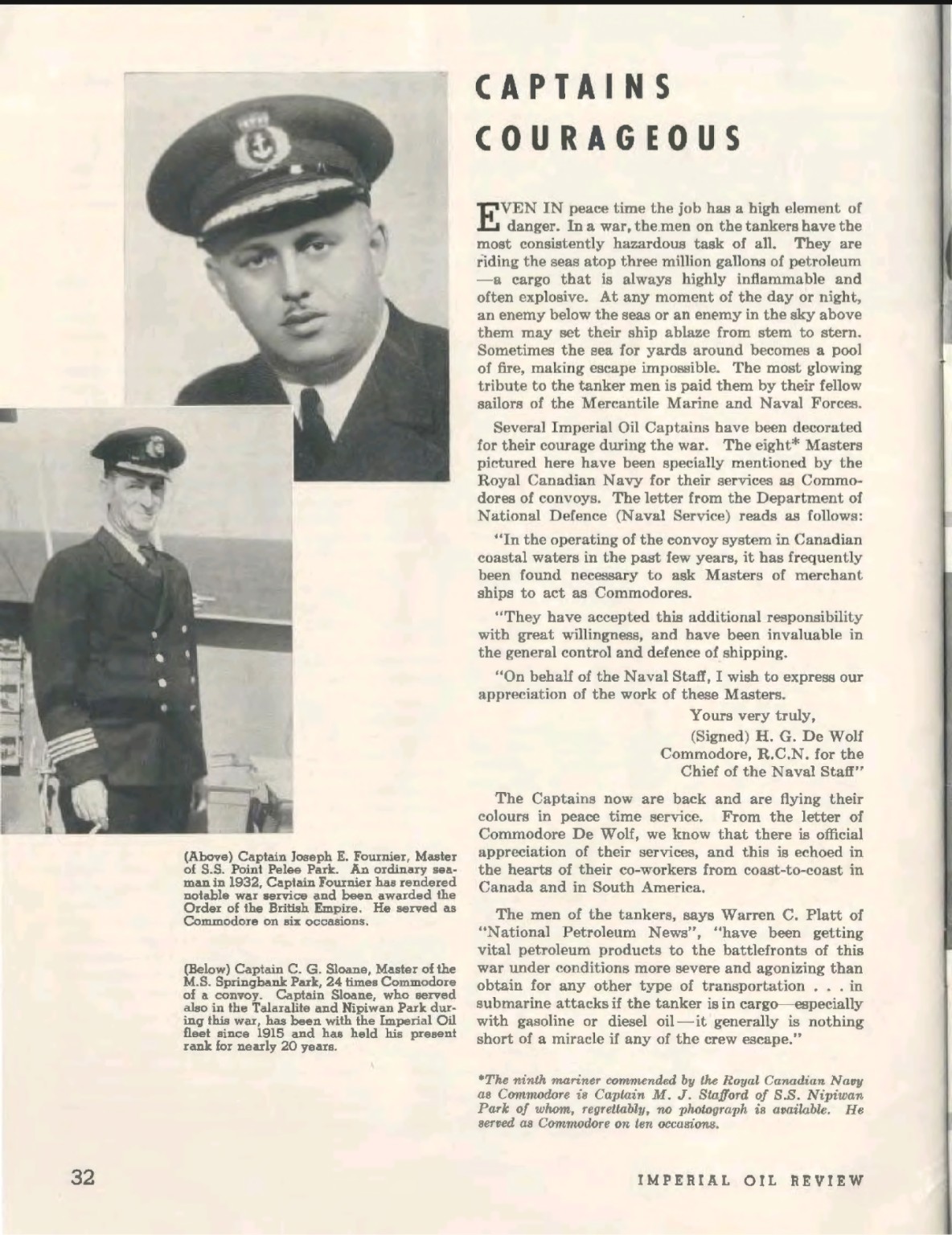
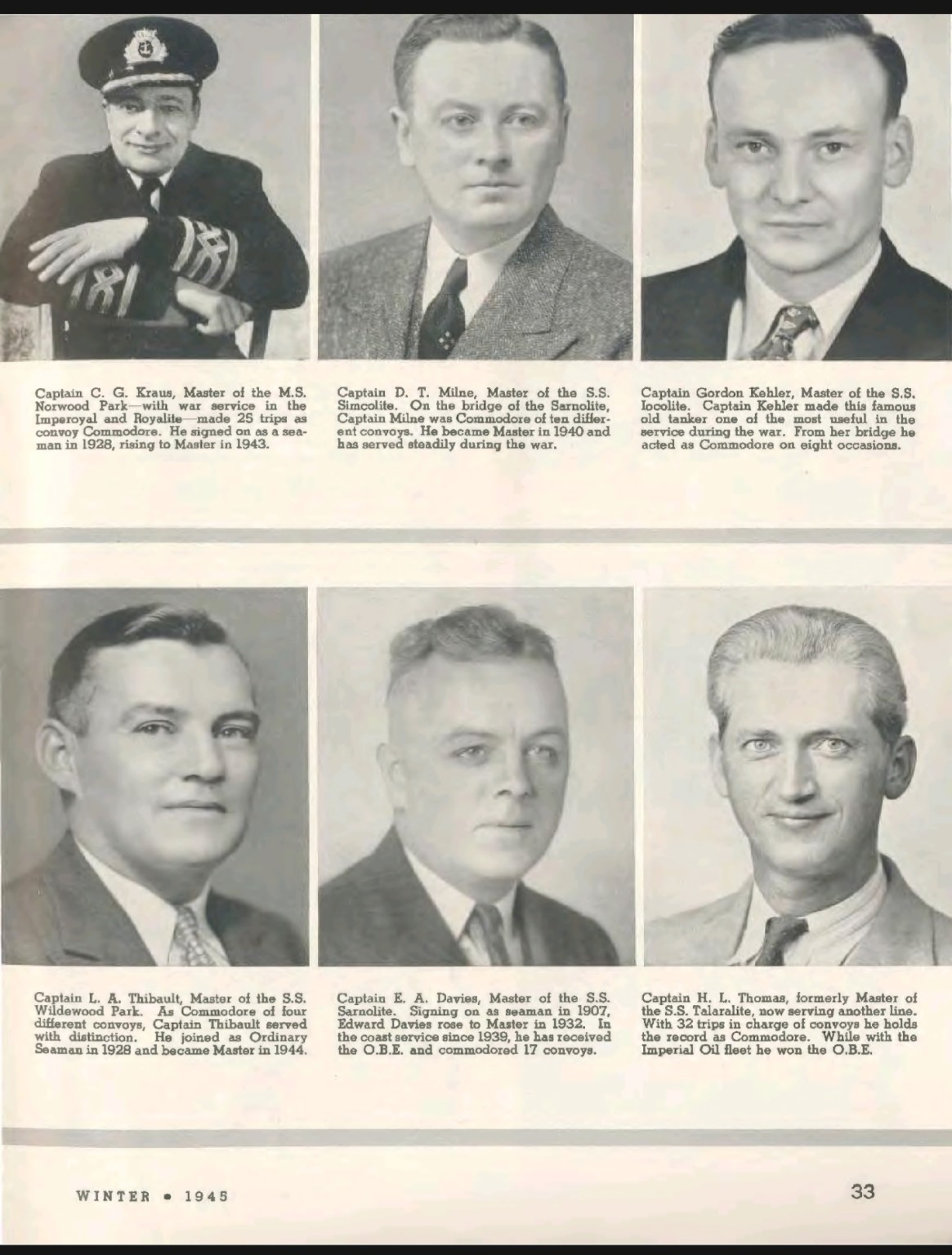
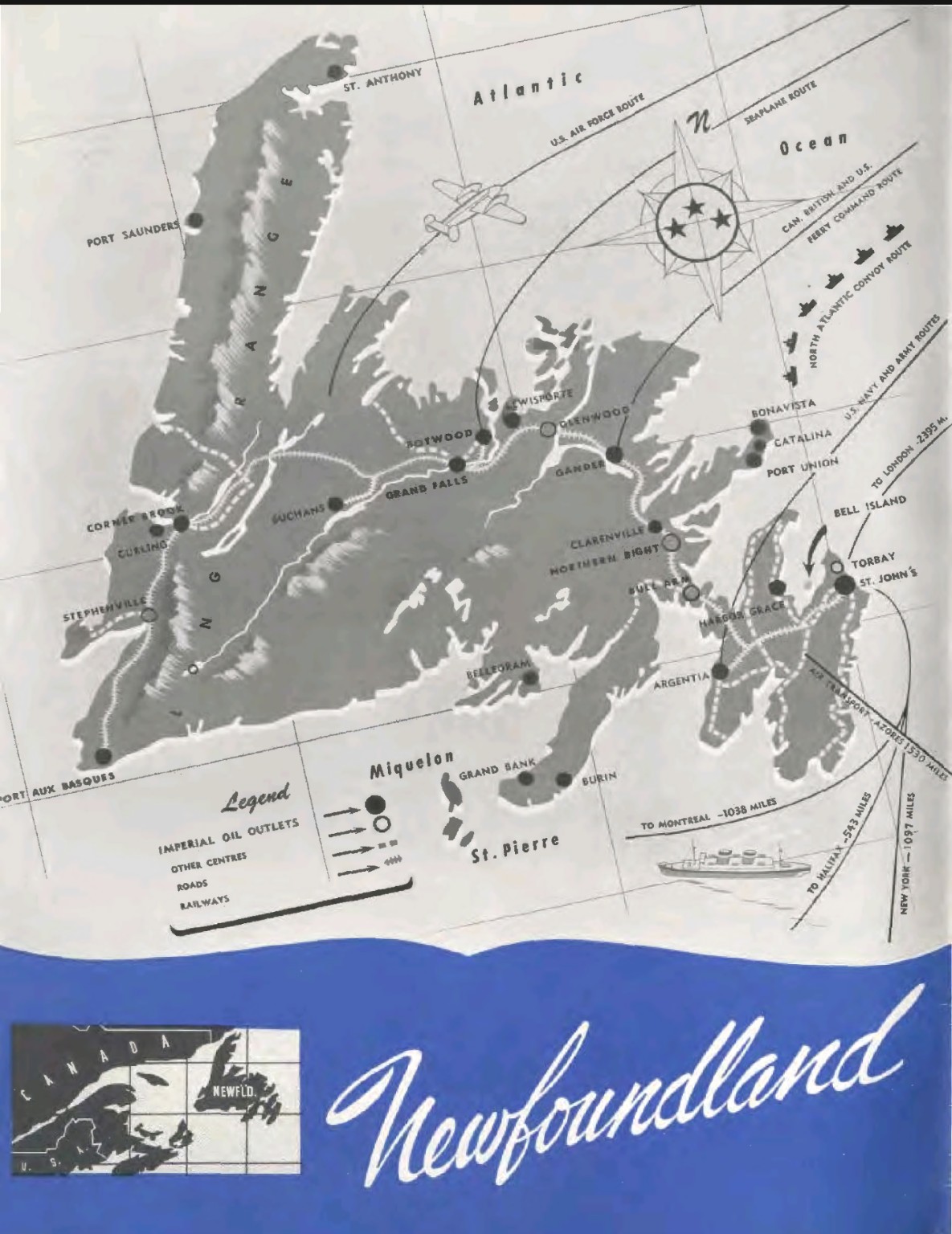
The vessel connection between Captain Ted and his son Robert is now strong enough to preserve as a documented structural finding. Sarnolite, Official No. 134515, was renamed Imperial Sarnia in 1947 and Imperial Hamilton in 1948. Robert James Davies’s discharge book records his 1955 summer engagement aboard S.S. Imperial Hamilton, Official No. 134515. [S15]
The 1945 Imperial Oil Review independently identifies Captain E. A. Davies as master of S.S. Sarnolite. The Canada Gazette independently names Captain Edward Alfred Davies in the same wartime period. Taken together, those sources clear the project’s former bar on connecting father, hull and son. [S13–S15]
| Issue | What the records say | Current ruling |
|---|---|---|
| Ted’s full name | Primary records presently prove Edward Alfred Davies; family/derivative material gives Edward Alfred Reginald Clarence Davies. | Use Edward Alfred in source-level claims; retain full form as family-grade until a primary record gives all names. |
| Ted’s 1905 birth | 6 Nov 1905 is strongly supported; direct baptism/birth image still wanted. | Very high confidence, not fully closed. |
| Alfred’s birthplace | Census evidence favors England; family chart says Wales. | Open conflict. |
| 1891 male infant | A one-month-old son appears before Ted. | Use “only known surviving son,” not “only son.” |
| Violet’s names | Violet Alberta / Violet B. / Bertha / Alberta / Violet Alice appear across records. | Same woman at very high confidence; preserve variant forms. |
| 1920 “spinster” entry | Conflicts with her 1918 Hall marriage and 1919 child. | Do not explain without evidence; investigate Charles Hall. |
| Who first took Ted after 1916? | No guardianship record yet. | Open; probate/guardianship is highest-value source class. |
| “Sister to sister” sequence | Family phrase; one placement is now documented. | Plausible and partly corroborated, but no named sequence. |
| Started sailing at 12–13 | Age was supplied by interviewer, not Ted Jr. | Withdrawn as testimony. |
| “Signed on in 1907” | Printed in 1945 Review, incompatible with birth. | Unresolved anomaly. |
The following is intentionally fuller than the prose likely to appear in Robert’s main story. Its purpose is preservation: to keep the family reconstruction in readable form without overstating what the records can prove.
Edward Alfred “Ted” Davies was born into a large Halifax family at the beginning of the twentieth century. His father, Alfred Davies, worked as a carpenter — a trade recorded in census material and remembered publicly after his death as that of a “well known carpenter.” His mother, Ellen, raised a household dominated by older daughters. A surviving family photograph from 1904 names Lottie, Laura, Nellie, May, Florence, Bertha and Alice. Ted had not yet been born. By 1911, however, the federal census still shows Alfred and Ellen together in Halifax with a young son in the household, placing Ted’s childhood firmly inside that family before everything changed a few years later.
Alfred died in 1915. Ellen died in 1916. Ted was only about ten. Ellen’s obituary is unusually valuable because it captures the family at the moment of the second loss: the widow of Alfred the carpenter, living at 56 Tower Road, surrounded by a surviving group of married and unmarried daughters and a son recorded simply as Alfred. That name matters. Five years later, the census would again record a fifteen-year-old Alfred Davies, and Captain Ted’s documentary name was Edward Alfred Davies.
Family memory held that the orphaned boy moved “from sister to sister for maybe a little while.” On its own, that would remain a moving but unverified family story. The records now give it substance. In 1918, one sister, Violet Alberta Davies, married Charles Michael Hall. Her marriage registration names her deceased parents as Alfred and Ellen and identifies Alfred’s occupation as carpenter. Florence Myrtle Davies stood as witness. A year later Violet gave birth to Roy Albert Hall at 25 Wellington Street. City directories then place a “Bertha Hall” at the same address, followed by a young chauffeur named Burton MacKenzie boarding there.
In November 1920, Burton Ronald McKenzie married Violet Alice Hall. That marriage record contains awkward contradictions: it calls her a spinster, gives a different birthplace, and appears to turn her father into Alfred Hall rather than Alfred Davies. Those entries cannot simply be cleaned up. Yet the surrounding record trail is too dense to ignore. By 1 June 1921, Burton McKenzie was living at 46 Bland Street with his wife Alberta, a one-year-old son Ray, and a fifteen-year-old brother-in-law named Alfred Davies. Three weeks later, Ronald Edward McKenzie was born to Burton Ronald McKenzie and Violet Alice Hall; the birth registration says Ronald was his mother’s second living child. Ten years after that, the 1931 census shows Bert and Bertha McKenzie with sons Roy and Ronald in exactly the age order the earlier records predict.
The result is not a perfect paper chain in which every clerk used the same first name. It is something more realistic: a woman who appears as Violet Alberta, Violet B., Bertha, Alberta and Violet Alice across civil, directory and census records, but whose children, husband, addresses and family relationships hold together. That chain identifies the 1921 Alberta McKenzie with very high confidence as Ted’s older sister. It also makes the fifteen-year-old Alfred at 46 Bland Street a powerful match to the orphaned Edward Alfred Davies. For the first time, the family can point to a specific household and say: by 1921, Ted was living with one of his sisters.
Exactly what happened in the five years between Ellen’s death and that census remains the central gap. No surviving record yet tells us who first took responsibility for him in 1916, whether a guardian was formally appointed, or whether he moved through several sisters’ homes. But the wider family network was real. Ted Jr. later remembered a paternal aunt in Spryfield, married name McNeil, whom his parents visited often and who remained close to them. He remembered the family walking several miles to visit. Florence appears independently in the 1918 marriage record. Period addresses at 25 Wellington and 55 Cunard may point to Kirby and Turner sister households as well, though those identifications still need marriage or death records before they can be stated as fact.
This makes the safest picture of Ted’s adolescence one of family continuity rather than institutional disappearance. He lost both parents young, but he did not vanish from the family record. By fifteen he was inside an older sister’s household, and the surviving evidence suggests a web of sisters who remained connected to one another and to him. The exact route through that web is unfinished research, not a blank that should be filled with invention.
Ted’s later maritime life makes the childhood story more striking. The Winter 1945 Imperial Oil Review identified Captain E. A. Davies as master of S.S. Sarnolite and credited him with commodoring seventeen convoys. The official Canada Gazette independently named Captain Edward Alfred Davies as an Officer of the Order of the British Empire. The boy who had lost both parents before adolescence had become a wartime merchant master entrusted with convoy leadership. The same contemporary Imperial Oil account describes tanker crews carrying highly flammable petroleum through submarine-threatened waters and records casualties on the Newfoundland fuel routes. The danger in the service record was therefore not rhetorical; it was built into the cargo, the route and the enemy campaign.
There is also an intergenerational connection to Robert’s story. Sarnolite, Official No. 134515, later became Imperial Hamilton. In the summer of 1955, Robert James Davies — Ted’s son — signed aboard Imperial Hamilton under that same official number. The records therefore support a remarkable but precise statement: Robert’s final high-school summer at sea was spent aboard the same hull his father had commanded a decade earlier as Sarnolite. What they do not prove is that Ted still commanded the vessel when Robert sailed on her. The significance lies in the hull and the family continuity, not in an invented father-and-son overlap.
If no further research is ever completed, the record is already substantially better than family memory alone. We can say that Ted was orphaned around ten; that his older sisters formed an active Halifax family network; that at least one of those sisters took him into her household by 1921; that those sibling relationships endured into his married life; and that he rose from that difficult beginning to a documented career as a decorated wartime master. What remains unfinished is narrower: the identity of his immediate caregiver after 1916, the legal status of any guardianship, and the exact sequence of homes before the 1921 census.
These are ranked by what they would add to the story, not by general genealogical completeness.
| Priority | Target | Why it matters | Best owner |
|---|---|---|---|
| 1A | Halifax probate / administration / guardianship, Alfred (1915) and Ellen (1916) | Could directly identify a guardian, administrator, or arrangements for minor Edward/Alfred. | Brian retrieval + ChatGPT finding-aid work |
| 1B | Charles Michael Hall, 1918–1920: CEF file + NS death search | Could explain the 1920 remarriage and “spinster” contradiction without speculation. | ChatGPT public search + Brian archive retrieval if needed |
| 2 | Edward/Alfred Davies baptism or birth, late 1905; St. Paul’s microfilm 11555 | Formally closes parentage, name continuity and exact birth details. | Brian / archives |
| 3 | Nellie/McNeil marriage and 1950 Spryfield death | Could identify the aunt remembered by Ted Jr. and add another proven sister node. | Brian + ChatGPT |
| 4 | Joseph Kirby and Christopher C. Turner marriage/death records | Tests whether 25 Wellington and 55 Cunard were sister households. | ChatGPT + Brian where images require login |
| 5 | 1915–1922 McAlpine address matrix for all sisters | Could recover a movement sequence even if no guardianship file survives. | ChatGPT |
| 6 | Master/seaman certificate file for Edward Alfred Davies | May resolve the 1907 anomaly and document the school-to-sea transition. | Archives / LAC |
If Diane or another family witness is asked, begin without supplying the answer:
This order preserves evidentiary value by avoiding unnecessary prompting.
These additions are family photographs or artifacts, not replacements for the period documentary record. Identifications are preserved at the level supplied by the family.
| ID | Source | Grade | Use |
|---|---|---|---|
| S1 | 1891 Census of Canada, Halifax City, Ward 1D, page 29, family 106. | PRIMARY | Alfred/Ellen household; carpenter/joiner; migration clues; one-month-old male infant. |
| S2 | 1904 annotated Davies family photograph. | FAMILY ARTIFACT | Parents and daughters named; useful sibling-order evidence. |
| S3 | 1911 Census of Canada, Halifax, LAC image e001970791, page 19, 92½ Pleasant Street. | PRIMARY | Alfred/Ellen household with young male son; handwriting caution on given name. |
| S4 | Ellen Davies obituary, Halifax newspaper, July 1916. | PERIOD PRIMARY | Widow of Alfred; “well known carpenter”; 56 Tower Road; surviving children. |
| S5 | Marriage register, 7 Feb 1918, Violet Alberta Davies + Charles Michael Hall, Halifax, licence 3369. | PRIMARY | Parents Alfred/Ellen deceased; father carpenter; Florence Myrtle witness. |
| S6 | Roy Albert Hall birth, Halifax, 15 Aug 1919, registration 49500796, NS Archives ID 381441. | PRIMARY | Charles M. Hall + Violet B. Davies; 25 Wellington. |
| S7 | McAlpine Halifax directories, 1919–20 through 1921–22. | PERIOD PRIMARY | Bertha Hall / Burton MacKenzie / 25 Wellington → 46 Bland continuity. |
| S8 | Marriage register, 23 Nov 1920, Burton Ronald McKenzie + Violet Alice Hall, Halifax. | PRIMARY | Hall→McKenzie bridge; contradictory bride fields preserved. |
| S9 | 1921 Census of Canada, Halifax District 57, Sub-district 44, page 6, lines 17–20. | PRIMARY | Burton, Alberta, Ray, Alfred Davies at 46 Bland; Alfred = brother-in-law, age 15. |
| S10 | Ronald Edward McKenzie birth, Halifax, 25 Jun 1921, registration 40600125, NS Archives ID 403124. | PRIMARY | Burton Ronald + Violet Alice Hall; Ronald = second living child; 55 Cunard. |
| S11 | 1931 Census of Canada, Bert/Burton and Bertha McKenzie household. | PRIMARY | Roy and Ronald age sequence; Bertha naming continuity. |
| S12 | Ted Jr. interview transcript + preserved raw audio, Aug 2026. | TESTIMONY | Spryfield/McNeil aunt; family visits; “sister to sister” phrasing; correction to 12–13 sailing-age attribution. |
| S13 | Imperial Oil Review, Vol. 29 No. 3, Winter 1945, “Captains Courageous.” | PERIOD PRIMARY | E. A. Davies, Sarnolite master, O.B.E., 17 convoys; 1907 anomaly. |
| S14 | Canada Gazette, Part I, Vol. LXXIX, No. 1, 1 Jan 1945. | PRIMARY GOVERNMENT | Official O.B.E. appointment of Captain Edward Alfred Davies. |
| S15 | Vessel identity records + Robert James Davies discharge book 27710. | PRIMARY / DOCUMENTARY | Sarnolite O.N. 134515 → Imperial Hamilton O.N. 134515; Robert aboard in 1955. |
| S16 | Parks Canada — Halifax Explosion National Historic Event. | NATIONAL HISTORICAL AUTHORITY | 6 Dec 1917 collision/explosion, approximate death toll, widespread destruction and next-day snowstorm. |
| S17 | Canadian War Museum — Arthur Lismer, Convoy in Bedford Basin. | NATIONAL MUSEUM | Halifax convoy assembly, 1917 U-boat threat and dazzle camouflage chronology. |
| S18 | Historic Nova Scotia / Halifax Public Libraries — “How to Dodge ‘Flu’”. | LOCAL HISTORICAL SYNTHESIS | Halifax influenza response, October 1918 closures and continued wartime maritime traffic. |
| S19 | Halifax Municipal Archives — historical review. | MUNICIPAL ARCHIVAL CONTEXT | Explosion reconstruction, Hydrostone context and the sharp 1921 economic downturn. |
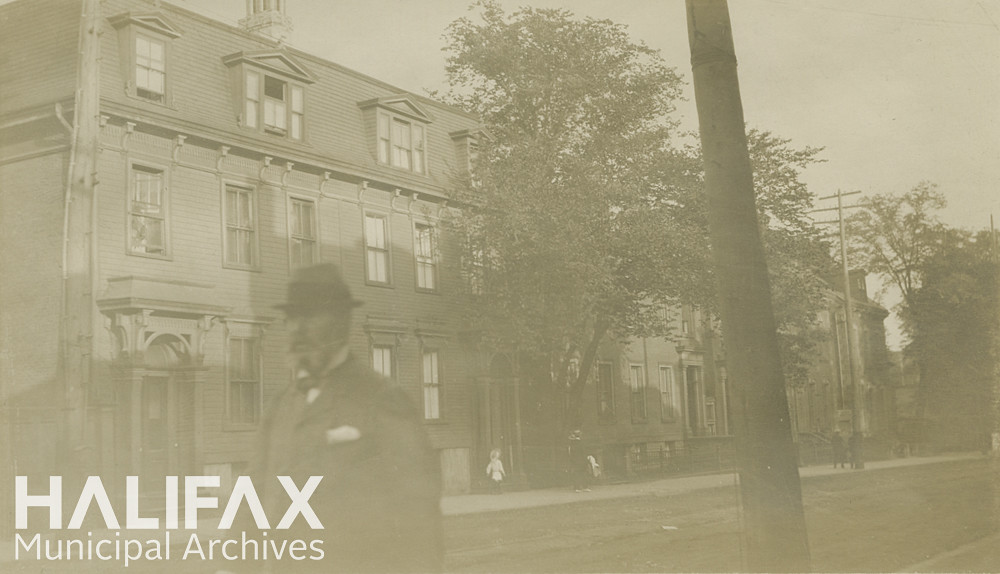
| S20 | Halifax Municipal Archives, CR108-3.08 — Pleasant Street / South End streetscape, early twentieth century. | MUNICIPAL ARCHIVE IMAGE | Physical context for Ted’s 1911 Pleasant Street neighbourhood; not the Davies house. |
| S21 | Nova Scotia Archives — Halifax Explosion aftermath photographs, including W. G. MacLaughlan Pier 8 view and winter street/industrial damage views. | ARCHIVAL PHOTOGRAPHS | Visual context for the damaged city after 6 Dec 1917; not evidence of Ted’s precise location. |
| S22 | N.S. Board of Insurance Underwriters — “Plan showing devastated area of Halifax City, N.S.,” 1918, Nova Scotia Archives Map Collection V6 240. | PRIMARY PERIOD MAP | Geographic extent of the devastated area. |
| S23 | Canadian War Museum — Arthur Lismer, “Olympic with Returned Soldiers,” 1919, CWM 19710261-0343. | NATIONAL MUSEUM | Dazzle camouflage, Halifax dockyard and the transition from wartime harbour to demobilization. |
| S24 | Royal Canadian Navy — The Battle of the Atlantic, 1939 to 1945. | OFFICIAL NAVAL HISTORY | U-boat campaign, convoy system, wolf-pack attacks, tanker-target context, Gulf/St. Lawrence attacks and broader convoy losses. |
| S25 | Royal Canadian Navy — The Merchant Navy. | OFFICIAL NAVAL HISTORY | Merchant-shipping strategic role, Canadian losses, and the approximately 50 percent survival rate for seamen aboard vessels that were hit. |
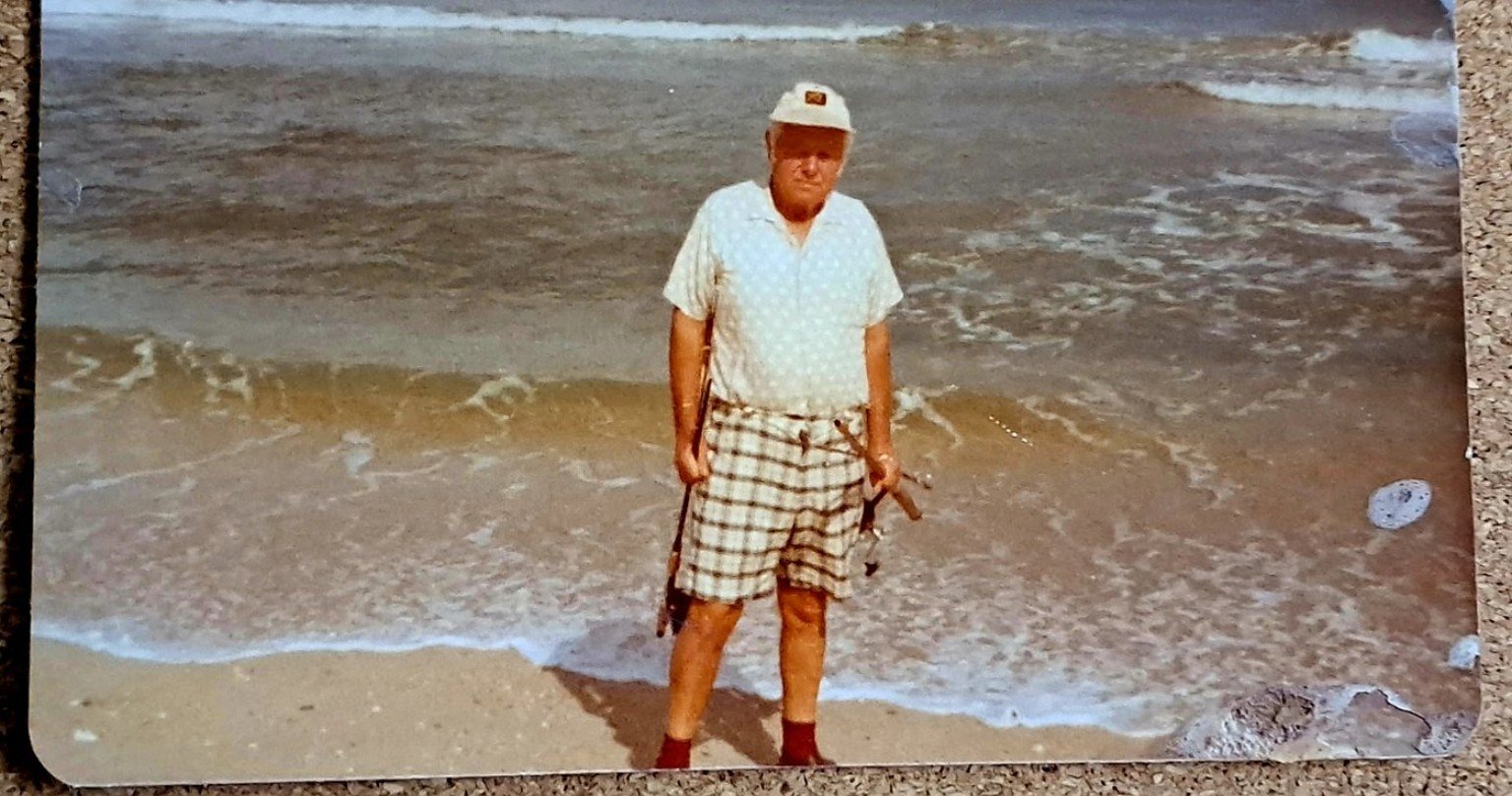
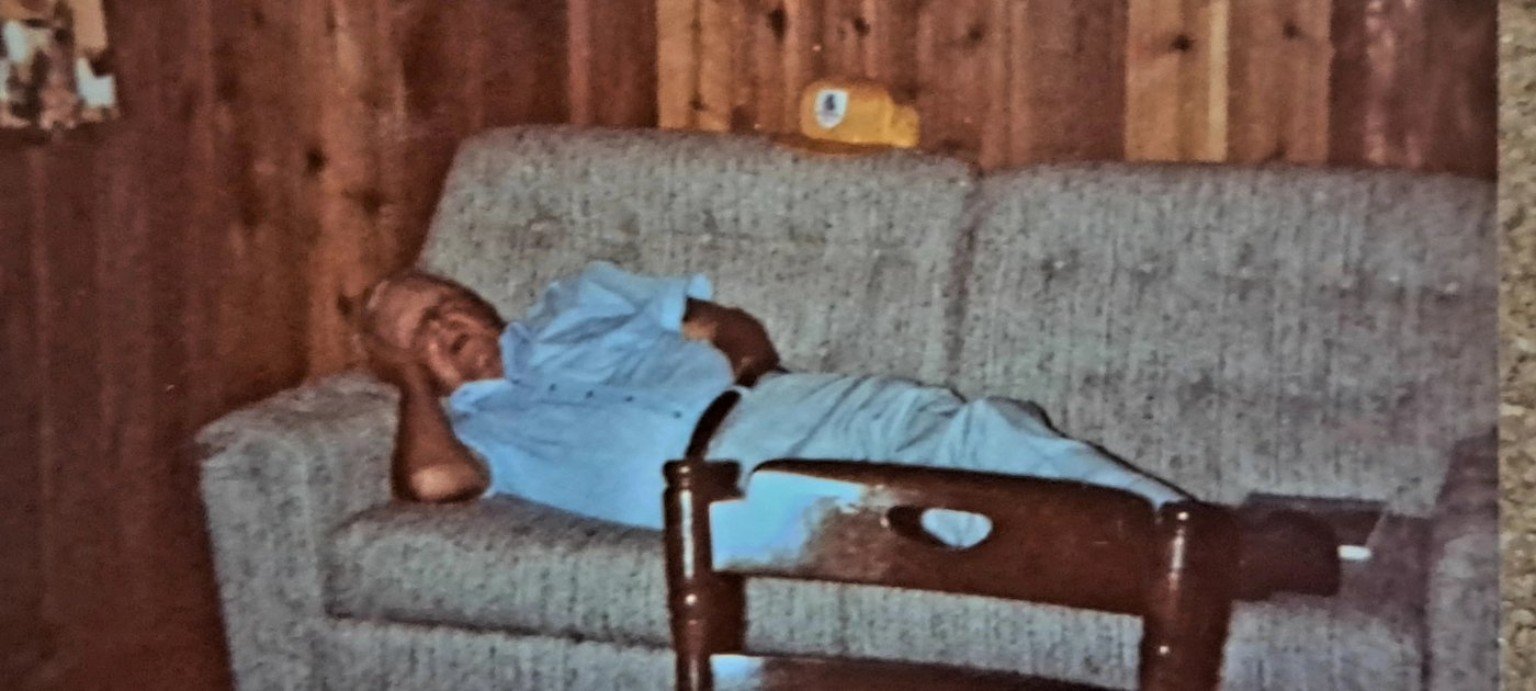
| S26 | Brenda family testimony, preserved Aug 2026, identifying Vero Beach and the Florida trailer, c. 1976. | FAMILY RECOLLECTION | Captain Ted at Vero Beach; Edward and Eileen’s trailer; fishing, small sharks, swimming; couch photograph about 1976. |
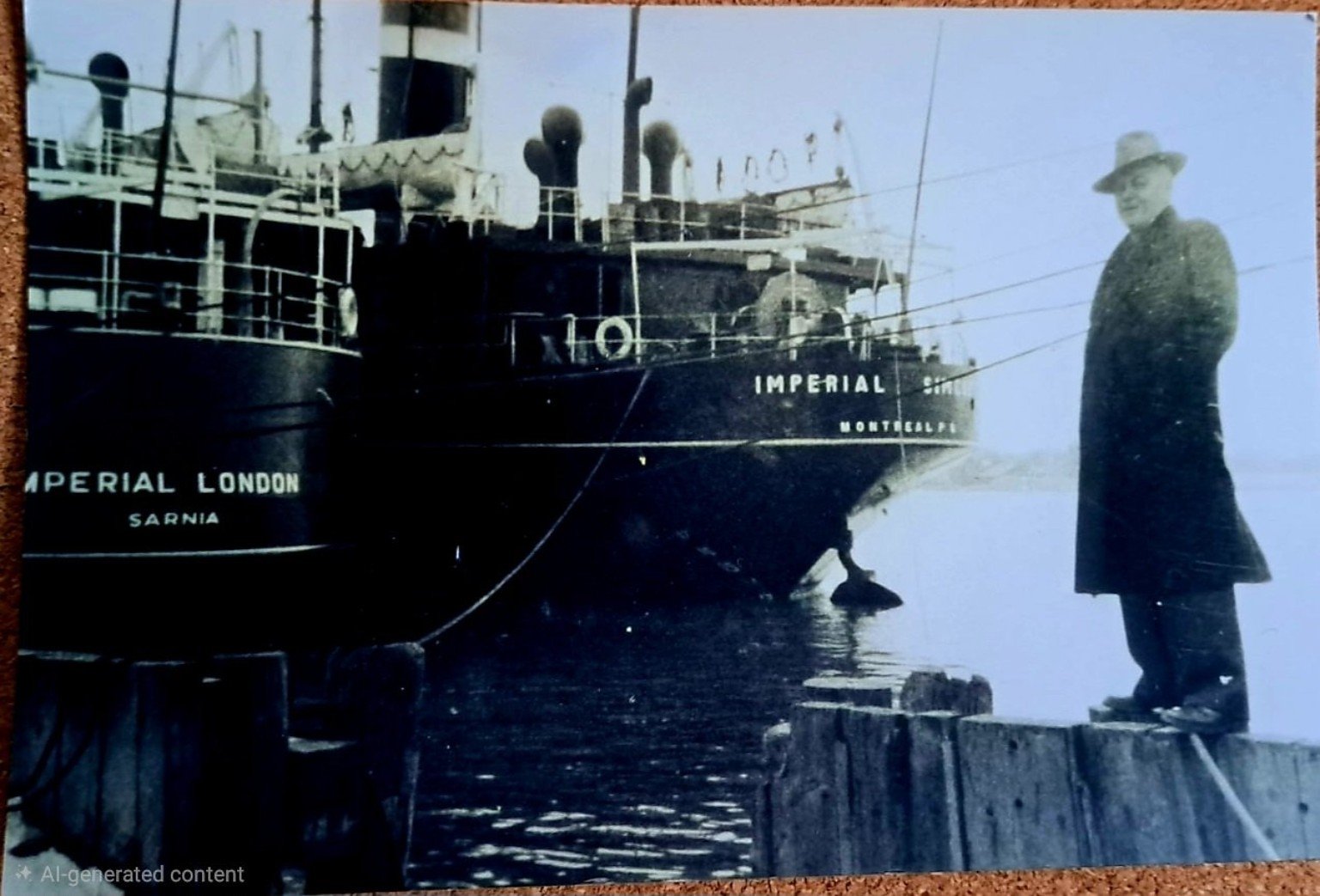
| S27 | Brian/family identification of enhanced family photograph showing Captain Ted with Imperial London and Imperial Simcoe. | FAMILY TESTIMONY | Identifies subject and ship names; exact date and port remain open. Modern enhancement mark is not evidence about the original scene. |
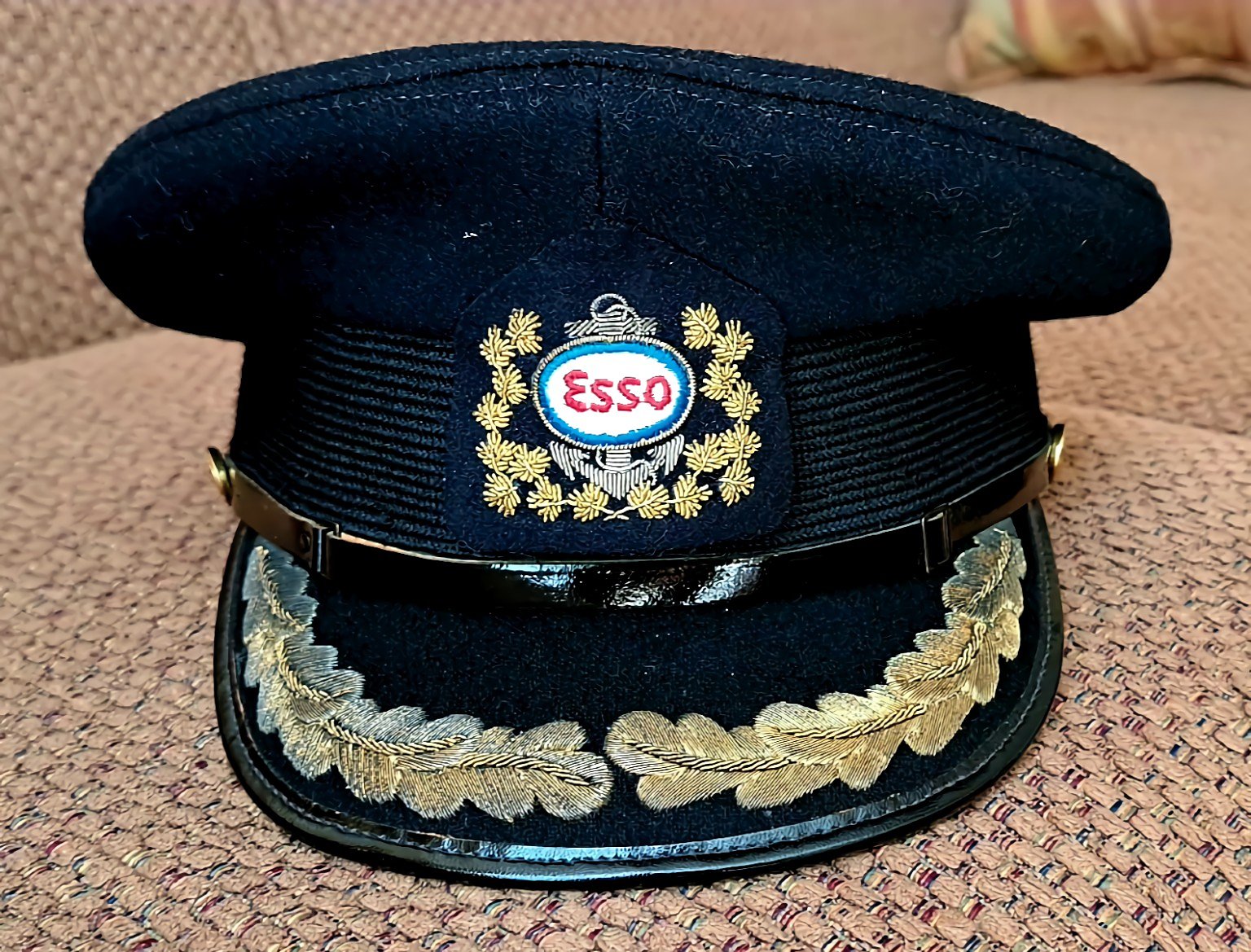
| S28 | Esso officer’s cap preserved with Captain Edward Davies family material. | FAMILY ARTIFACT | Physical maritime/company object associated with the Captain Ted family collection. |
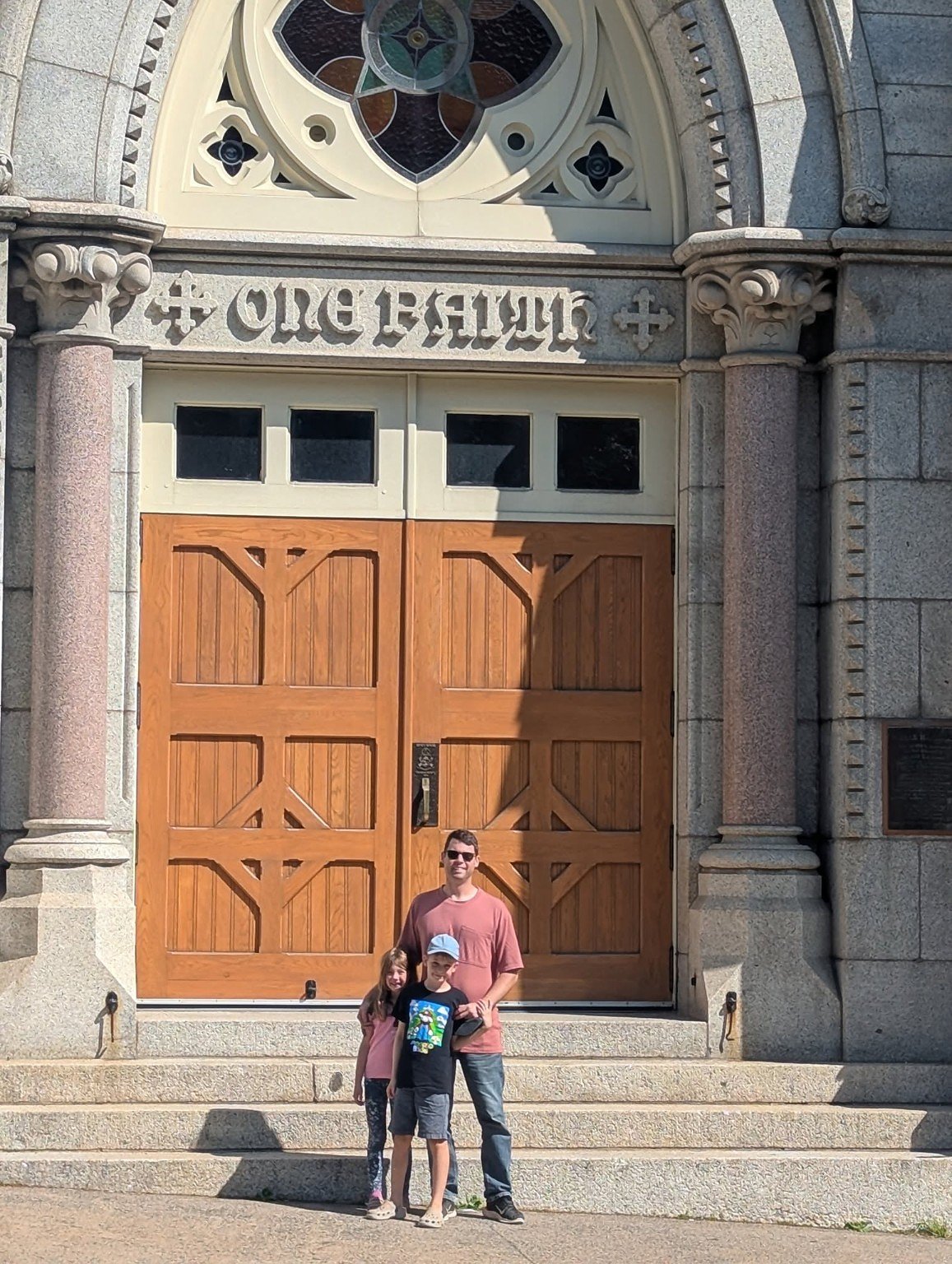
| S29 | Family record of Edward Davies + Eileen Supple marriage, 16 Feb 1928, St. Mary’s Cathedral, Halifax; later family photograph at the cathedral. | FAMILY RECORD / PLACE CONTINUITY | Marriage location and later-generation place continuity; later photo does not evidence the 1928 ceremony. |
Official online links preserved in this appendix: Roy Albert Hall birth (NS Archives ID 381441) | Ronald Edward McKenzie birth (NS Archives ID 403124)
Imperial Oil Review, Winter 1945 (Memorial University) | Canada Gazette, 1 Jan 1945 (LAC)
RCN Battle of the Atlantic official history | RCN Merchant Navy official history
Parks Canada: Halifax Explosion | Canadian War Museum: Convoy in Bedford Basin | Historic Nova Scotia: 1918 influenza in Halifax
Visual context sources: Nova Scotia Archives — W.G. MacLaughlan / Still Standing | Nova Scotia Archives — devastated-area plan | Canadian War Museum — Convoy in Bedford Basin | Canadian War Museum — Olympic with Returned Soldiers
END OF APPENDIX